
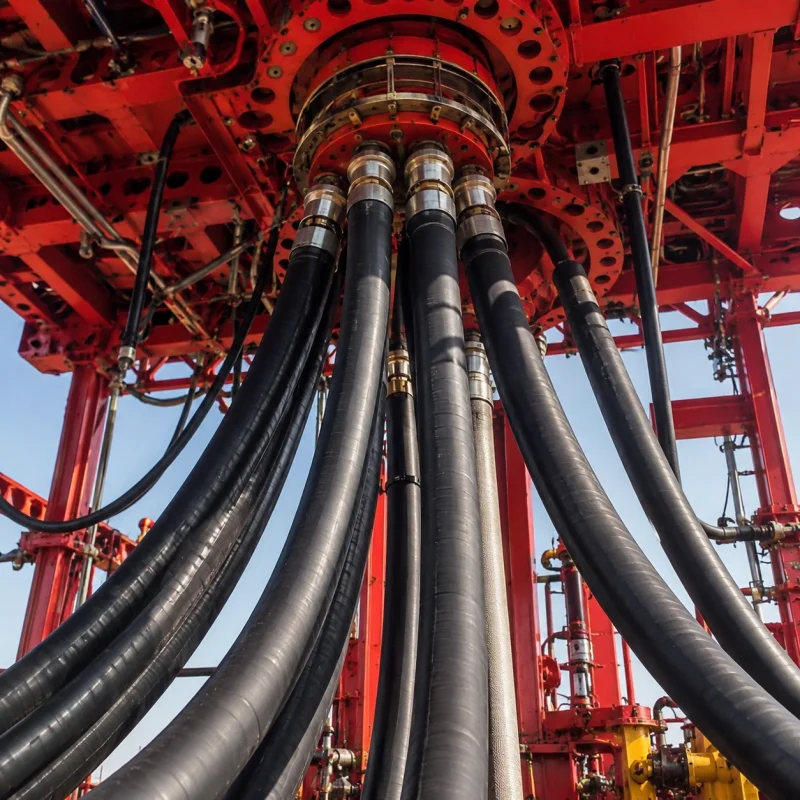
Oilfield hose standards can look similar on a datasheet, but they do not cover the same equipment or service. API Spec 7K is associated with drilling and well-servicing equipment, API Spec 16C with choke and kill equipment, and API Spec 16D with control systems for well-control equipment. Selecting by pressure alone can therefore put the wrong hose in the wrong part of a rig.
This glossary explains the terms that appear on hose datasheets, quotations, laylines and test records. Use it as a starting point, then confirm the applicable standard edition, qualified model, working pressure, temperature, fluid, routing and end connections with the manufacturer. For a complete RFQ workflow, see How to Specify an Oilfield Hose.
Oilfield Hose Standards at a Glance
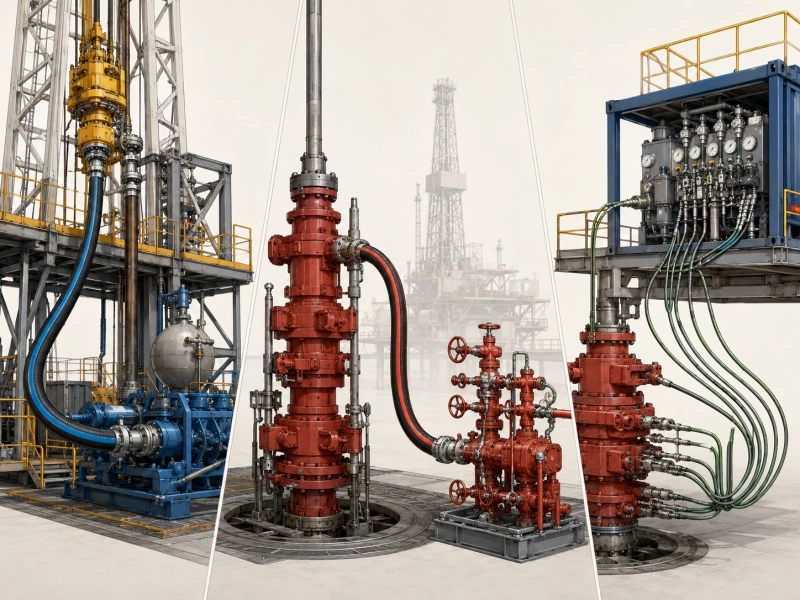
| Standard | Main hose context | What the buyer should confirm |
| API Spec 7K | High-pressure mud and cement hose; rotary drilling and vibrator hose applications | Product type, FSL where applicable, working pressure, medium, temperature, MBR and end connections |
| API Spec 16C | Flexible choke and kill lines used in well-control systems | FSL, service conditions, pressure class, temperature, sour-service requirements, construction and termination |
| API Spec 16D | BOP hydraulic control hose used within well-control control systems | Qualified hose model, fire-resistance requirement, pressure values, temperature, routing and documentation |
The standard name is only the first filter. A correct selection still depends on the complete assembly and its documented operating limits.
Where ISO and SAE Standards Fit
ISO and SAE documents are important for many hydraulic hose and fitting applications, but they are not automatic substitutes for API 7K, API 16C or API 16D. If the application is general hydraulic service, use the hydraulic hose standards guide to review adjacent SAE, EN and ISO terminology. For drilling, choke-and-kill or BOP-control service, start with the oilfield-specific equipment and project requirements.
API Spec 7K: High-Pressure Mud, Drilling and Cement Hose Terms
In hose procurement, API Spec 7K commonly appears with high-pressure mud and cement hoses, rotary drilling hoses and vibrator hoses. A rotary hose normally provides a flexible high-pressure connection between the standpipe and the swivel or top drive. A vibrator hose is normally installed between the mud-pump discharge line and the standpipe, where it helps accommodate vibration and pressure pulsation.
Do not treat every API 7K hose as interchangeable. A cement hose and a rotary/vibrator hose can differ in application, construction, routing and approved connections even when some pressure values overlap. Review the API 7K hose range and the broader drilling hose range for the product-level distinction.
Key API 7K quotation terms include hose ID, overall length, working pressure, test pressure, temperature range, conveyed medium, minimum bend radius, termination style and end-connection rating. FSL should be stated where it applies to the selected product and scope.
API Spec 16C: Flexible Choke and Kill Line Terms
A flexible choke and kill line is a pressure-rated flow path used within a well-control system. It may connect equipment around the BOP, choke manifold or kill manifold while accommodating movement, vibration or installation geometry that rigid piping cannot easily absorb.
API 16C selection requires more than the label ‘choke and kill hose.’ Confirm the specific hose assembly, pressure class, temperature, FSL, fluid exposure, sour-service requirement, armor, termination and connection. AlienFrac lists four configuration families: crimped armored A831, crimped unarmored A832, built-in armored A833 and built-in unarmored A834. The API 16C choke and kill hose page provides the current website routing for those models.
For qualification terminology and inspection boundaries, use the dedicated API 16C hose testing guide. Do not copy a test temperature, cycle count or pressure ratio from one configuration and present it as a universal API 16C rule.
API Spec 16D: BOP Control Hose Terms
API Spec 16D concerns control systems for drilling well-control equipment. In this context, a BOP control hose carries hydraulic control fluid used to operate the blowout preventer remotely. It serves a different function from a choke and kill hose, which carries drilling or well-control fluids through a pressure line.
AlienFrac’s current website lists the A841 crimped armored BOP control hose and the A842 crimped unarmored BOP control hose to API Spec 16D. The published product tables show 3,000 psi and 5,000 psi working-pressure configurations, with model- and size-specific test, burst and MBR values. Treat these as product data, not as universal API 16D ratios.
Certification wording matters here. The supporting material reviewed for this glossary identifies API 7K and API 16C Monogram scopes, but no API 16D Monogram certificate was identified. The safe wording is therefore ‘listed to API Spec 16D’ for the relevant A841/A842 products, subject to confirmation against the current controlled product documents.
What Does FSL Mean?
FSL means Flexible Specification Level. It is used to distinguish levels of technical requirements within the applicable hose specification and product scope. A higher number should not be translated into a vague claim that one hose is always ‘better.’ The selected FSL must match the service, procurement specification, qualification evidence and certificate scope.
When FSL appears in an RFQ, verify it in three places: the applicable specification, the manufacturer’s qualified product documentation, and the API certificate or license scope where relevant. AlienFrac’s reviewed certificate material lists FSL 0, FSL 1 and FSL 2 for high-pressure mud and cement hoses under API 7K, and FSL 0 through FSL 3 for flexible choke and kill lines under API 16C. For a practical explanation, see API 16C FSL Levels.
Pressure Terms: Working Pressure, Test/Proof Pressure and Burst Pressure
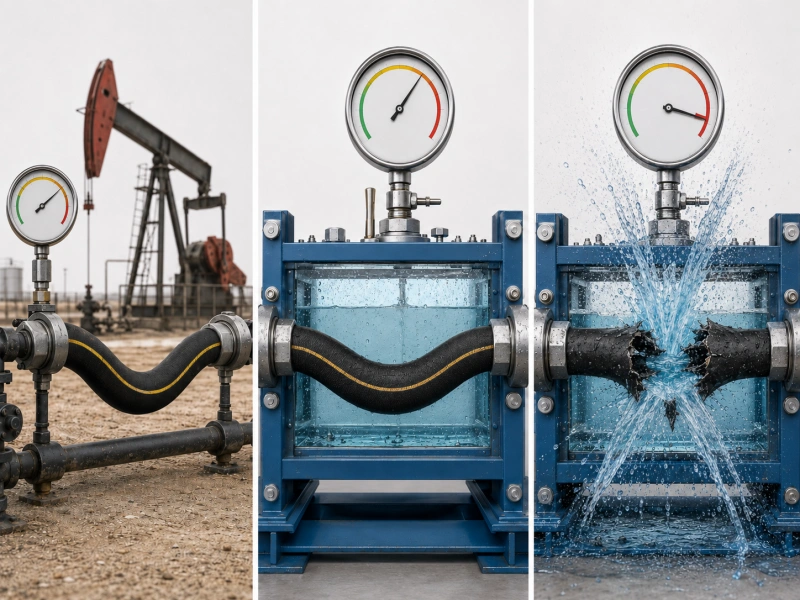
Pressure terms are easy to confuse because several values can appear in the same product table. They describe different limits and checks.
- Working pressure (WP): the maximum pressure assigned to the hose assembly for normal service under its stated conditions. System operating and surge conditions must remain within the approved limits.
- Test or proof pressure (TP/PP): the pressure applied during a defined verification test. It is not a routine operating target.
- Burst pressure (BP): a destructive qualification or design-verification value associated with hose failure. It must never be used as the allowable operating pressure.
- Pressure class: a rating used for the hose or connection family. Every component in the assembly must be compatible with the required pressure and service.
Important: there is no single working:test:burst ratio that should be applied across every oilfield hose family. Use the ratios and values in the controlled standard, qualified datasheet and approved assembly documentation for the exact product.
| Example configuration | Working pressure | Test/proof pressure | Burst pressure |
| API 7K A802C example | 10,000 psi | 15,000 psi | 22,500 psi |
| API 16C A831 example | 5,000 psi | 7,500 psi | 11,250 psi |
| API 16D A841 example | 3,000 psi | 6,000 psi | 12,000 psi |
These values are product-configuration examples used to show why one universal ratio is unsafe. They are not a substitute for the current datasheet, certificate, approved quotation or applicable standard edition.
Hose Dimensions and Routing Terms: ID, OD, OAL and MBR
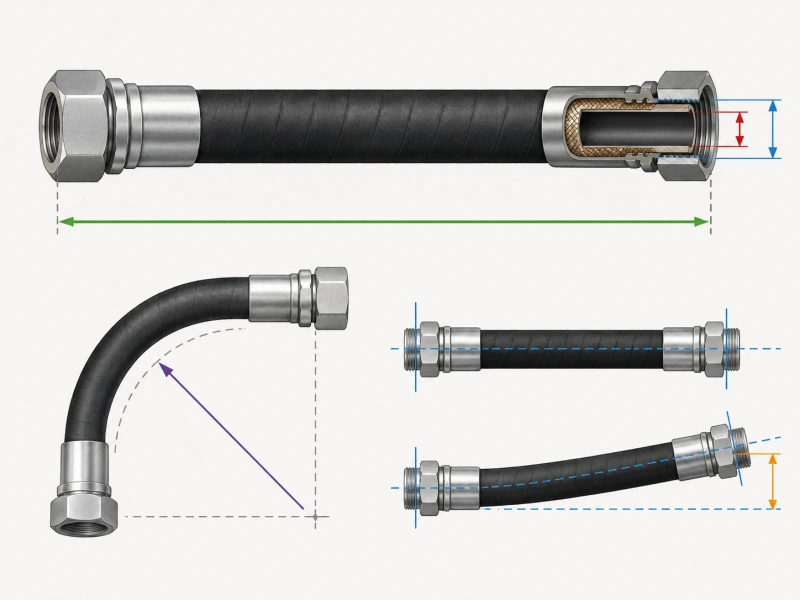
- ID – inside diameter: the nominal bore through which the fluid passes. ID affects flow velocity, pressure loss and connection selection.
- OD – outside diameter: the external diameter of the hose body. OD matters for clamps, armor, handling equipment and installation clearance.
- OAL – overall length: the finished length of the complete hose assembly. The measurement points must be agreed because end connections change the result.
- MBR – minimum bend radius: the smallest permitted bend radius for the stated condition. Some products distinguish storage MBR from operating MBR.
Bending below the stated MBR can overstress the reinforcement, distort the bore and concentrate load near the coupling. Keep the first bend away from the termination and avoid twist during installation. The minimum bend radius guide explains how to read and apply the value.
Oilfield Hose Construction Terms: Tube, Liner, Reinforcement, Cover and Armor
- Tube or liner: the innermost fluid-contact layer. Its material must be compatible with the conveyed medium, temperature and expected abrasion or chemical exposure.
- Reinforcement: steel-wire, steel-cable or textile layers that carry pressure and help control dimensional change. The qualified construction is product-specific.
- Middle layer: an elastomeric layer used between reinforcement or structural components in some designs.
- Cover: the outer protective layer. Required resistance may include abrasion, oil, weather, ozone, heat or flame, depending on the model and service.
- Armor: an external protective layer intended to reduce mechanical damage. Armor does not change the need to meet MBR, inspection and handling limits.
Material names alone do not prove compatibility. Ask for the exact qualified construction and review the fluid, temperature and service conditions. See Oilfield Hose Inner Tube Materials for a focused material-selection discussion.
Termination and Connection Terms: Crimped, Built-In, Hammer Union, API Flange and Hub
A hose body and its end connection are one pressure-containing assembly. Connection selection must cover size, pressure class, sealing geometry, material, orientation, installation space and mating equipment.
- Crimped termination: the coupling is mechanically compressed onto the hose using a controlled assembly process.
- Built-in or bonded termination: the end structure is integrated with the hose during manufacture rather than added through a field-style crimping step.
- Hammer union: a quick make-up oilfield connection identified by its figure, size, pressure/service rating, seal arrangement and material. Color alone is not enough for identification.
- API flange: a bolted connection whose type, size, pressure rating, material and ring-groove details must match the mating equipment.
- Hub connection: a compact end connection that requires a compatible clamp and seal system.
Compare termination choices in Built-In vs Crimped Oilfield Hose. For connection-specific checks, use the API flange resource and hammer union pressure-rating guide.
Testing and Documentation Terms
- Hydrostatic pressure test: a controlled test that uses liquid pressure to check assembly integrity under a defined procedure.
- Qualification test: evidence that a design or product family has met specified requirements. It is different from a routine test on each delivered assembly.
- Fire-resistance test: a model- and procedure-specific evaluation. State the exact product, exposure and test basis; do not turn one result into a standard-wide claim.
- Visual and dimensional inspection: checks for construction, condition and dimensions such as ID, OAL, connection orientation and marking.
- Traceability: the link between the finished assembly and its serial or batch records, materials, manufacturing history and test documents.
- Certificate scope: the product and FSL coverage named on the certificate or license. A logo without readable scope is not enough.
Before accepting documentation, compare the hose layline, assembly drawing, quotation, test report and certificate scope. Use the API Hose Certificate Checklist and the inspection and hydrotest schedule guide as procurement references. Inspection and retest intervals must follow the operator’s program, applicable requirements and actual service history; this glossary does not set a universal interval.
What Buyers Should Verify Before Ordering?
- Define the actual service: drilling mud, cement slurry, choke or kill line, BOP control fluid, or another medium.
- State normal working pressure, expected surge conditions and the required test basis.
- Confirm the applicable standard, product scope and FSL instead of using ‘API hose’ as a complete specification.
- Provide hose ID, required flow, OAL and the exact length measurement points.
- Provide minimum and maximum temperatures, including any short-duration exposure that must be evaluated.
- Confirm fluid compatibility and identify H2S or other sour-service conditions when present.
- Provide routing drawings or available space, then verify operating MBR, movement, twist control and support points.
- Specify each end connection, size, pressure class, material, seal and orientation.
- State whether armored or unarmored and crimped or built-in construction is required.
- List the required documents: approved drawing, certificate or license scope, material records, test report, inspection record and traceability information.
If the hose will operate in an H2S environment, add the service conditions and documentation requirements at the RFQ stage. See the sour-service oilfield hose guide before finalizing material and assembly requirements.
AlienFrac API Scope and Product Mapping
The certificate and catalogue evidence reviewed for this glossary shows the following scope. Buyers should still request the current controlled certificate and model documentation with the quotation.
| Evidence | Scope shown in reviewed material | Publication wording |
| API Q1, Q1-5074 | Design and manufacture of high-pressure mud and cement hoses and flexible choke and kill lines; validity shown as Feb. 14, 2025-Feb. 13, 2027 | State the exact QMS scope and validity; do not present Q1 as a product Monogram |
| API Spec 7K Monogram, 7K-0601 | High-pressure mud and cement hoses at FSL 0, FSL 1 and FSL 2; validity shown as Feb. 14, 2025-Feb. 13, 2027 | Use with the exact product and FSL scope |
| API Spec 16C Monogram, 16C-0566 | Flexible choke and kill lines at FSL 0, FSL 1, FSL 2 and FSL 3; validity shown as Feb. 14, 2025-Feb. 13, 2027 | Use with the exact flexible-line and FSL scope |
| API Spec 16D product listing | A841 armored and A842 unarmored BOP control hose pages are listed to API Spec 16D | Say ‘listed to API Spec 16D’; no API 16D Monogram certificate was identified in the reviewed material |
For a side-by-side application comparison, read API 16C vs API 7K vs API 16D Hoses. That page helps identify the likely hose family; the approved datasheet and project specification remain the final selection basis.
FAQ
Is API 7K the same as API 16C?
No. API 7K and API 16C cover different equipment contexts. For hose selection, API 7K is associated with drilling and well-servicing hose applications such as high-pressure mud, cement, rotary and vibrator service, while API 16C is associated with flexible choke and kill lines used in well-control systems.
Is burst pressure an allowable operating pressure?
No. Burst pressure is not an operating limit. Use the documented working pressure for normal service and confirm surge, temperature, fluid and assembly conditions.
Does every oilfield hose use a 4:1 burst-to-working-pressure ratio?
No. The relationship varies by specification, product family and qualified design. Use the values for the exact hose assembly rather than applying one ratio to every API hose.
What information is needed to quote an oilfield hose?
Provide the application, medium, working pressure, surge conditions, temperature, hose ID, overall length, routing or MBR limits, construction, end connections, quantity, required documents and applicable standard or FSL.
How do I verify an API hose certificate?
Check the certificate or license number, manufacturer name, product scope, FSL scope and validity. Then match that scope to the quoted hose model and assembly documentation.
Use the Standard as a Starting Point, Not a Shortcut
A reliable hose specification connects the standard to the actual service. Identify where the hose sits in the system, then confirm pressure, fluid, temperature, dimensions, routing, construction, connections, FSL and documentation for the exact assembly. That approach prevents the most common error in oilfield hose procurement: choosing a familiar label without verifying the qualified product behind it.
Need an engineering review for a drilling, choke-and-kill or BOP-control hose? Send AlienFrac the operating conditions and connection details through the oilfield hose product hub so the quotation can be checked against the correct hose family and documentation scope.