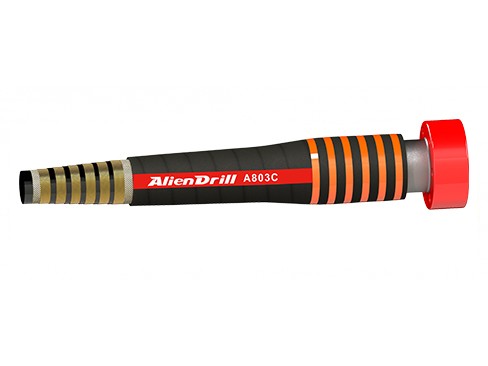
AlienFrac manufactures high-pressure cement hose assemblies for the flexible connection between the cementing pump manifold and cementing head. Our range handles water- and oil-based cement slurries and includes crimped and built-in constructions with synthetic-rubber or UHMW-lined tubes. Depending on the model, working pressure reaches 20,000 psi, with API Spec 7K FSL 0 designs for oilfield cementing service. Send us the hose ID, pressure, length, temperature and end-connection details, and we’ll match the assembly to your job.
Send us the operating data and connection details. We’ll confirm the suitable cement hose model, available configuration, documentation package and quotation for your project.
Crimped cementing hose with a synthetic-rubber full-flow tube and multi-spiral high-tensile steel-wire reinforcement. Current configurations include 10,000 psi across 2–4 in. IDs, plus selected 15,000 and 20,000 psi models. Temperature: -20°C to +121°C. API Spec 7K / ABS.
Crimped cementing hose with a UHMW + synthetic-rubber full-flow tube and multi-spiral high-tensile steel-wire reinforcement. Current configurations include 10,000 psi across 2–4 in. IDs, plus selected 15,000 and 20,000 psi models. Temperature: -20°C to +121°C. API Spec 7K / ABS.
Built-in cementing hose with a synthetic-rubber full-flow tube and high-strength steel-cable reinforcement. Current product data lists 10,000 and 15,000 psi configurations, with maximum continuous length up to 61 m depending on the selected size and model. Temperature: -20°C to +121°C. API Spec 7K / ABS.
Built-in cementing hose with a UHMW + synthetic-rubber full-flow tube and high-strength steel-cable reinforcement. Current product data lists 10,000 and 15,000 psi configurations, with maximum continuous length up to 61 m depending on the selected size and model. Temperature: -20°C to +121°C. API Spec 7K / ABS.
A high-pressure cement hose, also called a cementing hose, is a flexible oilfield hose that moves cement slurry between cementing equipment under pressure. It is commonly installed between the cementing pump manifold and cementing head, where the assembly has to cope with abrasive slurry, high pressure, bending and field handling. This page is for API 7K oilfield cementing service—not dry-bulk cement transfer or construction concrete pumping.
Choose the hose from the full service envelope, not pressure alone. Confirm working and maximum pressure, inside diameter, length, temperature, cement system, liner, minimum bend radius, end connections and documentation before ordering. AlienFrac’s current range includes synthetic-rubber and UHMW-lined options, crimped and built-in constructions, and 10,000–20,000 psi working-pressure levels depending on the model.
| Specification | Details |
|---|---|
| Application | Flexible connection in the cementing manifold for delivery of water-based and oil-based cement slurries at high pressure. |
| Standard / FSL | API Spec 7K; FSL 0. ABS is listed on the current AlienFrac cement hose product pages. |
| Tube / Liner | Synthetic rubber, or UHMW + synthetic rubber, full flow depending on model. |
| Reinforcement | Crimped models: Multi-layer high-tensile spiral steel wire. Built-in models: High-strength steel cable. |
| Cover | Abrasion-, oil- and weather-resistant synthetic rubber. |
| Temperature | -20°C to +121°C (-4°F to +250°F) on current A801C–A804C product pages. |
| Working Pressure | 10,000 / 15,000 / 20,000 psi depending on model. Current built-in pages list up to 15,000 psi; current crimped pages list up to 20,000 psi. |
| Inside Diameter | 2–4 in. depending on pressure and model. |
| Proof / Burst Pressure | 10,000 psi WP: 15,000 psi proof / 22,500 psi burst. 15,000 psi WP: 22,500 psi proof / 33,750 psi burst. 20,000 psi WP: 30,000 psi proof / 45,000 psi burst. Confirm final values on the approved assembly datasheet. |
Built-in and crimped cement hoses can both be engineered for demanding cementing work. A built-in hose integrates the end termination during hose manufacture; a crimped assembly uses a matched fitting mechanically compressed onto the finished hose body. The better choice depends on pressure, temperature, movement, bore, connection, lead time and validation requirements. Compare the approved assembly data rather than choosing by coupling style alone.
For standard cementing duty, a synthetic-rubber tube provides the conventional full-flow option used on A801C and A803C. AlienFrac also lists UHMW + synthetic-rubber liner options on A802C and A804C. Select the liner against the actual cement slurry, additives, cleaning method, temperature and service conditions rather than treating one material as universally better.
Treat the end connection as part of the hose assembly specification. Your RFQ should state the connection type, size, pressure class, material, orientation and mating equipment. Hammer unions, flanges and hubs are common oilfield connection families, but the final connection has to match the approved hose design and your cementing package. Do not substitute fittings or change the end connection without manufacturer approval.
Send the application, hose ID, required length, working and maximum pressure, cement slurry or other medium, fluid and ambient temperature, end connections, movement/bend requirements, quantity, destination and documentation list. With those details, AlienFrac can match the request to the appropriate built-in or crimped cement hose model and prepare a technical and commercial quotation.
It is used as a flexible high-pressure connection in oilfield cementing systems, typically between the cementing pump manifold and cementing head, to carry cement slurry.
High-pressure mud and cement hoses fall under API Spec 7K. Cement hoses are specified at FSL 0; confirm the exact model, certificate scope and project requirements before purchase.
AlienFrac’s current cement hose product pages list 10,000, 15,000 and 20,000 psi options depending on model. Built-in pages currently list up to 15,000 psi, while crimped pages list selected models up to 20,000 psi.
Choose from the complete service envelope: pressure, temperature, movement, bore, routing, connection, lead time and validation. Neither coupling style is automatically the right choice for every job.
Do not assume sour-service suitability from the pressure rating alone. Send the H2S concentration, temperature, pressure, fluid composition and project requirements so the exact hose, liner, end materials and certificate scope can be checked.
At minimum, send hose ID, length, working and maximum pressure, cement slurry/media, temperature, end connections, quantity, destination and required documentation. Add movement, bend radius, H2S and witness requirements when they apply.
Looking for dry bulk cement hose, cement discharge hose, cement suction hose, cement grouting hose or another construction/material-handling hose? Visit our general Cement Hose page. This High Pressure Cement Hose page is dedicated to oilfield cementing and API 7K service.
WhatsApp us