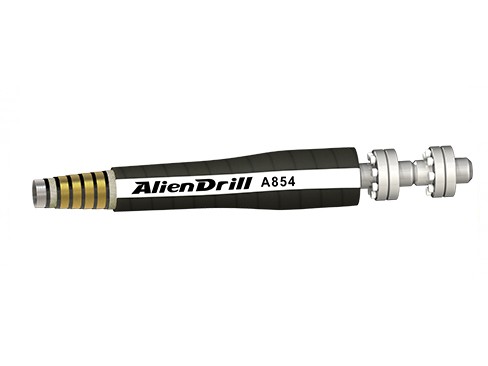
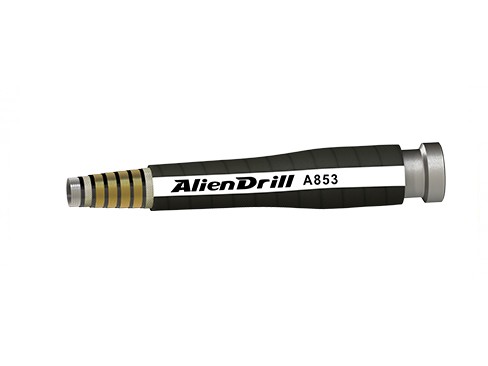
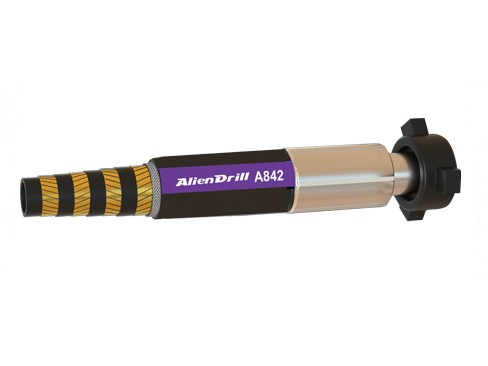
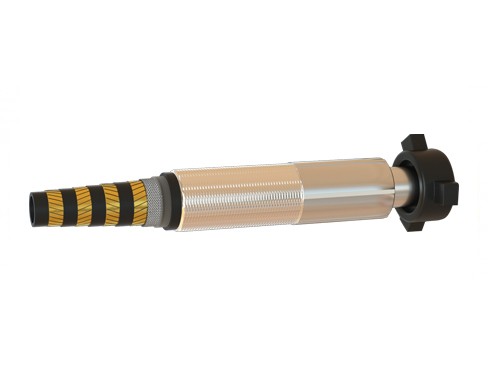
A drilling hose is not a generic pressure line. Its construction, bore, length, end connections and documentation must match the job it will perform on the rig. AlienFrac supplies drilling hose assemblies for mud circulation, cementing, well control and related rig service, with built-in and crimped configurations available for project review.
Start with the service location and operating conditions, then compare the hose families below. If you already have a specification, drawing or old assembly tag, send it with your inquiry so our team can check the configuration before quotation.
For the fastest technical review, send the hose type or service location, ID, overall length, working pressure, fluid, temperature range, end connections, standard or FSL requirement, quantity and delivery country. Add drawings, photos or the existing hose tag when available. We will review the request and identify any missing information before finalizing the quotation.
Terms such as rotary hose, mud hose, vibrator hose and kelly hose are sometimes used loosely. The safer approach is to identify where the assembly sits, what it carries, how it moves and which standard applies. A standpipe-to-top-drive hose sees different movement from a pump-to-standpipe vibrator line, while a choke and kill hose belongs to a different well-control duty.
A useful quotation starts with operating data. Provide the items below, even when some values are provisional. If a detail is unknown, describe the rig location and service and ask the manufacturer to recommend a configuration.
API 7K is commonly associated with drilling and well-servicing hose applications such as rotary, vibrator, mud and cement service. API 16C applies to flexible choke and kill lines used for well control, while BOP control hose requirements are handled separately. The correct standard, edition, FSL and documentation package must be confirmed for the exact assembly being quoted.
Both constructions can be appropriate when the complete hose-and-fitting assembly is qualified for the intended service. Built-in couplings are integrated during manufacture; crimped assemblies use a matched hose, fitting and controlled assembly process. The decision should follow the approved configuration, pressure class, size, movement, documentation and delivery requirement—not a blanket assumption that one method is always better.
AlienFrac focuses on high-pressure oilfield hose and related connections. Our role is to help buyers turn field requirements into a clear assembly specification, then align the hose construction, end connections, accessories and documentation with that request. Available options depend on the product family and approved configuration.
A drilling hose is a flexible hose assembly used to carry mud, cement, hydraulic fluid or other media at designated locations on drilling and well-servicing equipment. The correct construction and standard depend on the service.
A rotary hose normally connects the standpipe to the swivel or top drive and must accommodate movement. A vibrator hose normally sits between the mud pump and standpipe and helps absorb vibration and pressure pulsation.
No. API 7K is relevant to specified drilling and well-servicing hose applications, but choke and kill service is associated with API 16C, and BOP control hose has separate requirements. Confirm the standard for the exact function.
Use the system’s normal operating pressure and expected surge or pulsation, then apply the project’s required margin and standard. Do not select a hose from the nominal pressure alone without checking the full assembly and service conditions.
Choose the construction that is qualified for the required hose size, pressure class, movement, connection and documentation package. Both can be suitable when the complete assembly is correctly designed and controlled.
Send the service location, hose ID, overall length, working pressure, fluid, temperature, end connections, standard or FSL, quantity and delivery country. Drawings, photos and existing hose tags reduce follow-up questions.
Only when the tube, assembly and qualification are suitable for the exact fluid, concentration, temperature and gas exposure. Provide the full fluid information so compatibility can be reviewed before quotation.
Follow the operator’s inspection and test program, the manufacturer’s instructions and the applicable standard. Check the cover, fittings, restraint points, routing, bend radius, leakage, deformation and service history; remove the assembly from service when its condition is uncertain.
WhatsApp us