
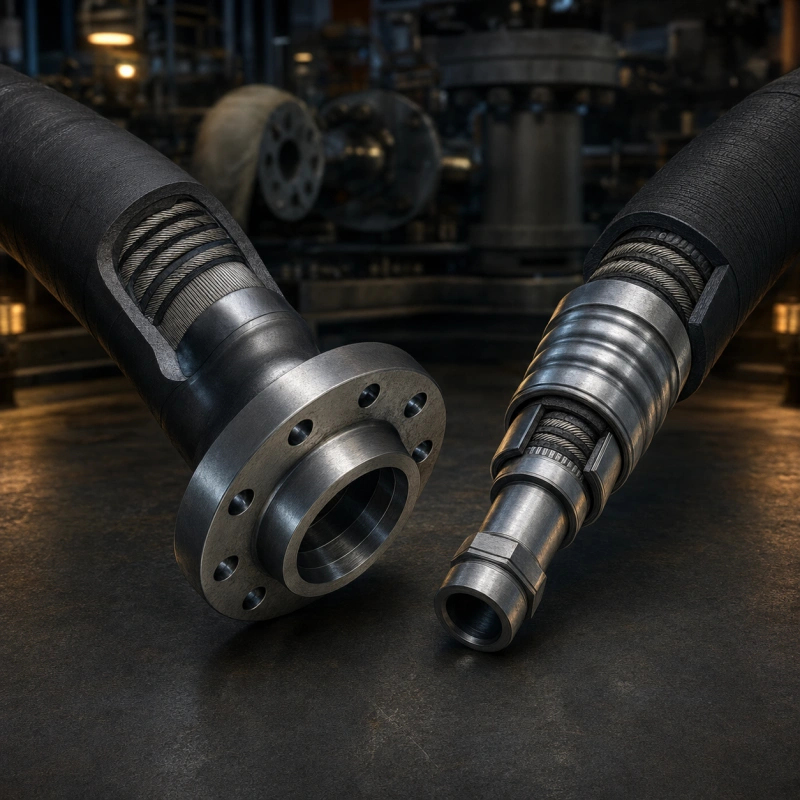
Choosing a built-in vs crimped oilfield hose is not a matter of picking the “strong” option and the “economical” option. Both constructions can be engineered for demanding oilfield work. The right choice depends on the complete service envelope: pressure, temperature, pulsation, movement, conveyed medium, flow requirement, end connections, delivery schedule and the validation package your project must approve.
That is why a useful comparison starts at the coupling but does not end there. A hose assembly is a system. The tube, reinforcement, cover, end fitting, bend-control arrangement and manufacturing process must work together.
A high pressure rating on a datasheet means little if the hose is routed below its minimum bend radius, paired with the wrong connection, exposed to an incompatible fluid or supplied without traceable test records.
This guide explains how built-in and crimped oilfield hoses differ, where each construction usually fits, and what buyers should request before issuing a purchase order.
Key Takeaways
- A built-in hose uses a bonded or integral coupling incorporated during hose manufacture and vulcanization.
- A crimped hose uses a matched coupling mechanically compressed onto a finished hose body. “Swaged” is another term used in the market, although suppliers may distinguish between crimping and swaging processes.
- Built-in construction is often selected for severe dynamic duty, high temperature, strong pressure pulsation, short rigid-end requirements or a full-bore flow path.
- Crimped construction can provide faster supply and practical standardization when the exact hose-and-fitting combination is already qualified for the intended service.
- Neither construction automatically proves API compliance, a pressure rating or an FSL. Approval must be based on the exact assembly, certificate scope, technical drawing and test documentation.
What Does “Built-In” Mean?
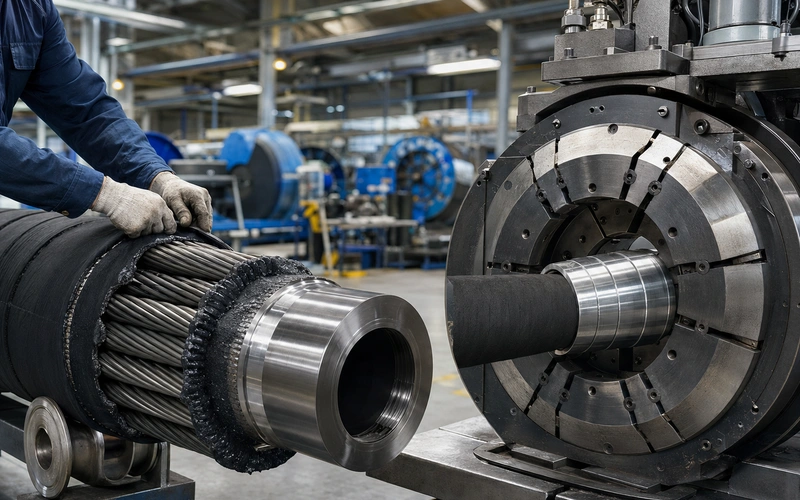
In a built-in oilfield hose, the end fitting is integrated while the hose is being built. Reinforcement cables or wires are anchored into the coupling area, and the end structure is bonded with the rubber and reinforcement during vulcanization. The result is a single engineered assembly rather than a finished hose body with a coupling added later.
This construction gives the designer more control over the transition from flexible hose to rigid end fitting. It can accommodate integral neck reinforcement, a shorter rigid coupling zone and a smooth full-bore design. Those details matter when a hose moves repeatedly, works close to equipment, carries abrasive media or sees high-frequency pressure changes.
Built-in does not mean every product has the same internal structure. Manufacturers use proprietary coupling geometries, bonding systems, reinforcement terminations and bend-control designs. One supplier’s built-in rotary hose may differ significantly from another supplier’s built-in choke and kill hose.
Ask for a cross-section or approved general arrangement drawing when the termination design is important to your application.
What Does “Crimped” Mean?
A crimped oilfield hose is produced in two main stages. First, the hose body is manufactured and cured. A compatible stem and ferrule are then installed at each end. Controlled mechanical compression locks the coupling onto the hose and creates the required seal and retention.
The process may be called crimping or swaging, depending on the equipment, tooling and supplier terminology. Do not assume that the words describe identical processes across all manufacturers. What matters is the approved assembly specification: hose type, fitting design, preparation method, insertion depth, target crimp dimension, tolerance, inspection method and test requirement.
Crimped construction supports efficient production when standard hose, fittings and tooling are available. It can also help fleet owners standardize common sizes and connections. However, repeatability depends on disciplined process control.
The wrong ferrule, an incorrect crimp diameter, damaged reinforcement during preparation or an unsuitable hose-and-fitting combination can reduce retention strength and service life.
For high-pressure oilfield service, a crimped hose should be treated as a factory-controlled assembly. Do not plan on field re-coupling, welding or changing an end fitting unless the hose manufacturer supplies a documented and approved procedure for that exact product.
Built-In vs Crimped Oilfield Hose Decision Matrix
| Decision factor | Built-in / bonded | Crimped / swaged | Commercial decision |
|---|---|---|---|
| Construction | Coupling, reinforcement termination, and hose end are integrated during hose construction and vulcanization. Full-bore and built-in neck-reinforcement designs are available. | A matched stem and ferrule are compressed onto a cured hose body. Bore, coupling length, and reinforcement contact depend on the selected design. | Compare the approved cross-section, bore, rigid-end length, bend-control arrangement, and connection drawing. Do not purchase based on the label alone. |
| Service | Often favored for severe pressure, temperature, pulsation, repeated flexing, and compact routing—provided the design is qualified for those conditions. | Suitable for many drilling, cementing, and transfer duties when the complete assembly is validated for the operating envelope. | Rank surge pressure, dynamic motion, temperature, fluid compatibility, abrasion, minimum bend radius, and consequences of failure before comparing prices. |
| Lead time | Commonly longer because the coupling is part of the hose construction. Custom ends, materials, engineering reviews, or new qualification work can extend the schedule. | Commonly shorter when the factory already has approved hoses, fittings, dies, and work instructions for the requested configuration. | Request a confirmed ex-works lead time after technical documents are approved. Separate normal production time from engineering and qualification time. |
| Validation | Review design or prototype qualification, coupling design, material traceability, and test records for the completed assembly. | Review the same assembly evidence, plus the approved hose-and-fitting match, crimp specification, tooling control, and measured crimp results. | Neither construction automatically meets an API specification or FSL. Verify the exact model, manufacturing location, certificate scope, and project documentation. |
Construction: Look Beyond the Coupling Name
The coupling is the visible difference, but the hose body still determines much of the assembly’s performance. Start with the inner tube. Drilling mud, cement slurry, acid, hydrocarbon fluids and hydraulic media place different demands on rubber or polymer linings. Abrasion resistance, chemical compatibility, gas permeation and decompression behavior may matter as much as pressure.
Next, review the reinforcement. High-pressure oilfield hoses may use multiple layers of steel cable, spiral wire and textile materials. Reinforcement angle, adhesion and termination determine how pressure loads travel through the hose and into the coupling. A strong coupling cannot compensate for a hose body that is unsuitable for the duty.
The cover protects against weather, oil, ozone, abrasion and handling damage. Offshore, well-control and fire-exposure applications may need additional protection, armor or a qualified fire-resistant layer. These features add weight and stiffness, so confirm how they affect installation and minimum bend radius.
Finally, examine the end transition. A long rigid end can make routing difficult and concentrate bending close to the coupling. An integral or separate bend stiffener may control this transition. Built-in designs often allow the manufacturer to engineer this area as part of the assembly.
Crimped designs can also perform well, but the drawing should show the actual rigid length and the point where the minimum bend radius is measured.
Service Conditions: When Built-In Usually Has the Advantage
Built-in construction is often the stronger candidate when the hose sees continuous motion, repeated flexing, high-frequency pulsation or elevated fluid temperature. Rotary and vibrator hoses, offshore lines and critical well-control duties can combine several of these loads. Integrating the reinforcement termination and neck area gives the manufacturer more freedom to manage stress at the coupling.
A full-bore path can also be important. A smooth transition helps reduce local velocity changes and turbulence. That can matter with abrasive mud, cement or fracturing slurry, where disturbed flow may accelerate wear. However, do not assume every built-in assembly is full bore or every crimped assembly is restricted. Confirm the minimum internal diameter through the coupling on the drawing.
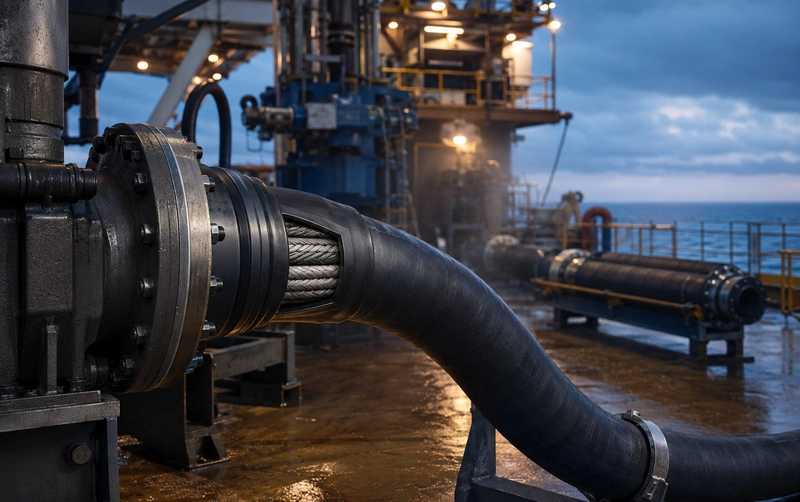
Severe service also includes what happens outside the hose. Unsupported hose weight, incorrect lifting points, axial tension, torsion, impact, clamp loads and bending next to the fitting can shorten life. A premium construction installed poorly is still a poor system. Ask the supplier to review the routing, operating movement and support arrangement when the hose is critical.
Service Conditions: When Crimped Is a Practical Choice
Crimped construction is often practical when the operating envelope is well defined and a qualified standard assembly already exists. A drilling contractor may need common hose sizes with repeatable end connections across several rigs.
A distributor may need stock configurations that can be supplied quickly. A cementing package builder may prefer an approved crimped design that matches established equipment and documentation.
The key word is “approved.” The hose, stem, ferrule and crimp procedure must be treated as one controlled combination. A fitting that physically enters the hose is not necessarily compatible. Buyers should avoid mixed-brand assemblies or substitutions made without written engineering approval.
Crimped does not automatically mean low pressure or short life. Manufacturer catalogs include high-pressure oilfield assemblies with crimped ends. Actual capability depends on size, hose construction, connection, temperature, application and qualification level. Compare exact product records, not general claims about the attachment method.
Lead Time: Separate Production from Approval
Lead time is one of the clearest commercial differences in a built-in vs crimped oilfield hose decision. Built-in ends are normally incorporated during hose manufacture, so the assembly follows the main build and cure schedule. Special coupling materials, nonstandard flanges, sour-service requirements, armor, fire protection or customer witness points may add time.
Crimped assemblies can move faster when the hose body, fittings and dies are already available. The factory can cut the hose to length, prepare the ends, crimp the couplings, inspect the assembly and perform the required testing. This advantage disappears if the configuration needs a new fitting, new tooling or qualification work.
Do not accept a lead-time promise before technical clarification. Ask the supplier to state three dates: drawing submission, document approval and ex-works delivery. Also confirm whether the quotation includes customer inspection, third-party witness, material certificates, hydrostatic test reports and final data books.
A hose that ships quickly but waits for missing documents does not protect your project schedule.
For urgent operations, discuss spares at the same time as the main order. A validated spare assembly on site can be more valuable than saving a few days on the initial purchase.
Validation: The Most Important Row in the Matrix
Construction is a design choice; validation is the evidence that the choice works. Begin with the applicable specification. Rotary, vibrator and cement hoses may be purchased under API 7K requirements. Choke and kill assemblies may fall under API 16C. BOP control hoses may involve API 16D. The correct standard depends on the equipment and service, not the pressure number alone.
Where a specification uses an FSL or another qualification level, state the required level in the RFQ. Do not infer it from the coupling type. Published manufacturer ranges show that bonded and crimped constructions can be offered in different qualified configurations. The certificate or license scope must cover the exact product family, and project approval may require more than a general company certificate.
Ask for the design or prototype qualification evidence that applies to the hose model. Depending on the product and specification, this may address pressure, pulsation, temperature, bending, fire performance, gas service or other application loads. The purpose is to show that the design has been tested, not merely that one finished hose held pressure for a short period.
Then review finished-assembly documentation. A typical package may include:
- approved datasheet and general arrangement drawing;
- hose identification, serial number and layline or marking details;
- material certificates and traceability for critical end fittings;
- dimensional inspection results;
- hydrostatic test procedure, calibrated gauge records and test report;
- NDT records where required for welded or machined end components;
- certificate of conformity and applicable API or third-party documentation;
- preservation, storage, lifting and installation instructions;
- inspection and replacement recommendations.
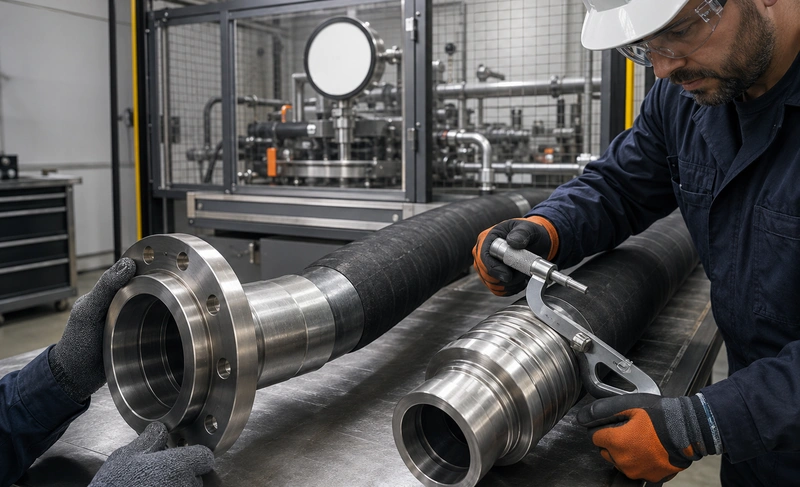
For crimped assemblies, add the controlled crimp specification and evidence that the finished crimp dimensions were checked. For built-in assemblies, confirm the coupling termination, neck reinforcement and bore shown on the approved drawing.
Note: A hydrostatic test is an assembly acceptance check, not a substitute for design qualification. You need both forms of evidence when the project or applicable standard requires them.
Application-Specific Recommendations
Rotary and Vibrator Hose
Rotary and vibrator hoses carry drilling mud between the standpipe, top drive, mud pump and related equipment. They may see pump pulsation, rig movement, vibration, elevated temperature and repeated bending. Built-in construction is a strong candidate when dynamic duty is severe or the routing needs a compact reinforced neck.
A crimped assembly may be a sound commercial choice when the exact API 7K configuration and FSL are approved for the service. Confirm hose length at operating position, allowable movement, support, minimum bend radius and connection orientation.
Cement Hose
Cement slurry is abrasive and often moves at high pressure. Liner selection, bore geometry and velocity control deserve close attention. Built-in full-bore designs may help reduce local turbulence at the ends, while qualified crimped cement hoses can offer efficient supply for standard packages.
Ask the supplier to confirm slurry compatibility, cleaning method, minimum bore through the coupling and whether the end connection can tolerate the installation loads.
Choke and Kill Hose
Choke and kill service is part of the well-control system, so consequence of failure and documentation requirements are high. Temperature, pressure, sour gas, fire exposure, gas decompression, movement and external protection may all influence selection. Built-in or bonded ends are widely used for critical service because the termination can be engineered as part of the hose.
Even so, the decision must follow the approved API 16C assembly, FSL, certificate scope and project requirements. Do not substitute a similar-looking hose or connection.
Fracturing and High-Pressure Well-Service Hose
Fracturing systems combine high pressure, pulsation, abrasive slurry, chemical exposure and demanding field handling. Connection style, liner, reinforcement, cover protection and bend control must be evaluated together. Built-in construction may suit severe cyclic duty and integrated full-bore designs.
Crimped construction may support faster replacement and standardization when the assembly is qualified for the pressure-pumping system. Confirm that pressure surges, not only normal working pressure, are included in the selection review.
Maintenance and Replacement Planning
Neither built-in nor crimped construction removes the need for inspection. Before use, check the cover, fittings, guards, armor, lifting points and identification. Look for cuts, abrasion, blistering, corrosion, exposed reinforcement, leakage, coupling movement, kinks or a flattened section. Remove a suspect hose from service and follow the manufacturer’s evaluation procedure.
During operation, prevent twisting and avoid bending directly at the coupling. Support the hose without creating sharp clamp loads. Keep the assembly away from hot surfaces, moving equipment and abrasion points. After service, clean it with a method compatible with the liner, cap the ends and store it without tight bends.
Replacement intervals should reflect actual duty, inspection history and manufacturer guidance. Calendar age alone does not describe the accumulated damage from pressure cycles, movement, heat and chemical exposure. Keep a hose register with serial number, installation date, service location, inspection results, tests and retirement reason. This data improves future purchasing decisions and helps you compare real lifecycle performance between constructions.
How to Compare Total Commercial Cost
The lowest unit price is not always the lowest operating cost. Compare the installed and lifecycle cost of each option. Include engineering time, qualification, freight, spare inventory, installation labor, inspection, planned replacement and the cost of downtime if the hose is unavailable.
Built-in assemblies may justify a higher price or longer schedule when severe duty, fatigue resistance, compact routing or full-bore flow reduces operational risk. Crimped assemblies may deliver better value where an approved standard design can be supplied quickly and stocked across a fleet.
Avoid assigning a universal service-life number to either construction. Routing, pressure cycles, temperature, media, maintenance and handling can outweigh the coupling method. The best commercial evidence is a validated design combined with field history in a comparable application.
What to Put on Your RFQ
A clear RFQ shortens quotation time and reduces technical exceptions. Provide:
- Hose application and equipment connection points.
- Inside diameter, required length and length tolerance.
- Normal working pressure, maximum surge pressure and test requirements.
- Minimum and maximum fluid and ambient temperatures.
- Conveyed medium, concentration, solids content and flow rate where relevant.
- H₂S, sour-service, gas or decompression requirements.
- Static or dynamic service, movement envelope and expected pulsation.
- Minimum bend radius, available routing space and support arrangement.
- End connection type, size, pressure class, material and orientation.
- Armor, fire protection, external guarding or lifting accessories.
- Applicable API specification, FSL and customer specifications.
- Documentation, inspection, witness and third-party approval requirements.
- Quantity, spare quantity, destination and required delivery date.
Ask the supplier to identify any assumptions or deviations in the quotation. The final purchase description should reference the approved datasheet and drawing revision, not only a short product name.
Which Oilfield Hose Construction Should You Buy?
Choose built-in when the service is severe, movement and pulsation are significant, the bore must remain smooth, the rigid end must be compact or the project places a premium on an integral termination design. Accept the longer lead time when it buys a better-matched assembly and stronger lifecycle case.
Choose crimped when the service fits a proven hose-and-fitting system, standard parts are available, fleet consistency matters and a shorter production schedule has real commercial value. Make process control and finished crimp inspection part of the approval package.
The final built-in vs crimped oilfield hose decision should be made from the operating data, approved drawings and qualification evidence. If two assemblies meet the same technical requirement, then compare lead time, service support, spares and total cost.
Alienfrac manufactures built-in and crimped high-pressure hoses for fracturing, drilling, cementing and well-control applications. Send your operating conditions, connection drawing and documentation list with the inquiry. Our team can compare both constructions and prepare a proposal for technical and commercial review.