
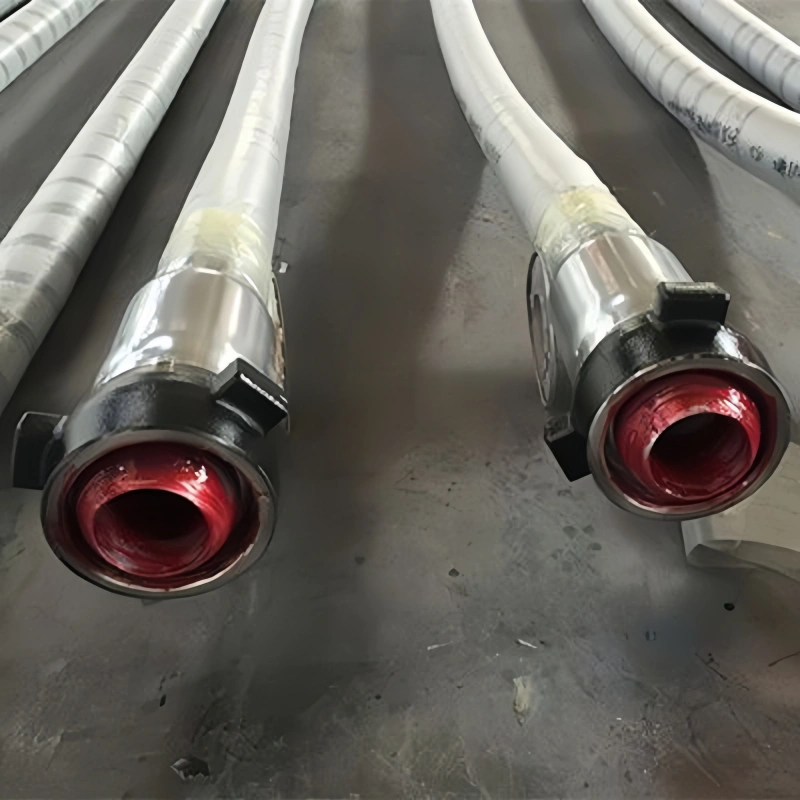
A Sour-Service Oilfield Hose must do more than carry pressure. It must keep its liner, reinforcement, bonding system, and end fittings reliable while exposed to hydrogen sulfide (H₂S), carbon dioxide (CO₂), water, hydrocarbons, drilling chemicals, heat, pressure cycling, and movement.
That is why the words “H₂S resistant” are not enough for a purchase specification. Sour-service suitability belongs to a defined hose assembly in a defined service envelope. Change the gas concentration, pressure, temperature, water phase, additives, decompression rate, fitting metallurgy, or duty cycle, and the engineering decision may change.
This guide explains how to select a Sour-Service Oilfield Hose, how to state its operating limits, which documents to request, and where common certificates stop providing evidence.
Key Takeaways
- Define the complete service envelope before selecting a liner or asking for a sour-service statement.
- Treat the hose as an assembly. The liner, reinforcement, adhesive, end fitting, seal, cover, armor, and manufacturing process all affect performance.
- H₂S concentration alone does not define metallic sour severity. H₂S partial pressure, water, pH, chlorides, temperature, stress, and material condition also matter.
- HNBR, FKM, FEPM, PTFE, and UPE can all be useful candidates, but polymer family names are not qualification results. Compound formulation and test conditions control the claim.
- NACE MR0175/ISO 15156 primarily addresses metallic materials in upstream H₂S-containing environments. It does not certify the complete rubber hose or prove elastomer compatibility.
- ISO 23936-2 and NORSOK M-710 are important references for non-metallic qualification, including sour-fluid ageing and rapid gas decompression, but results remain limited to the tested material and conditions.
- A hydrostatic test confirms pressure integrity at the time and conditions of the test. It does not prove long-term H₂S resistance, fatigue life, rapid gas decompression resistance, or chemical compatibility.
- Put every important limit and deliverable in the purchase order, data sheet, inspection and test plan, and hose certificate.
What Makes an Oilfield Hose “Sour Service”?
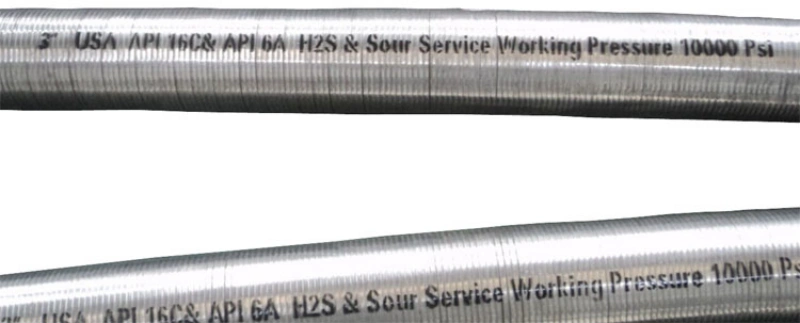
Sour service begins when H₂S-containing oilfield fluids can create credible material damage or a serious personnel hazard. For metallic components, the concern includes sulfide stress cracking, hydrogen-induced cracking, stress corrosion cracking, and related mechanisms. For elastomers and thermoplastics, the concern includes swelling, hardening, softening, loss of tensile properties, blistering, permeation, bond failure, and rapid gas decompression damage.
A Sour-Service Oilfield Hose therefore needs two connected evaluations:
- Can each wetted material tolerate the specified fluid and mechanical environment?
- Can the complete hose assembly maintain pressure integrity, flexibility, end-fitting retention, and safe operation for the required duty?
The answer cannot come from a generic chemical-resistance chart alone. It must come from application data, a controlled design, relevant qualification evidence, production verification, and clearly stated boundaries.
Start With the Service Envelope
Before choosing a Sour-Service Oilfield Hose, collect the same information that the manufacturer will need to accept or reject the application. The STAMPED selection method is a useful starting point—Size, Temperature, Application, Material or media, Pressure, Ends, and Delivery—but sour service requires more detail inside several of those fields.
| Required input | What to specify | Why it matters in H₂S service |
|---|---|---|
| Hose function | Rotary/vibrator, choke and kill, cement, acidizing, test, transfer, BOP control, or another duty | The governing hose design, movement, pressure cycle, and standard can differ |
| Fluid composition | H₂S, CO₂, CH₄, oil, water, brine, chlorides, solids, acids, amines, methanol, inhibitors, scavengers, and cleaning fluids | Combined fluids can attack a compound differently from one chemical tested alone |
| H₂S condition | Mole %, volume %, ppm where relevant, maximum credible value, and whether exposure is continuous or intermittent | A single nominal concentration can hide peaks or upset conditions |
| Pressure | Normal, maximum working, surge, test, vacuum, and absolute system pressure | Pressure affects structural demand, gas permeation, H₂S partial pressure, and RGD risk |
| Temperature | Fluid, ambient, minimum start-up, maximum continuous, and short-duration upset | Temperature changes chemical ageing, permeation, flexibility, and pressure capability |
| Fluid phase | Dry gas, wet gas, gas-condensate, oil, water, multiphase, slurry, or foam | Water and phase behavior influence both corrosion and polymer exposure |
| Decompression | Normal shutdown rate, emergency blowdown rate, pressure drop, hold time, and number of cycles | Absorbed gas can expand inside the liner or seals and cause blistering or internal cracks |
| Mechanical duty | Static or dynamic, bend radius, routing, vibration, axial load, torsion, pulsation, and cycles | Chemical ageing and mechanical fatigue act together |
| End connections | Flange, hub, hammer union, thread, seal material, metallurgy, pressure class, and orientation | The end fitting is part of the pressure boundary and may be the most sour-sensitive metallic area |
| External exposure | UV, ozone, salt spray, oil, chemicals, abrasion, impact, fire, immersion, and temperature | The cover and armor need their own compatibility and damage controls |
| Required life | Job duration, planned service interval, storage period, inspection interval, and retirement rule | “Sour resistant” does not create an unlimited service life |
| Compliance | Required API/ISO/NORSOK/AMPP documents, edition, FSL or other level, third-party witness, and local regulation | A standard name without edition, scope, or level is open to misinterpretation |
H₂S Concentration Is Not the Same as H₂S Partial Pressure
For a gas mixture, a simple screening calculation is:
H₂S partial pressure = H₂S mole fraction × absolute system pressure
For example, the same H₂S percentage produces a higher H₂S partial pressure at higher total pressure. This is one reason a concentration claim cannot be transferred automatically from one working pressure to another. Use absolute pressure in the calculation, not gauge pressure, and let the responsible materials engineer assess the full ISO 15156 environment for wetted metallic parts.
The calculation is only one input. Water phase, in-situ pH, chlorides, sulfur species, temperature, material strength, hardness, heat treatment, weld condition, stress, and exposure time may also control metallic selection. For polymers, total gas pressure, gas composition, liquid phase, temperature, decompression rate, geometry, and compound formulation are often equally important.
Material Selection for a Sour-Service Oilfield Hose

Select a Qualified Liner Compound, Not Just a Polymer Name
The inner tube or liner provides the primary fluid barrier. It sees the chemical mixture, pressure, temperature, velocity, entrained solids, and decompression cycles. A strong specification therefore identifies the actual compound or controlled material specification and connects it to evidence for the intended environment.
Two HNBR compounds can behave differently because acrylonitrile content, degree of hydrogenation, filler, plasticizer, cure system, hardness, processing, and post-cure are different. The same principle applies to FKM, FEPM, NBR, and other elastomer families.
Research on HNBR and FKM after sour-gas ageing has shown multiple chemical changes can occur at the same time, so a small change in one physical property should not be treated as proof of universal resistance.
| Liner family | Where it may fit | Important boundaries to verify |
|---|---|---|
| HNBR | Often a strong starting candidate for oilfield fluids, heat, abrasion, and sour oil/gas duties | Exact compound, H₂S/CO₂ mixture, aromatic content, amines and additives, temperature, gas pressure, ageing, RGD, and low-temperature flexibility |
| FKM | Useful where high temperature, hydrocarbons, and broad chemical resistance are important | FKM type and cure system, sour-gas chemistry, bases/amines, low-temperature flexibility, RGD, elongation, and bonding |
| FEPM | Can be considered for hot sour fluids, steam, amines, and aggressive chemical mixtures | Fluid-specific ageing, RGD, low-temperature performance, dynamic fatigue, bond system, and availability |
| FFKM | Considered for severe chemical and temperature exposure in selected seals or components | Cost, mechanical strength, permeation, RGD evidence, size availability, and whether it is practical for the hose liner design |
| PTFE/PFA-based liner | Strong chemical barrier and high-temperature capability for selected hose constructions | Flex fatigue, cold flow, permeability, electrical properties, abrasion, bonding, fitting design, and pressure-cycle qualification |
| UPE/UHMWPE | Attractive for abrasion and broad chemical service, including selected slurries and acid-transfer duties | Temperature ceiling, permeation, flex fatigue, bonding, static charge, gas service, RGD behavior, and exact chemical mixture |
| NBR | Cost-effective oil resistance and abrasion performance in many conventional hose duties | Do not assume severe sour suitability; verify the exact compound, temperature, gas exposure, ageing, and decompression conditions |
Protect the Reinforcement From Both Load and Environment
Steel-wire or steel-cable reinforcement carries the pressure load. It is normally separated from the conveyed fluid by the liner, but it can still be threatened by permeation, liner damage, end-fitting pathways, trapped corrosive fluid, external cover damage, and condensation.
Check reinforcement design for rated working pressure, impulse and pulsation, minimum burst or proof requirements, bend fatigue, axial load, collapse or vacuum, and permitted length change. Also verify how the construction vents permeated gas, controls wire corrosion, and prevents a damaged cover from becoming a hidden corrosion cell.
Do not use burst pressure as an operating limit. Burst testing is destructive design evidence under specified conditions; the working pressure on the hose data sheet and layline controls normal operation, subject to temperature and application derating.
Specify Sour-Compatible End Fittings and Seals
End fittings deserve the same attention as the hose body. Specify the wetted metallurgy, material grade, hardness, heat treatment, weld and overlay condition, seal compound, flange or union class, connection geometry, and any environmental limits.
NACE MR0175/ISO 15156 can support the selection and qualification of metallic materials for upstream H₂S-containing production environments. Its scope is not a blanket certificate for the complete hose. A useful compliance statement identifies the exact component, material, manufacturing condition, environmental region or limits, standard edition, and supporting material records.
Field welding, unapproved heat input, machining, plating changes, or substitution of a seal can invalidate the original material basis. Treat any fitting modification as an engineering change that requires manufacturer review.
Match the Cover, Armor, Adhesive, and Bonding System
The outer cover must tolerate the actual site: abrasion, oil, UV, ozone, saltwater, chemicals, handling damage, and heat. Stainless-steel armor or a fire sleeve can add external protection, but it can also hide cover damage and does not make an incompatible liner suitable for sour fluid.
Adhesive and bonding layers are easy to overlook. A liner may survive the fluid while the liner-to-reinforcement bond weakens. Qualification should therefore consider the finished composite and any bond or retention tests required by the hose design—not only free elastomer coupons.
Limits That Must Be Written Down
A good Sour-Service Oilfield Hose quotation and data sheet state a usable operating window. Avoid open-ended phrases such as “H₂S resistant,” “NACE hose,” or “suitable for sour gas” without conditions.
Pressure Limits
State rated working pressure, maximum transient or surge conditions, factory proof/test pressure, design qualification pressure, vacuum or collapse limit where relevant, and any temperature derating. Confirm that the hose body, couplings, seals, and mating equipment share a compatible pressure rating.
Temperature Limits
State minimum and maximum fluid temperature, ambient temperature, continuous exposure, and short-duration upset limits. A broad polymer temperature range from a raw-material brochure does not automatically become the hose assembly rating.
Chemical and H₂S Limits
State the maximum credible H₂S concentration, total pressure, calculated H₂S partial pressure where applicable, CO₂ level, water phase, pH, chlorides, hydrocarbon type, aromatic content, acids, amines, alcohols, inhibitors, scavengers, biocides, oxygen ingress, solids, and cleaning chemicals. Identify whether the approval is for continuous, intermittent, or emergency exposure and for how long.
Gas and Decompression Limits
State whether the hose is approved for gas, wet gas, liquid, or multiphase service. Define the maximum decompression rate, pressure drop, soak time, and number of cycles. Rapid gas decompression resistance should be demonstrated when credible for the application; it should not be inferred from ordinary liquid immersion or hydrotesting.
Mechanical and Installation Limits
State minimum bend radius for static and dynamic use, maximum unsupported span, torsion prohibition, axial load, permissible movement, vibration and pulsation duty, allowable length change, lifting method, routing clearance, and required restraints or safety clamps. Never route a hose at a bend radius smaller than its marked or documented minimum.
External and Emergency Limits
State cover compatibility, abrasion protection, armor, electrical continuity or insulation requirements, fire-test rating where required, storage conditions, and post-event replacement rules. A fire-tested design is not automatically approved for reuse after fire exposure.
Documentation to Request From the Manufacturer
Documentation is part of the product because it defines what was built, what was tested, and what the evidence actually covers. Agree the package before production.
Core Technical Documents
- Approved data sheet with hose type, size, length, working pressure, temperature range, minimum bend radius, weight, end connections, liner, cover, armor, and applicable standard.
- General arrangement or assembly drawing with controlled revision and bill of materials.
- Manufacturer’s service-envelope acceptance, including H₂S and CO₂ conditions, fluid composition, exposure duration, decompression limits, and exclusions.
- Installation, operation, inspection, storage, cleaning, and retirement manual.
- Certificate of conformity tied to the purchase order, hose serial number, and manufacturing location.
Sour-Service Material Documents
- Material certificates for pressure-containing metallic components, with grade, heat number, heat treatment, hardness, chemical composition, and mechanical properties as applicable.
- NACE MR0175/ISO 15156 compliance or qualification statement for each relevant wetted metallic part, including the environmental and material-condition limits.
- Elastomer or thermoplastic compound identification under document control, with traceability to the production batch.
- ISO 23936-2, NORSOK M-710, or application-specific sour-fluid ageing evidence where required, including actual test fluids, gas composition, pressure, temperature, duration, specimen geometry, acceptance criteria, laboratory, and report number.
- RGD test report when high-pressure gas or rapid blowdown is credible, including decompression rate and crack-rating method.
- Fluid-compatibility evaluation for the complete mixture, not only H₂S in isolation.
Manufacturing and Assembly Verification
- Inspection and Test Plan (ITP) and Quality Control Plan (QCP), with hold, witness, and review points.
- Production hydrostatic test certificate and pressure-time chart for the serialized hose assembly.
- Coupling installation, crimping or swaging record, including controlled dimensions and tooling identification.
- Nondestructive examination reports for fittings and welds where specified, plus personnel qualifications and acceptance criteria.
- Dimensional inspection, visual inspection, electrical continuity test where applicable, and final layline/nameplate verification.
- Calibration certificates for critical test and assembly equipment, valid on the test date.
- Type-test or design-validation reports for pressure, burst, impulse, bend, fire, gas permeation, bond, or fitting retention as required by the hose standard and specification level.
Traceability and Lifecycle Records
Every hose should have a unique serial number linked to its drawing revision, material batches or heat numbers, production route, assembly records, inspections, test certificate, release status, and date of manufacture. The operator should continue that record with installation date, service, cleaning, inspections, pressure events, repairs approved by the manufacturer, storage periods, and retirement decision.
Verification Boundaries: What Each Document Does—and Does Not—Prove
| Evidence | What it supports | What it does not prove by itself |
|---|---|---|
| Polymer supplier data sheet | General properties of a polymer grade or compound | Finished hose performance, bond durability, RGD resistance, or compatibility with every sour-fluid mixture |
| Chemical resistance chart | Early material screening | Design approval at a specific pressure, temperature, duration, or decompression rate |
| NACE MR0175/ISO 15156 statement | Metallic material selection or qualification within stated upstream H₂S limits | Elastomer compatibility, complete hose certification, downstream applicability, or unlimited H₂S service |
| ISO 23936-2 or NORSOK M-710 report | Non-metallic performance under the report’s test media and conditions | All compounds in the same polymer family, every hose geometry, or harsher untested conditions |
| Material Test Certificate | Chemistry, mechanical properties, heat treatment, and traceability for the listed material | Correct assembly, finished-hose performance, or suitability outside the certificate’s material scope |
| Type or design qualification test | Design performance under the stated configuration and test conditions | Every production unit unless production controls and traceability connect it to the qualified design |
| Production hydrotest | Assembly pressure integrity during the specified water test | H₂S ageing, gas permeation, fatigue life, chemical compatibility, burst margin in service, or RGD resistance |
| Burst test | Destructive design margin for the tested sample and conditions | A permissible operating pressure or proof that an in-service hose remains healthy |
| Fire test | Performance of a tested design under the specified fire procedure | General heat resistance, chemical compatibility, or permission to reuse a fire-exposed hose |
| API Monogram/license | Manufacturer’s licensed scope and conformity system for the identified API product | Coverage beyond the listed product, facility, specification edition, FSL or configuration |
| Third-party inspection certificate | The activities the inspector reviewed or witnessed in the approved ITP | Design responsibility, unobserved steps, future field condition, or unlimited service fitness |
| Field pressure test | Leak or integrity check under the approved field procedure | Original design qualification, remaining life, internal liner condition, or sour compatibility |
A Practical RFQ Checklist
Send the following information when requesting a Sour-Service Oilfield Hose quotation:
- Hose application and governing equipment standard.
- Inside diameter, required length, tolerance, and quantity.
- Normal, maximum working, surge, test, and vacuum pressures.
- Minimum, continuous maximum, and upset temperatures for fluid and ambient air.
- Complete fluid composition, including maximum H₂S and CO₂, water, pH, chlorides, hydrocarbons, additives, solids, and cleaning fluids.
- Fluid phase and flow condition: liquid, dry or wet gas, multiphase, slurry, velocity, and pulsation.
- Normal and emergency depressurization profiles.
- Static or dynamic service, minimum routing radius, movement, vibration, torsion, axial load, and unsupported span.
- End connection type, size, pressure class, metallurgy, seal material, orientation, and mating equipment.
- External exposure, armor, fire protection, electrical requirements, lifting devices, and restraints.
- Required design life, inspection interval, storage period, and retirement criteria.
- Applicable standards, editions, addenda, FSL or other level, operator specifications, documentation, and third-party inspection points.
Ask the supplier to return a compliance matrix showing “Comply,” “Exception,” or “Not Applicable” against every requirement. Any exception should include the proposed alternative and its technical basis before purchase-order release.
Acceptance and Verification Workflow
Step 1: Freeze the Design Basis
Approve the service envelope, data sheet, standards, document list, and inspection plan before manufacturing. Unresolved fluid chemistry or depressurization data should remain an open technical query, not an assumed condition.
Step 2: Review Material Evidence
Check that metallic compliance statements match the actual grades, hardness, heat treatment, weld condition, and H₂S environment. Check that non-metallic reports match the actual compound—not only the generic polymer—and compare test pressure, temperature, fluid, duration, decompression, and specimen configuration with the application.
Step 3: Confirm Design Qualification
Verify that the offered hose size, pressure class, end fitting, temperature class, fire rating, and specification level fall within the qualified design family. Ask how substitutions, repairs, and process changes are controlled.
Step 4: Verify Production Records
Match the serial number on the hose to the certificate, pressure chart, assembly record, drawing, material records, and nameplate or layline. Confirm test-equipment calibration and resolve every nonconformance before release.
Step 5: Inspect the Delivered Assembly
Check shipping damage, cover condition, armor, fittings, seals, protective caps, identification, length, bend condition, cleanliness, and completeness of the document package. Quarantine any hose whose marking and certificate do not match.
Installation, Inspection, and Operating Controls
Correct selection can still fail through poor installation or operation. Support the hose so it is not twisted, kinked, crushed, dragged, or bent below the minimum radius. Keep the first bend away from the coupling, use approved lifting points and restraints, and protect the assembly from hot surfaces, sharp edges, traffic, and incompatible chemicals.
Inspect before use and after abnormal pressure, temperature, impact, fire, or chemical events. Look for cover cuts, blisters, soft spots, hardening, kinks, exposed reinforcement, corrosion, leaks, fitting movement, damaged armor, or unreadable identification. Internal damage can exist without obvious external evidence, so follow the manufacturer’s inspection and test procedure and the operator’s risk-based hose management program.
Remove the hose from service when it exceeds a documented limit, fails an inspection or authorized test, loses traceability, suffers an unapproved repair, or reaches its retirement criterion. Do not attempt field repair or welding unless the original manufacturer has provided a written, controlled procedure and formally reaccepts the assembly.
H₂S is also a personnel hazard. OSHA notes that it is highly toxic and that odor cannot be relied on as a warning because olfactory fatigue can occur. Hose selection does not replace gas detection, ventilation, site alarms, respiratory protection, emergency response, exclusion zones, or other required H₂S controls.
Common Sour-Service Hose Specification Mistakes
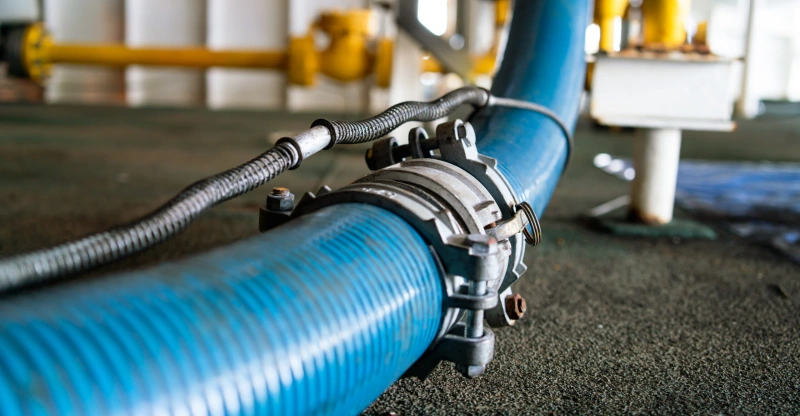
Mistake 1: Writing Only “NACE Compliant”
Correct it by identifying the metallic components, applicable ISO 15156/NACE MR0175 edition, material condition, environmental limits, and required evidence. Add a separate non-metallic qualification requirement for the liner and seals.
Mistake 2: Selecting HNBR by Name Alone
Correct it by approving a controlled compound specification and matching the sour ageing and RGD reports to the intended environment.
Mistake 3: Using H₂S Percentage Without Pressure or Duration
Correct it by specifying concentration, total absolute pressure, maximum credible partial pressure where relevant, temperature, water phase, exposure duration, and upset condition.
Mistake 4: Treating Hydrotest as Sour-Service Qualification
Correct it by separating production pressure verification from chemical ageing, gas permeation, RGD, fatigue, and complete-assembly design qualification.
Mistake 5: Ignoring End Fittings and Seals
Correct it by reviewing every wetted and pressure-containing part, including metallurgy, hardness, heat treatment, welds, plating, elastomer seals, and mating connections.
Mistake 6: Leaving Decompression Undefined
Correct it by supplying both normal and emergency blowdown profiles and requiring applicable RGD evidence and operating limits.
Mistake 7: Assuming a Certificate Has No Boundary
Correct it by recording the design, size, compound, test method, specimen, fluid, pressure, temperature, duration, decompression, acceptance criteria, and manufacturing scope covered by each certificate.
How Alienfrac Supports Sour-Service Hose Selection?
Alienfrac manufactures oilfield hose families for drilling, cementing, well control, fracturing, and fluid transfer, including API 7K and API 16C product categories. For an H₂S application, the useful starting point is not a generic catalog label—it is a completed service-data sheet.
Share the full fluid composition, pressure and temperature envelope, hose movement, end connections, required standards, inspection plan, and document list with Alienfrac. The technical team can then review the appropriate liner, reinforcement, cover, armor, and fitting configuration and state the offered limits and documentation in the quotation.
For related selection guidance, see Alienfrac’s oilfield hose range, inner tube material guide, oilfield hose specification guide, minimum bend radius guide, and API 16C hose maintenance guide.
Conclusion
A reliable Sour-Service Oilfield Hose is the result of controlled selection, not one material name or one certificate. Define the service envelope, evaluate the complete assembly, state measurable limits, require traceable documents, and read every test result within its verification boundary.
When these steps are followed, you can compare suppliers more clearly, reduce hidden technical exceptions, and build a hose management program around evidence that matches the real H₂S environment.
Contact Alienfrac with your service conditions and required documentation to begin an application-specific Sour-Service Oilfield Hose review.
FAQ
What is a Sour-Service Oilfield Hose?
A Sour-Service Oilfield Hose is a hose assembly selected and verified for a defined H₂S-containing oilfield environment. Its liner, reinforcement, bonding system, end fittings, seals, cover, and manufacturing process must match the stated pressure, temperature, fluid, mechanical duty, exposure time, and decompression conditions.
Is HNBR always the best liner for H₂S service?
No. HNBR is often a strong candidate, but performance depends on the exact compound, cure system, gas and liquid composition, temperature, pressure, ageing time, and decompression duty. FKM, FEPM, PTFE, UPE, or another material may be preferable for some applications. Qualification must match the service envelope.
Does NACE MR0175 certify the entire hose?
No. NACE MR0175/ISO 15156 addresses the selection and qualification of metallic materials for defined upstream H₂S-containing environments. It can apply to wetted hose fittings and other metallic parts, but it does not by itself prove the sour-fluid compatibility of an elastomeric liner, seal, adhesive, or complete hose assembly.
What is the difference between H₂S concentration and H₂S partial pressure?
H₂S concentration describes the fraction of H₂S in the gas. H₂S partial pressure also accounts for total absolute system pressure. For a gas mixture, partial pressure is the mole fraction multiplied by absolute pressure. Metallic material selection still requires the full environment, including water, pH, temperature, chlorides, stress, and material condition.
Why does rapid gas decompression matter?
High-pressure gas can dissolve or permeate into elastomers. If external pressure falls too quickly, the absorbed gas expands inside the material and can create blisters, cracks, or internal separation. RGD risk depends on the compound, gas mixture, pressure, temperature, soak time, geometry, restraint, and decompression rate.
What documents should come with a Sour-Service Oilfield Hose?
At minimum, request the approved data sheet and drawing, certificate of conformity, serialized hydrotest chart, assembly record, material traceability, applicable metallic sour-service evidence, non-metallic ageing and RGD evidence where required, NDT reports, calibration records, and an installation/inspection manual. Tailor the list to the governing standard and project specification.
Can a hose be used above its working pressure if its burst pressure is higher?
No. Burst pressure is destructive design evidence, not an operating allowance. Use the rated working pressure and apply every documented temperature, service, and application derating. Pressure surges must remain within the manufacturer’s approved envelope.
How often should a sour-service hose be inspected?
Inspect it before use and after any abnormal pressure, temperature, impact, fire, chemical, or handling event. The detailed interval should follow the manufacturer’s manual, governing standard, service severity, regulatory requirements, and the operator’s risk-based hose management program. Replace the hose when it reaches a retirement criterion or loses traceable fitness for service.
Can the same Sour-Service Oilfield Hose handle every H₂S application?
No. Approval is limited to the documented design and service envelope. A change in H₂S level, total pressure, temperature, fluid phase, additives, decompression rate, mechanical duty, end connection, or standard can require a new engineering review.