
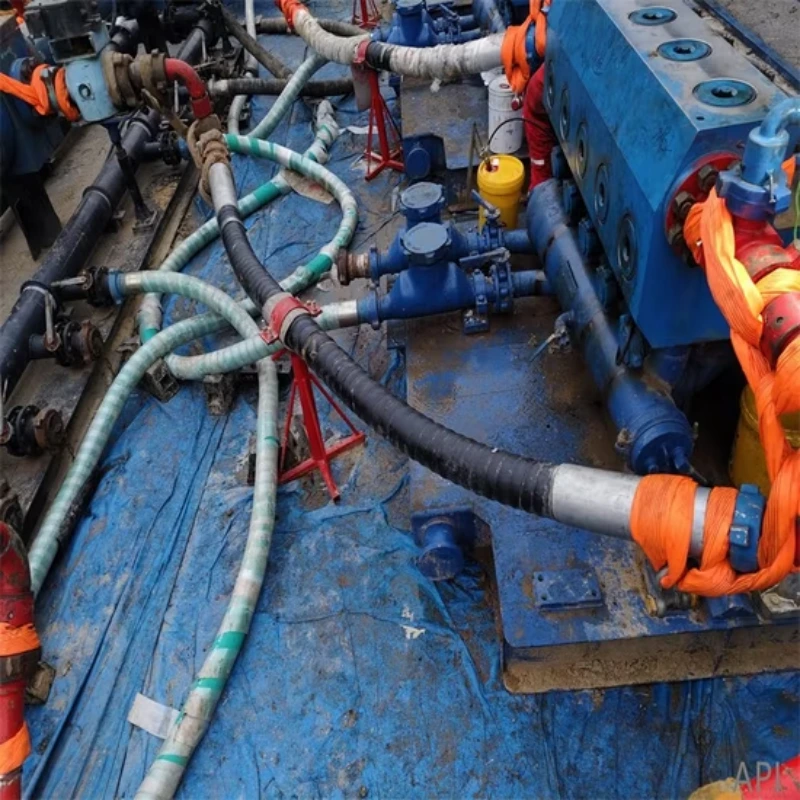
When you ask for an oilfield hose price, the number only makes sense if every supplier is pricing the same assembly. A quote for hose body alone is not comparable with a quote that includes end connections, hydrostatic testing, traceability records, export packing, and third-party inspection. One may look cheaper simply because important items are missing.
This oilfield hose cost guide shows you what changes the price and what to include in your request for quotation (RFQ). You will see how size, pressure, construction, ends, testing, documentation, and quantity affect the scope. More importantly, you will know how to write an RFQ that produces useful, comparable offers.
There is no universal price per meter for an oilfield hose assembly. A 3-inch transfer hose and a 3-inch API 16C choke and kill line may share a nominal bore, yet they solve very different problems. Their reinforcement, couplings, qualification requirements, inspection documents, and production route can differ sharply. Start with the service, then compare the total supplied scope.
Key Takeaways
- You get a more reliable price when you specify the complete assembly, not just diameter and length.
- Larger size, higher working pressure, more demanding construction, special ends, additional testing, expanded documentation, and small custom quantities usually add cost.
- Working pressure, test pressure, and burst or design-verification values are not interchangeable. State the required working pressure and applicable standard; let the approved design define the other values.
- End connections can change material, machining, welding, non-destructive examination, assembly time, weight, and freight.
- A certificate of conformance is not the same as a complete manufacturing data book. List every document you need before the supplier quotes.
- Compare price, lead time, compliance, documentation, packing, and exclusions on one bid-comparison sheet.
What Are You Actually Buying?
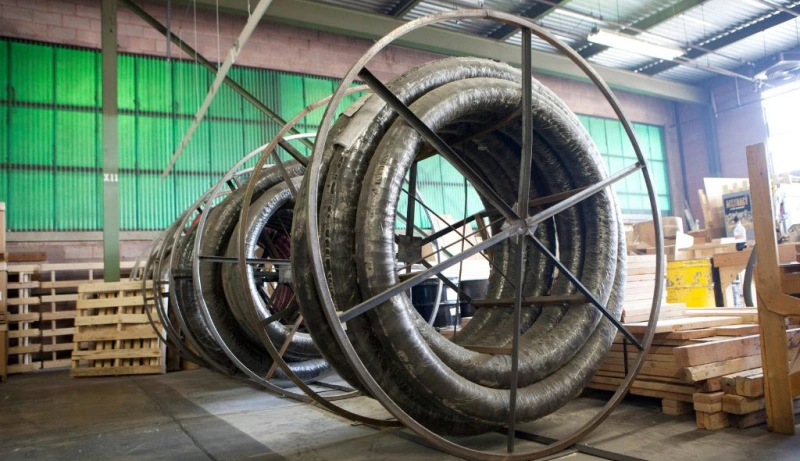
Your purchase is normally a finished hose assembly. The scope may include the hose body, couplings, end connectors, seals, external armor, lifting eyes, safety clamps, identification, tests, certificates, packing, and freight. It may also include engineering review, drawings, customer hold points, or third-party witness services.
That is why a short RFQ such as “4-inch hose, 5,000 psi, 20 meters” creates ambiguity. The supplier still has to guess the application, fluid, temperature, dynamic movement, connector standard, connection orientation, required FSL or other compliance level, inspection plan, and document package. Different guesses produce different prices.
Use the S.T.A.M.P.E.D. logic as a starting point: Size, Temperature, Application, Material or media, Pressure, Ends, and Delivery. For a commercial comparison, add testing, documentation, quantity, destination, and required delivery date. Those details turn a rough budget number into a quotable oilfield hose specification.
The Seven Main Oilfield Hose Cost Drivers
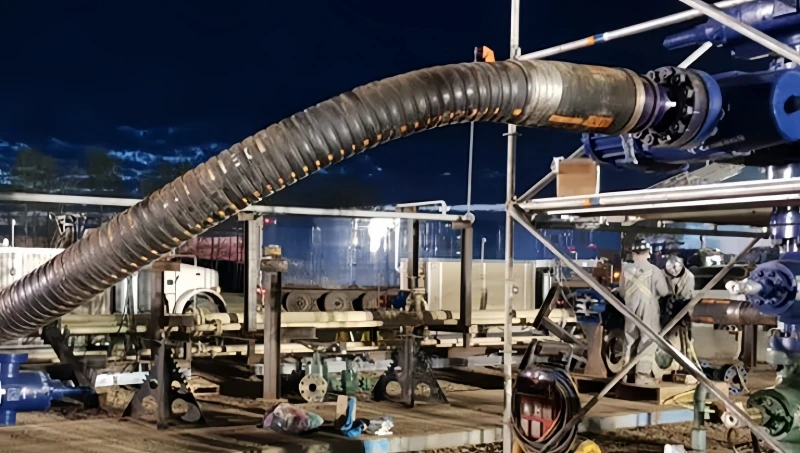
1. Size: ID, OD, Length, and Handling
Inside diameter affects flow area and the amount of material in the hose. As ID increases, the assembly may require more tube compound, reinforcement wire or cable, cover material, and larger couplings. The production equipment and mandrel capacity may also change. Cost therefore tends to rise with bore size, but not in a perfectly straight line.
Outside diameter matters too. It influences clearance, clamp selection, protective armor, crate dimensions, and weight. If your routing space is tight, give the supplier the maximum permitted OD instead of assuming every hose with the same ID will fit.
Length adds hose material, but it also affects manufacturing, testing, handling, packing, and transport. Very long assemblies may need special production arrangements or oversized crates. A short custom assembly may use little hose yet still carry most of the same engineering, setup, coupling, test, and documentation work as a longer one.
Specify how you measure length. “Overall length” can mean end-to-end, seal face-to-seal face, or another datum. Include a drawing when the connection faces, bend stiffeners, or rigid end sections make the measurement easy to misunderstand.
For rotary, vibrator, jumper, and other moving services, confirm the length and routing against movement and minimum bend-radius requirements rather than buying the shortest hose that reaches.
Your RFQ should state nominal ID, required overall length and tolerance, maximum OD if restricted, movement type, routing, and bend-radius limits. If you need multiple lengths, list the quantity for each one.
2. Pressure: Working Duty, Surges, and Pulsation
Higher pressure usually means a more demanding reinforcement package and heavier end connections. The hose may need additional or higher-strength steel layers, a different coupling design, tighter process controls, and a more extensive qualification basis. The finished assembly also becomes heavier and harder to handle.
Give the normal working pressure, maximum expected operating pressure, pressure surges, and whether the service is steady or pulsating. A mud line exposed to frequent pump pulsation is not the same duty as a transfer hose that sees relatively stable pressure.
API 7K, for example, distinguishes Flexible Specification Levels for different hose services and pressure-pulsation conditions. You should name the applicable standard and FSL in the purchase agreement when required, not ask for “API hose” as a generic label.
Do not build your RFQ around a burst-pressure number copied from another product. Burst and design-verification tests support the design; they are not operating ratings. Your working pressure must cover the real system duty, including the effect of pressure spikes and temperature, while remaining within the manufacturer’s approved service envelope.
Pressure also interacts with size. A large-bore, high-pressure assembly stores more energy and places greater demands on reinforcement, couplings, test equipment, and safe handling. That combination can move a project into a different manufacturing route, even when each requirement looks common on its own.
3. Construction: Tube, Reinforcement, Cover, and Coupling Method
Construction should follow the fluid and the environment. You may need an oil-resistant tube, an abrasion-resistant liner for cement or slurry, a compound suitable for sour or chemically aggressive media, or a low-temperature formulation. Every material choice should be tied to compatibility data and the exact temperature and pressure range.
Reinforcement can include textile plies, steel wire spirals, steel cable, or a design-specific combination. More reinforcement is not automatically better. The approved design must balance pressure capacity, flexibility, fatigue behavior, weight, and minimum bend radius. A requirement that is unnecessarily severe can add material and handling cost without improving your actual service.
The cover protects the assembly from weather, oil, ozone, abrasion, and mechanical damage. Stainless-steel armor, fire-resistant layers, external spirals, bend stiffeners, lifting eyes, or safety clamps may be valuable in the right location, but they should appear as named line items. Otherwise, one supplier may include them while another excludes them.
The connection method also affects price and lead time. Oilfield assemblies may use crimped, swaged, bonded, or built-in coupling designs, depending on product family and standard. These are not interchangeable options chosen only by cost. The approved hose-and-coupling system, working conditions, available length, field movement, and inspection requirements all matter.
Ask the supplier to identify the proposed tube, reinforcement, cover, coupling method, minimum bend radius, weight, temperature range, and relevant standard. If you require a particular construction, explain the service reason so the manufacturer can confirm that it is appropriate.
4. Ends: Connection Type, Material, Orientation, and Adapters
End connections are often one of the largest reasons two hose quotes differ. A standard threaded end is a different scope from a large hammer union, high-pressure flange, hub, or customer-specific connector. Larger or higher-pressure ends require more raw material and machining. Special alloys, sour-service requirements, coatings, and low-temperature impact properties can add further work.
List the connection on End A and End B separately. Include size, pressure class or figure, standard, flange face, hub profile, thread type, seal details, material grade, and any coating. If orientation matters, provide a clocking drawing and tolerance. If the hose has elbows or angled rigid ends, show the centerline dimensions.
Also say whether you want integral end connections or whether adapters are acceptable. Adapters may simplify sourcing, but they add joints, length, weight, potential leak paths, and installation steps. A quote with two adapters is not directly comparable with a quote for purpose-designed integral connectors.
Welding and attachment requirements can add procedure qualification, welder qualification, heat treatment, dimensional checks, and non-destructive examination. These items are easy to miss in a headline price. Ask for a clear description of the coupling and end-connector scope, including seals, protectors, fasteners, and loose items.
5. Testing and Inspection: Define Acceptance Before Production
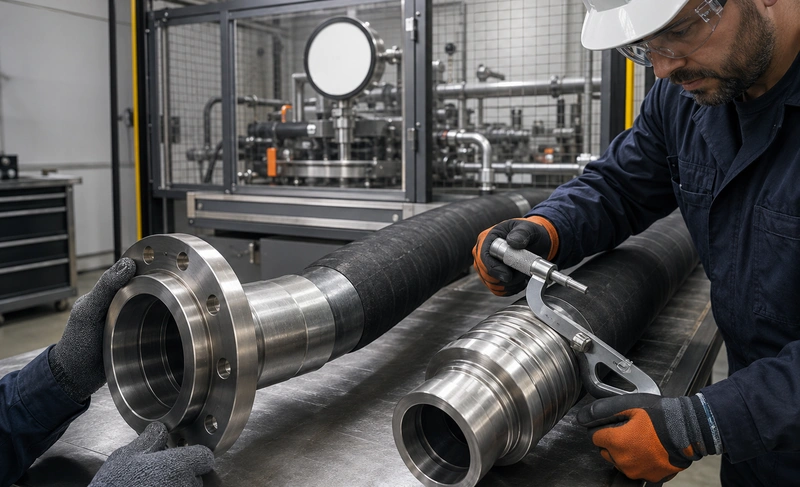
Testing cost depends on what is tested, how often, to which procedure, and who must witness it. Separate design qualification from routine acceptance testing. A design may have passed qualification tests for a defined product family; your individual assembly may then receive visual, dimensional, and hydrostatic acceptance tests. Those are different activities with different records.
For the order, state the applicable standard, required test pressure and hold time if contractually defined, acceptance criteria, measurement records, calibration requirements, and whether the test applies to every assembly or a sample. Do not invent a test pressure from a rule of thumb. Use the governing standard, approved procedure, and manufacturer’s design.
Additional inspection can include internal borescope examination, dimensional surveys, coupling-material verification, hardness checks, weld visual examination, magnetic-particle or liquid-penetrant testing, radiography or ultrasonic examination, and customer-specific inspections. Not every method applies to every assembly. Request only what your technical specification or risk assessment needs.
A third-party inspector adds coordination, witness points, scheduling, and reporting. If you require one, name the inspection agency or approval process, define hold and witness points, and say who pays the inspector. A vague note such as “third-party certificate required” invites assumptions.
The RFQ should also identify any special qualification evidence you expect, such as pulsation, bending, fire, gas decompression, low-temperature, or fluid-compatibility testing. Confirm that the evidence covers the proposed hose family, size, pressure, end design, and service conditions. A test report for a different construction is not automatically transferable.
6. Documentation: From Basic Certificate to Full Data Book
Documents have a real production cost. They require collection, review, traceability, approval, and sometimes customer-specific formatting. If you wait until the hose is complete to request a full data book, some records may be expensive or impossible to reconstruct.
Define the document package in the RFQ. A basic package might include a certificate of conformance, assembly test certificate, product datasheet, and packing list.
A project data book may also require approved drawings, inspection and test plan, material certificates for couplings and connectors, weld procedure and personnel qualifications, NDE reports, calibration certificates, traceability records, deviation approvals, photographs, preservation records, and third-party release notes.
Specify the required language, electronic format, file naming, document index, number of review cycles, and whether final approval is a shipment hold point. If you need paper copies, stamped originals, or legalization, state that as well.
Be precise with certification language. “API compliant,” “manufactured under an API quality system,” and “API Monogram marked” do not mean exactly the same thing. Name the standard, edition, product scope, FSL where applicable, and marking or licensing requirement. Ask the supplier to identify exceptions in the quotation.
Documentation can look like an administrative detail, but it affects your ability to receive, inspect, install, audit, and later trace the assembly. Compare document scope with the same care you give the hose specification.
7. Quantity: Setup Cost, Repeatability, and Delivery Strategy
Quantity affects unit price because engineering review, production setup, tooling, test preparation, documentation, and packing have fixed elements. One custom assembly carries those costs alone. A batch of identical assemblies can spread them across more units and may improve material purchasing and production efficiency.
The saving depends on repeatability. Ten hoses with different lengths, ends, materials, and document requirements are not the same as ten identical assemblies. Provide a line-by-line quantity schedule and identify which items share the same design.
Ask for price breaks at realistic quantities, not arbitrary volumes you are unlikely to order. You can request pricing for the immediate need, an optional spare, and a project batch. This shows whether adding critical spares now is more economical than restarting engineering, testing coordination, and export freight later.
Delivery strategy matters too. Split shipments may protect the schedule but add packing, inspection releases, freight, and customs work. An urgent order can require overtime, priority material, or a disrupted production plan. State the required ex-works date, destination, Incoterm, shipping method, and whether partial delivery is acceptable.
Why Two Quotes Can Look Far Apart?
Before you compare totals, normalize the scope. Check whether each supplier has included the same hose length, end connections, seals, armor, lifting accessories, tests, documents, packing, inspection, freight terms, and warranty. Read the exclusions and deviations, not just the first page.
One quote may include a wooden export crate and test certificates with every assembly. Another may price loose packing and offer material traceability, a full data book, or third-party witness testing as optional extras. Neither structure is automatically wrong. Your job is to place each offer on the same basis.
Use a bid-comparison table with four columns: requirement, Supplier A, Supplier B, and clarification needed. Mark every item as included, excluded, optional, or not stated. If a requirement is not stated, do not assume it is included.
How to Control Cost Without Underspecifying the Hose?
First, describe the real service instead of copying the most severe values from several projects. Excess pressure, temperature, armor, testing, or documentation requirements can push you into a heavier design and a longer production route. Under-specification is unsafe, but over-specification also has consequences.
Second, standardize where your system allows it. Repeating approved sizes, ends, lengths, drawings, and document formats can reduce engineering questions and spare-part complexity. Standardization works only when the common design still fits each application.
Third, separate mandatory requirements from options. Ask the supplier to price stainless-steel armor, third-party witness, expedited delivery, extra paper data books, or spare assemblies as distinct lines. You can then make a visible commercial decision instead of receiving one unexplained lump sum.
Finally, evaluate total landed and usable cost. Include freight, customs, inspection, adapters, installation items, missing-document recovery, and schedule risk. The lowest ex-works number can become the most expensive choice if the assembly arrives without the required ends or acceptance records.
Copy-Ready Oilfield Hose RFQ Checklist
Service and Operating Conditions
- Application: [rotary drilling / vibrator / jumper / choke and kill / cementing / fracturing / BOP control / petroleum transfer / other]
- Fluid or media: [name, composition, solids, additives, gas content, sour-service conditions, concentration]
- Fluid temperature: minimum [ ] and maximum [ ]
- Ambient temperature: minimum [ ] and maximum [ ]; start-up temperature [ ]
- Working pressure: normal [ ] and maximum [ ]
- Surge or pulsation: [frequency, amplitude, pump duty, known transients]
- Service mode: [static / intermittent movement / continuous dynamic movement]
- External exposure: [UV, ozone, oil, chemicals, abrasion, fire risk, seawater, ice, mechanical impact]
Hose Dimensions and Construction
- Nominal ID: [ ]
- Overall length and measurement datum: [ ]; tolerance [ ]
- Maximum OD or routing clearance: [ ]
- Minimum bend radius available in the installation: [ ]
- Hose type or preferred product family: [ ]
- Tube or liner requirement: [ ]
- Cover requirement: [ ]
- External protection: [armor / spiral guard / fire layer / none / supplier recommendation]
- Accessories: [lifting eyes, safety clamps, bend restrictors, end protectors, other]
End Connections
- End A: [type, size, figure/class/rating, standard, face or thread, material, coating]
- End B: [type, size, figure/class/rating, standard, face or thread, material, coating]
- Integral ends required: [yes/no]; adapters permitted: [yes/no]
- Orientation or clocking: [drawing reference and tolerance]
- Seals, fasteners, protectors, and loose items required: [ ]
Standards, Testing, and Inspection
- Applicable standard and edition: [ ]
- Required FSL or other specification level: [ ]
- API Monogram or other marking requirement: [ ]
- Assembly acceptance tests: [hydrostatic, visual, dimensional, other]
- Test procedure, pressure, hold time, and acceptance criteria: [reference document]
- Additional inspection or NDE: [ ]
- Third-party inspector: [agency]; hold/witness points: [ ]; cost responsibility: [ ]
- Qualification evidence required: [pulsation, bend, fire, gas, low temperature, compatibility, other]
Documentation and Commercial Information
- Required documents: [CoC, test certificate, datasheet, drawing, ITP, MTRs, WPS/PQR/WPQ, NDE, calibration, traceability, photos, packing list, third-party release, other]
- Document language and format: [ ]; review cycles: [ ]; final approval before shipment: [yes/no]
- Quantity by item and required spares: [ ]
- Required delivery date or ex-works date: [ ]
- Delivery destination, Incoterm, and shipping method: [ ]
- Packing and preservation: [export crate, caps, desiccant, outdoor storage period, other]
- Quote validity, warranty, exclusions, optional prices, and lead time required: [ ]
Questions to Ask When the Quote Arrives
Do not stop at “Is this your best price?” Ask questions that expose the scope.
- Which exact hose family and construction have you selected, and why does it match the stated service?
- Does the quoted working pressure apply to the complete assembly at the required temperature?
- Are both end connections, seals, protectors, armor, and accessories included?
- Which tests will be performed on each supplied assembly, and which reports will you provide?
- Does the qualification evidence cover the proposed size, pressure, construction, and end design?
- Which documents are included in the base price, and which are optional?
- What assumptions, exclusions, and deviations have you made?
- Is the lead time measured from purchase order, drawing approval, document approval, or material receipt?
- How will the assembly be packed, lifted, preserved, and shipped?
- What changes would reduce cost without changing the required service envelope or compliance?
FAQ
How much does an oilfield hose cost?
You need a defined assembly before the price is meaningful. Size, length, pressure, construction, end connections, testing, documentation, quantity, packing, and delivery all affect the quotation. Send the same complete RFQ to each qualified supplier and compare the included scope rather than relying on a generic price per meter.
Does a larger hose always cost more?
Larger ID usually requires more material and larger ends, so cost often increases. The relationship is not linear, however. Pressure, construction, coupling type, production capacity, length, and test requirements can matter as much as diameter.
Why do end connections change the price so much?
Ends can require significant raw material, precision machining, special alloys, welding, heat treatment, NDE, coatings, seals, and orientation control. A quote with integral high-pressure connectors is a different scope from one that relies on standard ends and separate adapters.
Is hydrostatic testing included in every quote?
Do not assume it is included or that every supplier follows the same procedure. State the applicable standard and acceptance-test requirements, then ask the supplier to list the test, pressure, hold time, records, and witnessing included in the base price.
What documentation should you request?
Request only the package your contract and quality plan need, but define it early. Common items include a certificate of conformance, assembly test certificate, datasheet, approved drawing, material certificates, NDE reports, traceability records, calibration certificates, and an indexed final data book.
Will ordering more hoses lower the unit price?
It can, especially when the assemblies are identical and the supplier can spread engineering, setup, testing, and documentation work across the batch. Mixed designs, split shipments, or different inspection requirements reduce that benefit. Ask for price breaks for realistic quantities and an optional spare.
What is the best way to compare supplier quotations?
Create a compliance matrix that lists every technical and commercial requirement. Mark each offer as included, excluded, optional, deviated, or not stated. Then compare the normalized total, lead time, documentation, inspection plan, packing, warranty, and technical fit.
Get a Quote You Can Actually Compare
A useful RFQ removes guesswork. When you define size, pressure, construction, ends, testing, documentation, and quantity, suppliers can select the correct assembly and show you where the money goes. You also spend less time resolving exceptions after the order.
Use this oilfield hose cost guide as your pre-RFQ review. Attach your service data, connection drawings, inspection requirements, and document index. Alienfrac can then review the application and prepare a line-by-line quotation for the hose assembly, options, tests, documentation, packing, and delivery you actually need.