

There is no single “offshore drilling hose” that fits every position on a rig. A rotary hose carries drilling mud. A choke and kill hose provides a flexible high-pressure flow path in the well-control system. A BOP control hose carries hydraulic control fluid. These assemblies may sit close to one another, but they do different jobs and are selected under different technical requirements.
The practical way to choose an oilfield hose for offshore drilling is to start with the service position, then define pressure, temperature, media, movement, routing, end connections, external exposure and documentation. Product names come later.
This guide separates API 7K rotary and vibrator hose, API 16C choke and kill hose, and API 16D BOP control hose so engineering and procurement teams can build a clear specification without mixing their functions.
Key Takeaways
- Select the hose by application and service envelope, not by a familiar product name or pressure number alone.
- Use API 7K for the relevant rotary, vibrator and high-pressure cement-hose applications; use API 16C for flexible choke and kill lines; use API 16D for BOP hydraulic control systems.
- Do not call an API 16C choke and kill hose a BOP control hose. It can be part of the wider well-control system, but its function is different from an API 16D control line.
- For offshore duty, evaluate salt exposure, corrosion, movement, bend radius, abrasion, impact, fire risk, sour service and restricted access for inspection or replacement.
- Specify both end connections completely. A correct hose body with the wrong flange, hub, union, pressure class or orientation is still the wrong assembly.
- Ask for evidence that matches the exact assembly: current datasheet, applicable certificate scope, pressure-test record, traceability and any project-required inspection documents.
1. What Makes Offshore Drilling Hose Selection Different?
Offshore selection is not simply an onshore hose specification with a corrosion-resistant cover. The installation has to remain workable in a compact, moving and weather-exposed environment where access may be limited and replacement may depend on a planned maintenance window.
- Saltwater and salt-laden air: attack exposed steel, damaged coatings, clamps and end fittings. Material and coating choices should match the actual exposure zone, not a generic “marine grade” label.
- Dynamic movement and vibration: can come from the top drive, mud pumps, vessel motion, riser movement or connected equipment. The route needs enough free length for movement without exceeding the assembly’s minimum bend radius.
- Deck abrasion and impact: can damage the cover long before the pressure reinforcement is visibly affected. Clamps, supports, armor and protective sleeves must suit the route without creating hard points.
- Fire and emergency duty: matter especially for BOP control functions. Fire-performance claims must be tied to the exact hose model, test method and acceptance criteria.
- Sour fluids and gas: require a defined H2S/CO2 service envelope, wetted-material review, fitting metallurgy review and decompression assessment where gas can permeate the liner.
- Long logistics and restricted access: raise the value of complete documentation, spare planning, preservation, identification and realistic inspection criteria.
Selection boundary: This article covers high-pressure drilling and well-control hose assemblies. Offshore loading, bunkering and floating marine transfer hoses are a different product category and should be specified under their own service requirements.
2. Offshore Drilling Hose Selection Matrix
Use this matrix to identify the correct hose family before comparing sizes or prices. Working pressure, temperature, bore, length and material details must come from the current datasheet for the exact assembly.
| Offshore operation | Hose and standard | Typical media | What to confirm |
| Rotary drilling / mud circulation | Rotary or Kelly hose — API 7K | Drilling mud | Pressure grade, ID, pulsation, movement, liner compatibility, MBR, standpipe/top-drive geometry |
| Mud-pump vibration isolation | Vibrator hose — API 7K | Drilling mud | Pump pulsation, offset, support, ID, length, end orientation and MBR |
| Choke line | Choke and kill hose — API 16C | Well fluid / returns | Working pressure, FSL, sour service, gas exposure, ends, movement, external protection |
| Kill line | Choke and kill hose — API 16C | Kill fluid | Pressure containment, fluid compatibility, H2S/CO2 limits, ends, routing and traceability |
| BOP hydraulic control | BOP control hose — API 16D | Hydraulic control fluid | Control pressure, fire performance, fluid compatibility, response reliability, armor and routing |
| High-pressure cementing | Cement hose — applicable API 7K scope | Cement slurry | Abrasion, pressure, bore, cleanout, bend control, ends and job-specific certification |
3. API 7K Rotary and Vibrator Hose for Mud Circulation
A rotary drilling hose connects the standpipe to the swivel or top drive. It moves with the traveling equipment while carrying high-pressure drilling fluid. A vibrator hose sits between the mud-pump discharge line and the standpipe, where it absorbs vibration, pulsation and small alignment changes.
Alienfrac’s rotary drilling and vibrator hose range is published for API Spec 7K service. The current family page lists 2-6 inch IDs, Grade D 5,000 psi and Grade E 7,500 psi configurations, built-in and crimped constructions, and synthetic-rubber or UHMW-lined options depending on model.
Treat those figures as a family overview; the available combination still has to be confirmed for the chosen liner, length, construction and end connections.
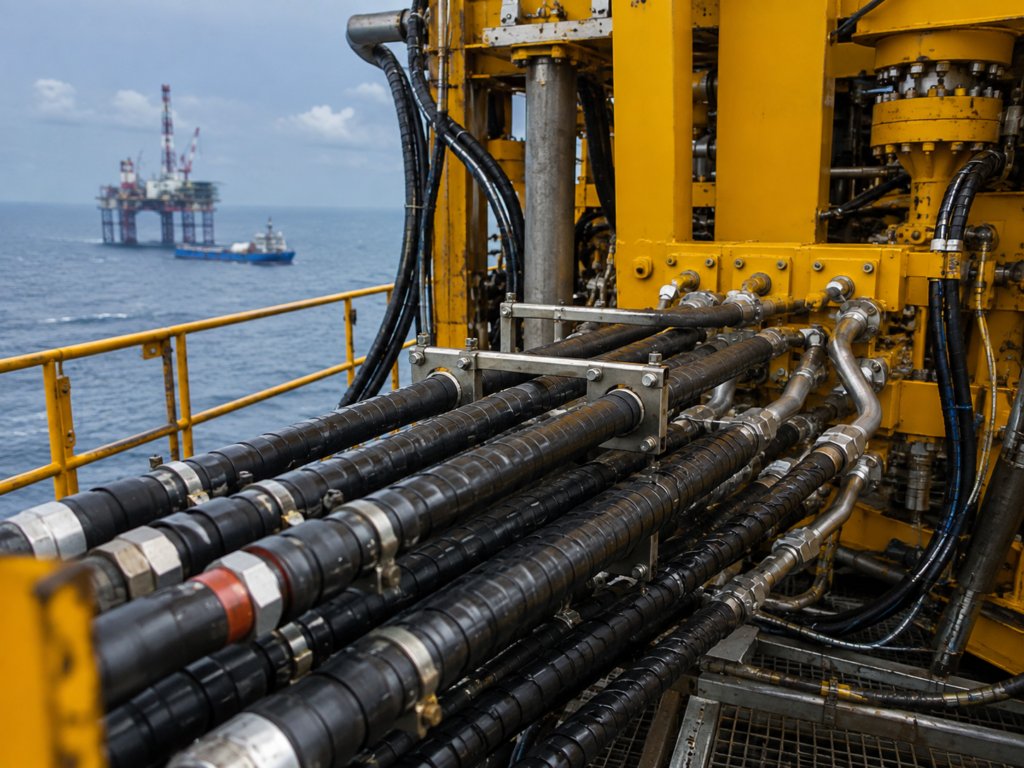
What to check for an offshore rotary or vibrator hose?
- Draw the installed route through the full operating travel. Do not calculate length from a straight-line distance alone.
- Check the manufacturer’s minimum bend radius against the worst position, including start-up, tripping and maintenance conditions.
- Define water-based or oil-based mud, solids, additives, cleaning fluids and maximum temperature so the liner can be reviewed.
- Specify End A and End B, including mating connection, size, pressure class, orientation and any handling or lifting features.
- Confirm whether the assembly needs built-in or crimped construction, FSL, ABS or other project documentation, third-party witness, and replacement-hose interchangeability.
For route design, use the minimum bend radius guide as a starting point, then use the controlled value for the exact hose assembly.
4. API 16C Choke and Kill Hose for Well-Control Lines
A flexible choke and kill hose is used where a pressure-rated well-control flow path must accommodate movement, vibration or installation variation. Typical offshore locations include connections between BOP equipment and choke or kill manifolds, riser-to-manifold arrangements and topside well-control packages.
The governing product category is API Spec 16C. This is a flexible choke and kill hose, not a hydraulic BOP control hose. Keeping the names separate prevents a serious specification error: API 16C addresses choke and kill equipment and flexible choke/kill lines, while API 16D addresses control systems used to operate BOP equipment.
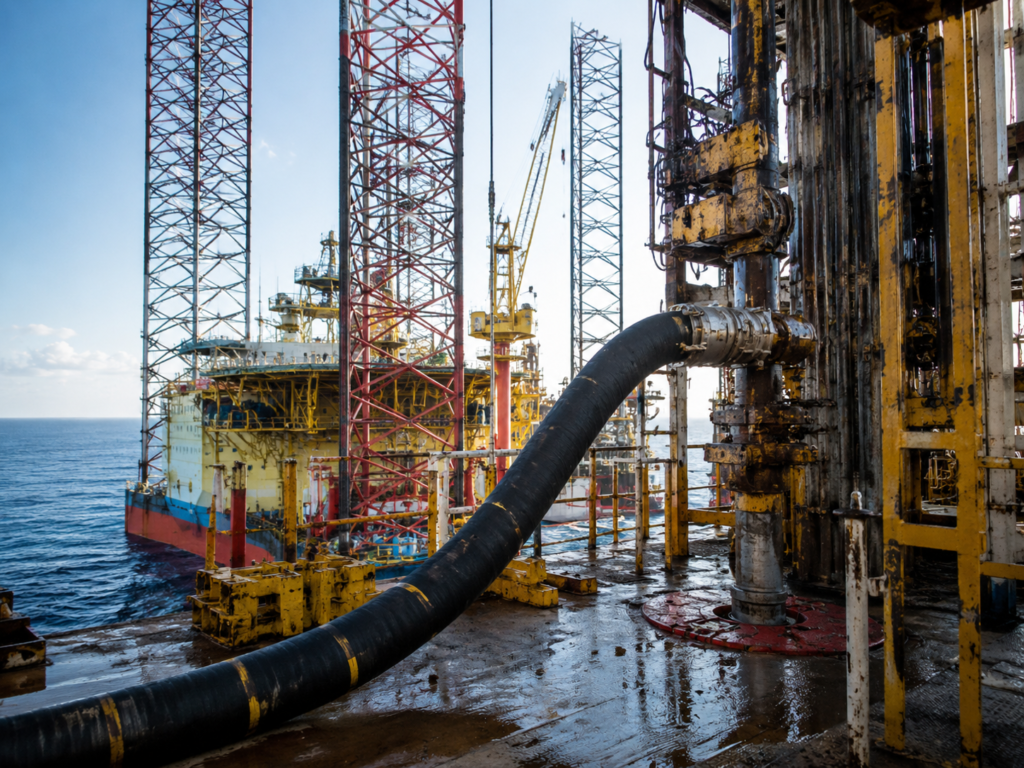
What to define for an API 16C line?
- Choke or kill service position, normal and maximum working pressure, expected transients and bore.
- Well fluid, gas content, solids, additives, H2S/CO2 conditions, temperature and decompression profile.
- Required Flexible Specification Level (FSL), applicable edition and any operator or classification-society requirements.
- Built-in or crimped termination, armored or unarmored protection, overall length, movement and bend radius.
- End A and End B details: flange, hub or hammer union; size; pressure class; material; sealing profile; coating; orientation and drawing reference.
- Required qualification, production test, NDE, material traceability, dimensional, marking and third-party release records.
If the line will see sour fluids, use the sour-service oilfield hose guide to build the service envelope. For connection data, follow the API 16C end-connection checklist instead of writing “standard ends” in the RFQ.
5. API 16D BOP Control Hose
A BOP control hose carries hydraulic control fluid between the control system and BOP functions. Its job is to transmit a control command reliably; it is not a choke or kill flow line and should not be selected from an API 16C table.
Alienfrac’s BOP control hose family includes armored and unarmored crimped models. The current A842 product page identifies API Spec 16D, 3,000 psi and 5,000 psi working-pressure families, 3/8-2 inch IDs and a -40°C to +121°C temperature range.
It also publishes a model-specific flame-resistance statement. Before using any of these values in a project specification, confirm the exact A841 or A842 configuration, test method, certificate scope, fluid compatibility and required fire-performance acceptance criteria.
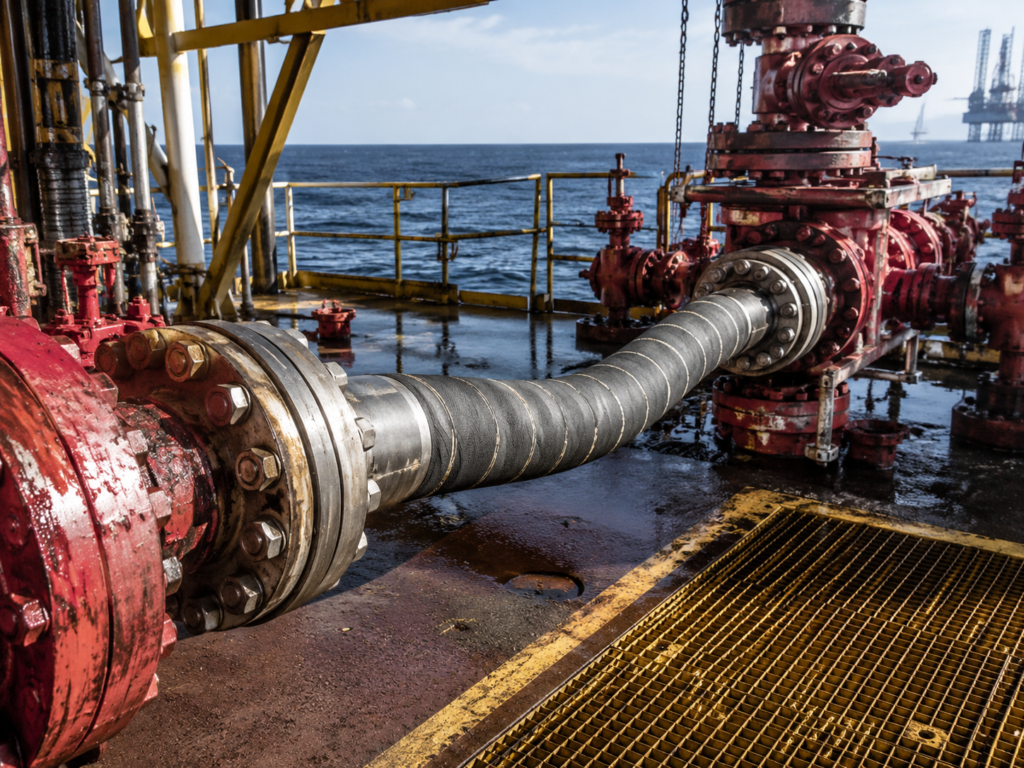
What matters beyond pressure?
- Control-fluid compatibility, including any environmentally acceptable hydraulic fluid used offshore.
- Fire exposure requirement and the evidence that applies to the exact hose construction and end assembly.
- Routing away from heat, sharp edges, crush points and areas where failed equipment could strike the line.
- Whether armor is required for impact or abrasion protection, balanced against added weight, outside diameter and handling effort.
- Connection cleanliness, end orientation, support and bend control so the line does not carry avoidable torsion or side load.
6. Offshore-Specific Selection Factors
Corrosion and external protection
Separate internal compatibility from external corrosion protection. The liner sees the process or control fluid; the cover, reinforcement, armor, end fittings, clamps and support hardware see the offshore environment. Specify coating systems, fitting materials and preservation according to the actual exposure zone.
Stainless material, plating or armor can help in the right design, but none of them makes a damaged or poorly routed assembly maintenance-free.
Movement, bend radius and torsion
A hose should flex in the plane and range intended by its design. It should not be pulled tight, twisted to make the second connection line up, bent sharply at the coupling or clamped so close to the end that movement concentrates in one short section.
Provide route drawings, equipment travel and connection orientation to the supplier. If a route changes during installation, recheck length and bend radius before pressurizing.
Temperature, fluids and sour service
State fluid temperature and ambient temperature separately. Include start-up minimums, normal operating values and credible short-duration upsets. List every fluid that may contact the hose, including cleaning chemicals and additives.
For H2S or CO2 exposure, a simple “sour service” note is too vague; define composition, pressure, water phase, temperature, exposure duration and decompression conditions. The oilfield hose temperature and fluid-compatibility guide provides additional specification prompts.
Connections and interfaces
Most field mismatches happen at interfaces. Specify each end independently and attach a drawing when the profile is not unambiguous. Check pressure class, material, seal, face or hub dimensions, coating, clocking and wrench or clamp clearance. The hose rating does not correct an underspecified mating connection.
Inspection access and replacement logistics
Plan how the full hose length, cover and end terminations will be seen and reached. A route that hides wear behind structure or makes removal impractical can defeat an otherwise sound inspection plan. For critical positions, define spare strategy, storage conditions, lifting method, identification and the records needed to install a replacement without repeating the entire engineering review.
7. How to Specify an Offshore Drilling Hose for RFQ
A useful RFQ gives suppliers enough information to quote the same scope. Use the following checklist and attach the relevant rig layout, connection drawings and document requirements. For a fuller data-sheet structure, see the oilfield hose specification guide.
- Application and exact installation position
- Applicable standard and edition: API 7K, API 16C, API 16D or project-specific requirement
- Required FSL or other specification level, where applicable
- Normal and maximum working pressure; surge or transient conditions; required test criteria
- Hose ID, required flow or pressure-drop constraint, and overall length definition
- Minimum and maximum fluid and ambient temperatures
- All media: mud, kill fluid, well fluid, hydraulic fluid, cement, gas, solids, additives and cleaning chemicals
- H2S, CO2, water phase, chlorides and decompression conditions where sour service applies
- Routing, available bend radius, movement, vibration, axial load, torsion risk and support points
- External exposure: salt spray, immersion, UV, ozone, oil, chemicals, abrasion, impact and fire
- End A and End B: type, size, pressure class, material, seal/profile, coating, orientation and drawing
- Built-in or crimped construction; armored or unarmored protection, if specified by the project
- Quantity, delivery location, required date, packing, preservation and spare-hose requirements
- Certificate scope, inspection and test plan, hydrostatic record, material traceability, NDE, dimensional report, marking and third-party witness requirements
Pressure terminology: Working pressure, proof or test pressure, and burst/design-verification values are not interchangeable. State the required operating duty and governing standard; verify the approved values for the exact assembly.
8. Common Offshore Hose Selection Errors
| Selection error | Better action |
| Using one “BOP hose” label for two different functions | Separate API 16C choke/kill flow lines from API 16D hydraulic control hoses in the equipment list, drawings and RFQ. |
| Choosing by pressure alone | Pressure is only one input. Bore, media, temperature, movement, connections, construction, fire duty and documentation can change the correct assembly. |
| Leaving the end connections until after hose selection | Treat the ends as part of the pressure-containing assembly from the start. Confirm both interfaces and orientation before quotation. |
| Routing below minimum bend radius | Rework the route or hose length. Armor, clamps or a heavier hose do not make overbending acceptable. |
| Assuming armor solves every external risk | Armor can improve protection in a suitable design, but it adds weight and diameter and does not correct torsion, poor support or hidden corrosion. |
| Copying a generic inspection interval | Base intervals and acceptance criteria on the governing standard, manufacturer instructions, operator program, service severity and inspection history. |
| Accepting a certificate without checking scope | Match the certificate and test record to the manufacturer, facility, product category, model, size, pressure, FSL and assembly supplied. |
9. Inspection, Testing and Replacement Planning
An offshore hose plan should define what is checked, when it is checked, who is competent to make the decision and what removes an assembly from service. Avoid universal calendar intervals that ignore duty and condition. Build the plan around the applicable standard, manufacturer instructions, operator requirements, service severity and previous findings.
Pre-use and routine visual checks
- Cracks, cuts, abrasion, soft spots, bulges, blisters, exposed reinforcement or heat damage on the cover.
- Corrosion, coating loss, leakage, seal damage, loose hardware or movement at end fittings.
- Kinks, flattening, twist, sharp bends, incorrect clamp positions or contact with structure and deck edges.
- Changed routing, unexpected movement, damaged protective devices or missing identification.
Records and testing
Keep a unique assembly ID, service position, installation date, inspection history, test records, repairs, exposure events and disposition. Hydrostatic testing can verify pressure integrity at the test conditions, but it does not by itself prove fatigue life, chemical compatibility, sour-service durability or future fitness.
Use the hose inspection and hydrotest planning guide to structure the program, then apply the project’s controlled procedure.
10. How to Verify Alienfrac Testing and Certification Evidence
For critical offshore service, verify evidence at three levels rather than relying on a general supplier statement.
| Evidence level | What to verify |
| Company and facility | Current management-system and API Monogram certificates, licensed product scope, issuing body, facility name and validity. Start with Alienfrac’s certifications page, then request controlled copies. |
| Product design | Current model datasheet, standard/edition, size-pressure matrix, temperature, FSL, liner, reinforcement, end design, minimum bend radius and qualification evidence. |
| Your supplied assembly | Nameplate/marking, dimensional report, pressure-test record, material and end-connection traceability, inspection release, deviations and third-party records required by the purchase order. |
Alienfrac publishes API and company certificates together with product-family and model pages. Use those pages to shortlist a hose, then request the current controlled documents for the exact assembly. The API hose certificate checklist can help procurement teams close gaps before release.
11. A Practical Selection Workflow
- Identify the service position and fluid path on the rig.
- Choose the correct hose family and governing standard: API 7K, API 16C or API 16D.
- Define the complete pressure, temperature, media, movement and external-exposure envelope.
- Resolve length, minimum bend radius, support and End A/End B interfaces from the actual layout.
- Compare only assemblies whose certification, tests, documents and supplied scope meet the same RFQ.
- Complete engineering review, inspection planning and replacement/spare planning before installation.
FAQ
What is the best hose for offshore drilling?
There is no universal best hose. The correct assembly depends on its function. Use an API 7K rotary or vibrator hose for the relevant mud-circulation position, an API 16C flexible hose for choke or kill lines, and an API 16D hose for BOP hydraulic control. Then confirm the complete service envelope and exact product evidence.
Is an API 16C choke and kill hose the same as a BOP control hose?
No. An API 16C choke and kill hose carries well-control fluids in choke or kill lines. An API 16D BOP control hose carries hydraulic fluid used to operate BOP functions. Both may belong to the wider well-control system, but they are not interchangeable.
Which offshore hose factors are easy to miss in an RFQ?
Movement through the full equipment travel, minimum bend radius, end orientation, salt exposure, deck abrasion, sour-service details, fire duty, cleaning chemicals, inspection access and document scope are commonly underspecified.
Should an offshore drilling hose always be armored?
No. Armor may be useful where abrasion or impact risk justifies it, but it adds outside diameter and weight. A protected route may use an approved unarmored design. The choice should follow the project risk assessment and the exact hose construction.
How often should offshore drilling hoses be replaced?
Do not use one universal replacement period. Follow the applicable standard, manufacturer instructions and operator hose-management program, then adjust for service severity, pressure cycles, movement, environmental exposure, inspection results and exceptional events.
What should be sent to Alienfrac for a hose recommendation?
Send the application, standard, working pressure, ID, length, media, temperatures, routing and movement, minimum bend radius, external exposure, sour/fire requirements, both end connections, quantity, delivery location and required certificates or test records.
Choose the Hose by Function, Then Verify the Assembly
A reliable offshore drilling hose specification begins with one clear question: what must this line do on the rig? Once the function is fixed, the correct standard, service data, route, ends and evidence become much easier to define.
Send Alienfrac your application, operating envelope, layout and documentation requirements. The engineering team can review the request against the current API 7K rotary and vibrator hose, API 16C choke and kill hose and API 16D BOP control hose ranges before preparing a project-specific recommendation and quotation.