
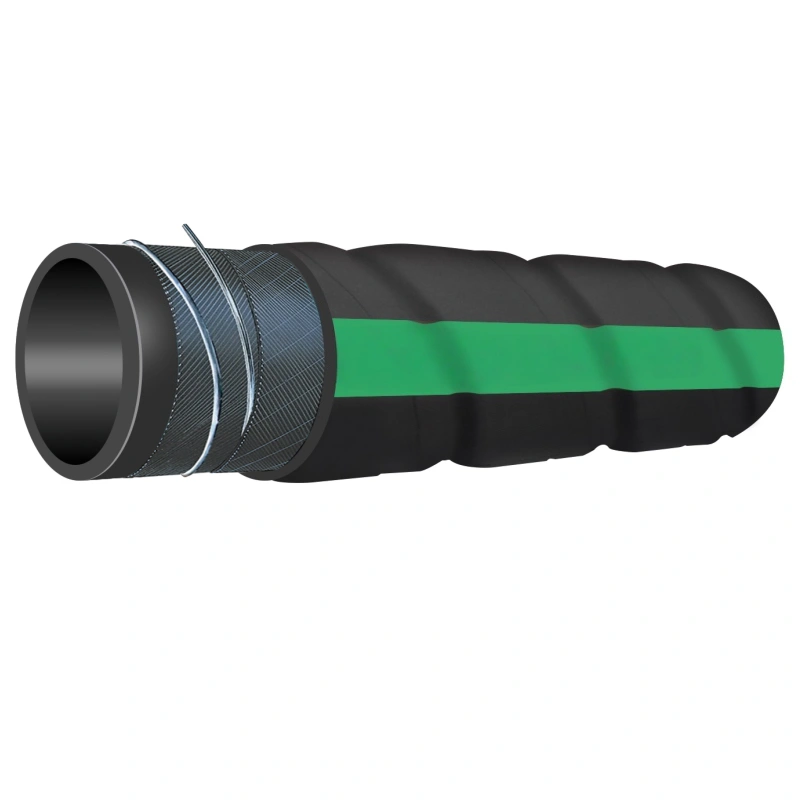
Choosing oilfield hose inner tube materials is not a matter of picking the polymer with the longest list of benefits. The liner sits directly in the flow path, but it works as one part of a complete hose assembly. Fluid chemistry, solids, temperature, gas exposure, pressure cycling, movement, end connections and the required standard all change the decision.
A UHMWPE hose liner may be a strong starting point for abrasive slurry or selected chemical service. HNBR may be useful within a qualified construction where heat, oil or aggressive oilfield media are involved.
Synthetic rubber tubes remain practical in many drilling and well-control duties. None of those material names, on its own, establishes the hose working pressure, temperature rating or sour-service suitability.
This guide shows how to screen oilfield hose liner materials by service and then connect the material choice to a real hose family. For final selection, use the approved datasheet and ask the manufacturer to review the full operating envelope.
Key Takeaways
- The liner is the primary barrier between the conveyed fluid and the hose body, but the complete assembly carries the pressure load.
- Select a compound and construction for the actual fluid mixture, not for one chemical name in isolation.
- UHMW or UHMWPE is often considered where abrasion, slurry or selected chemical resistance matters, but compatibility still needs to be checked at operating temperature.
- HNBR is a material family, not a universal sour-service approval. H2S service requires assembly-level review and qualification.
- Working pressure belongs to a specific hose model and size. It does not belong to NBR, HNBR or UHMWPE as a generic material.
- A useful RFQ includes fluid composition, solids, temperature, pressure, motion, ends, cleaning method and required documentation.
What Does the Inner Tube or Liner Do?
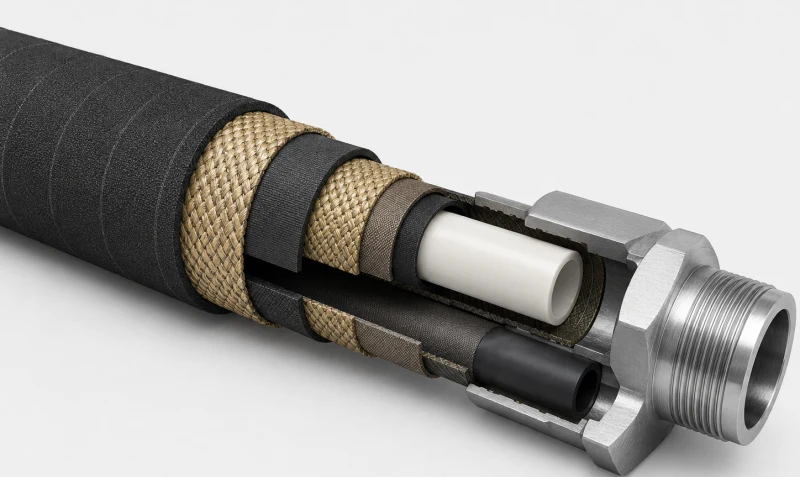
The inner tube or liner forms the hose’s primary conveyed-fluid barrier. It faces the fluid before any reinforcement or cover does. In service, that means direct exposure to base fluids, acids, hydrocarbons, water, inhibitors, cement additives, drilling-mud chemicals, entrained sand and other solids.
It also sees velocity, turbulence, pressure changes and temperature. In gas or multiphase service, molecules may permeate into the tube. If pressure is released too quickly, absorbed gas can expand inside the material and contribute to blistering or internal damage. In abrasive slurry service, wear can gradually reduce liner thickness even when the hose still looks sound from the outside.
The liner does not work alone. Reinforcement provides most of the structural capacity required to resist internal pressure. Bonding layers keep the tube, reinforcement and cover acting as a controlled construction. The cover protects against weather, oil, abrasion and handling. End fittings and their transitions complete the pressure boundary.
A liner with good chemical resistance cannot compensate for an unsuitable reinforcement design, damaged bond, wrong coupling or poor routing.
Why Polymer Name Alone Is Not Enough?
Two compounds from the same polymer family can behave differently. Formulation, cure system, hardness, fillers, plasticizers, reinforcement interface and manufacturing controls all influence the result. Exposure conditions matter just as much: a material that performs acceptably in one fluid at room temperature may swell, harden, soften or lose strength in a mixed fluid at a higher temperature.
This is why a generic chemical-resistance chart should be used for screening, not as a final approval. The chart rarely captures concentration, contamination, pressure, exposure time, solids, cleaning chemicals or the way the liner is bonded into the hose.
When the application contains H2S or CO2, the review also needs gas exposure and decompression conditions. See the sour-service oilfield hose guide for that qualification boundary.
Pressure must be handled the same way. A statement such as “HNBR is rated to 15,000 psi” is technically misleading. A named AlienFrac assembly may use an HNBR-containing construction and carry a 15,000 psi working-pressure rating, but the rating comes from the complete design: hose ID, reinforcement, layer count, coupling, manufacturing process, test basis and applicable specification.
Oilfield Hose Liner Materials Used in Real Hose Constructions
UHMW / UHMWPE Liners
UHMW and UHMWPE refer to ultra-high-molecular-weight polyethylene. In oilfield hose construction, this liner direction is commonly considered when abrasion and selected chemical exposure are important. Its smooth surface can also be useful in full-flow constructions carrying cement slurry, drilling mud or fracturing fluids.
AlienFrac uses UHMW with synthetic rubber in several published hose constructions. The A802C crimped cement hose lists a UHMW and synthetic-rubber, full-flow tube for water- and oil-based cement slurry. The A802D crimped rotary and vibrator hose and A804D built-in version use the same general tube description for drilling-mud service.
That does not make UHMWPE the automatic choice for every abrasive fluid. Ask what chemicals are blended into the slurry, how much solid loading is present, the particle shape, flow velocity, operating temperature, cleaning method and whether the hose will see continuous flexing.
Gas permeation, decompression response and bond performance also need attention where the duty involves gas or multiphase exposure.
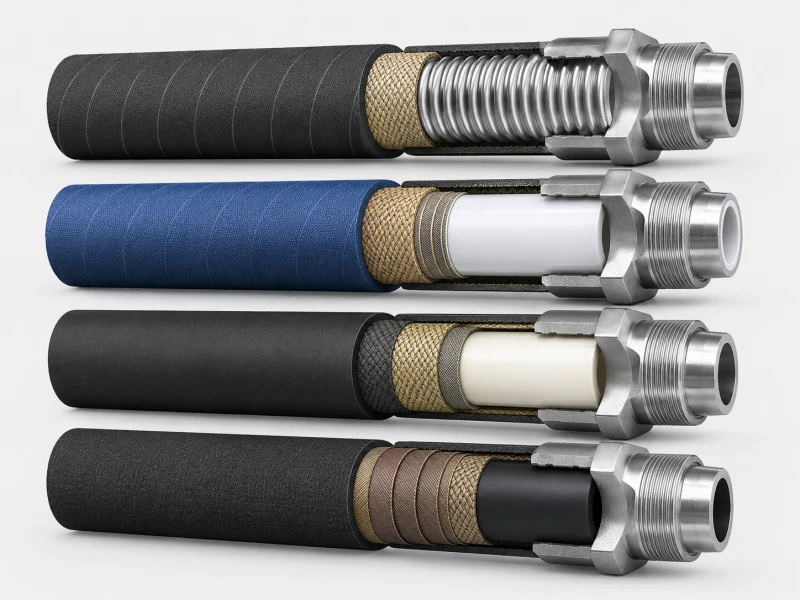
HNBR in Oilfield Hose Constructions
HNBR, or hydrogenated nitrile rubber, is used in oilfield sealing and hose compounds because a properly formulated grade can offer a useful balance of oil resistance, heat resistance and mechanical properties. The important phrase is “properly formulated.” A generic HNBR label does not tell you the acrylonitrile level, cure system, hardness, ageing response or decompression performance of the actual compound.
AlienFrac catalog references include UHMW plus HNBR constructions for selected high-pressure fracturing assemblies, including A801N/FN and A804F families. A useful HNBR hose liner decision therefore starts with the model and service envelope. Treat those references as a route to model-level review, not as a blanket claim that every HNBR hose is suitable for acid, gas or sour service.
Synthetic Rubber Tubes
Synthetic rubber is not one single material. Product pages may use the term for a proprietary compound selected around drilling mud, cement, oilfield additives, abrasion and flexibility. For choke-and-kill service, the API 16C choke and kill hose range describes an abrasion- and drilling-fluid-resistant inner-tube compound within a complete well-control assembly.
Final suitability still depends on the specified model, pressure, temperature, fluid and certification scope.
Rubber tubes can provide flexibility and strong bonding within a reinforced hose construction. Their performance must be judged by the actual compound and test evidence rather than by the word “rubber.”
NBR and Other Elastomers
NBR is widely used in industrial fluid-handling contexts where resistance to petroleum oils and fuels is needed. It is useful background for oilfield hose material selection, but it should not be attached to a specific AlienFrac model unless the approved product documentation names it.
The same caution applies to other elastomers: the family name helps narrow candidates; the compound data and complete assembly evidence close the decision.
How to Select an Oilfield Hose Liner by Service?
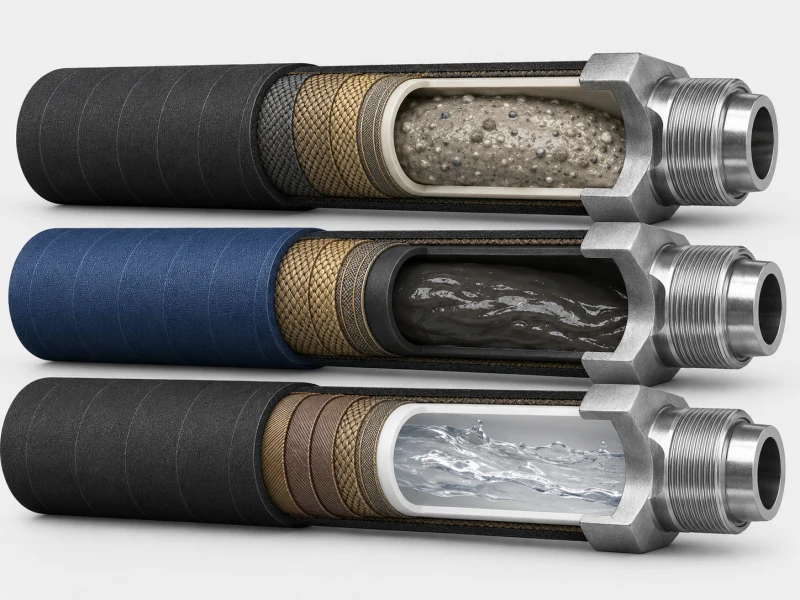
Start with the service, not the material. The matrix below is a practical first screen. It points you toward a construction family and highlights the information that can change the recommendation.
| Service / media | Main concern | Liner direction | Verify before selection | AlienFrac example |
| Cement slurry | Abrasion, additives, clean-out | UHMW / synthetic-rubber construction | Slurry chemistry, solids, temperature, velocity, cleaning method | A802C / A804C |
| Drilling mud | Abrasion, mud chemistry, flexing | Model-specific UHMW / rubber construction | Mud system, solids, temperature, pressure cycling, motion | A802D / A804D |
| Choke and kill | Well-control pressure, fluid, possible gas or sour exposure | Qualified complete construction | Exact media, temperature, pressure, gas exposure, FSL / scope | A831-A834 family |
| Fracturing fluid | Abrasion, acid and additives | UHMW / HNBR-type construction where qualified | Full chemical blend, proppant, temperature, duty cycle, clean-out | A801N/FN / A804F family |
| Sour-service fluid | H2S, CO2, permeation and decompression | Do not select from polymer name alone | Full service envelope, compound evidence, fitting metallurgy, qualification | Application review required |
Selection boundary: This matrix is for preliminary selection only. Final liner and hose assembly selection must be reviewed against the actual fluid composition, temperature, pressure, mechanical duty, end connections and required qualification.
AlienFrac Hose Liner & Product Mapping
The following mapping keeps material claims tied to real constructions. Values shown are assembly-level information from the listed product family or catalog reference. Confirm the exact part number and current approved datasheet before publishing a purchase specification.
| Model / family | Actual tube or liner | Typical service | Assembly temp. | Assembly working pressure | Standard / scope |
| A802C | UHMW + synthetic rubber, full flow | Cementing | -20 to +121 C | 10k / 15k / 20k psi by part number | API 7K; ABS listed |
| A804C | UHMW + synthetic rubber, full flow | Cementing | Confirm current datasheet | By part number | API 7K scope; verify |
| A802D | UHMW + synthetic rubber, full flow | Rotary / vibrator drilling | -20 to +121 C | By part number | API 7K; ABS listed |
| A804D | UHMW + synthetic rubber, full flow | Rotary / vibrator drilling | -20 to +121 C | 5k / 7.5k psi by part number | API 7K; ABS listed |
| A833 / A834 | Model-specific abrasion-resistant rubber compound | Choke and kill / well control | Confirm model and service | 5k / 10k / 15k psi family; confirm model | API 16C scope; verify assembly |
| Acid-frac built-in family | UHMW + synthetic rubber, full bore / full flow | Acid and sand fracturing | -29 to +100 C | 15k / 20k psi by part number | Catalog / project scope |
| A801N/FN / A804F | UHMW + HNBR catalog construction | High-pressure fracturing | Confirm current datasheet | 15k / 20k psi by model | Catalog / project scope |
Do not copy a rating from one row to another. Pressure and temperature belong to the stated assembly and part number. Standard markings and certification scope must be confirmed for the supplied configuration.
How Fluid, Temperature and Abrasion Change Material Selection?
Define the Whole Fluid, Not Just Its Base Name
“Drilling mud,” “cement slurry” and “frac fluid” are starting labels, not complete compatibility descriptions. A water-based cement slurry may still contain accelerators, retarders, dispersants and cleaning chemicals. A fracturing fluid may include acid, friction reducer, biocide, scale inhibitor, surfactant and proppant. Ask for the maximum concentration of each component, including flush and upset fluids.
Use Assembly Temperature, Not a Generic Polymer Limit
Temperature changes swelling, hardness, permeation, ageing and bond performance. It can also affect the pressure capability of a complete assembly. Separate minimum start-up temperature, maximum continuous fluid temperature, short-duration upset temperature and ambient exposure. Then compare those values with the approved model rating. The oilfield hose temperature rating guide explains this distinction in more detail.
Treat Abrasion as a System Problem
Liner material matters, but wear rate also depends on solids concentration, particle hardness and shape, velocity, turbulence, hose bends and cleaning practice. A tight bend can concentrate impact on one side of the liner. Poor flushing can leave solids that harden or attack the tube between jobs.
If abrasion is a primary risk, include expected flow rate, particle size and solids loading in the RFQ, and agree on inspection or retirement criteria.
Include Gas Exposure and Decompression
Gas can permeate into an elastomer or polymer during pressurized service. If the pressure falls quickly, the gas may expand faster than it can escape. The result can be blistering, internal cracking or bond damage. Specify normal shutdown and emergency blowdown rates, not only maximum pressure. This is especially important for H2S, CO2 and multiphase service.
Common Inner Tube / Liner Failure Modes
Liner damage usually points to a mismatch between material, operating conditions or mechanical duty. Watch for these patterns:
- Swelling: dimensions change after the compound absorbs part of the conveyed fluid.
- Softening or hardening: the liner loses mechanical properties, flexibility or sealing behavior.
- Chemical attack: surface cracking, tackiness, erosion or loss of material follows incompatible exposure.
- Abrasion: solids or high-velocity flow remove material, often unevenly around bends.
- Permeation: gas or liquid migrates through the liner and affects adjacent layers.
- Blistering or decompression damage: absorbed gas expands during a rapid pressure drop.
- Bond degradation: separation develops between liner, reinforcement or other layers.
External appearance alone may not reveal early internal damage. Establish inspection and retirement rules for the actual duty, and use the oilfield hose failure modes guide when investigating damage.
What Information Should You Send With an RFQ?
A useful request for quotation gives the manufacturer enough information to reject unsuitable constructions, not just enough to calculate a price. Send the following in one package:
- Hose function and applicable equipment: cementing, rotary/vibrator, choke and kill, fracturing, transfer or another duty.
- Required inside diameter, overall length and quantity.
- Normal and maximum working pressure, surge conditions and any specified test pressure.
- Minimum, continuous maximum and short-duration fluid and ambient temperatures.
- Complete fluid composition, concentrations, phase, pH where relevant, solids loading and particle size.
- H2S, CO2 or other gas exposure, including concentration, absolute pressure, exposure duration and decompression rate.
- Static or dynamic duty, bend radius, routing, vibration, torsion, axial load and expected cycles.
- End A and End B connection type, size, pressure class, metallurgy, seal and orientation.
- Cleaning, flushing and storage procedure, including chemicals used between jobs.
- Required standard, edition, FSL or other scope, third-party witness, inspection and document package.
If you are still building the datasheet, use the oilfield hose specification guide to organize size, pressure, temperature, ends and documentation. You can also review the full oilfield hose range or go directly to the API 7K hose family, cement hose range, API 16C choke and kill hose or frac hose range.
FAQ
What is the inner tube of an oilfield hose?
It is the primary material layer in contact with the conveyed fluid. It helps resist the specified media, temperature, abrasion and permeation environment, while the reinforcement, bonding, cover and end fittings complete the hose assembly.
Is UHMWPE better than rubber for oilfield hose liners?
Not in every service. UHMWPE can be a useful direction for abrasive slurry and selected chemical exposure. A rubber compound may provide a better balance in another duty. Compare the actual fluid, temperature, solids, gas exposure, movement and approved hose construction.
Is HNBR suitable for sour-service hose?
HNBR may be part of a sour-service construction, but the polymer name is not an approval. The compound, gas composition, temperature, pressure, water phase, decompression conditions, fitting materials and complete assembly qualification must be reviewed together.
Does liner material determine hose pressure rating?
No. Working pressure is assigned to the complete hose assembly and specific part number. Reinforcement, hose ID, layer count, coupling design, manufacturing process and qualification all contribute to the rating.
How do I choose a liner for cement or drilling mud?
Start with slurry or mud chemistry, solids loading, particle size, temperature, flow velocity, pressure cycling, movement and clean-out method. UHMW with synthetic rubber is used in AlienFrac A802C/A804C cement and A802D/A804D drilling constructions, but the final model must match the full duty.
What causes an oilfield hose liner to fail?
Common causes include chemical incompatibility, temperature outside the assembly limit, abrasive wear, permeation, rapid decompression, excessive bending, poor cleaning and degradation of the bond between layers.
What does AlienFrac need to select a liner?
Send the hose function, dimensions, complete fluid composition, solids, temperatures, working and surge pressures, gas exposure, motion and routing, end connections, cleaning method, required standard and document list.
Conclusion
Selecting oilfield hose inner tube materials begins with the service envelope and ends with an approved assembly. Use UHMWPE, HNBR, NBR and synthetic rubber as screening categories, then verify the exact compound and construction against the fluid, temperature, abrasion, gas exposure and mechanical duty. Keep pressure, temperature and standard claims tied to the specific model and part number.
For an application review, send AlienFrac the fluid composition, operating pressure and temperature, hose ID and length, end connections, routing conditions and required documentation. That information lets the engineering team recommend a liner and hose family without relying on material-name shortcuts.