
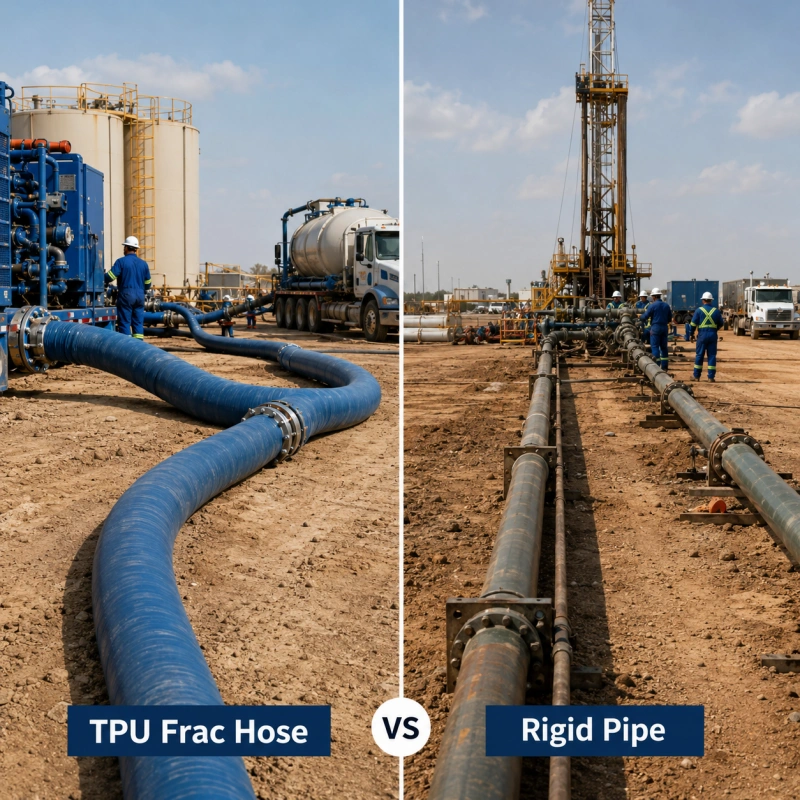
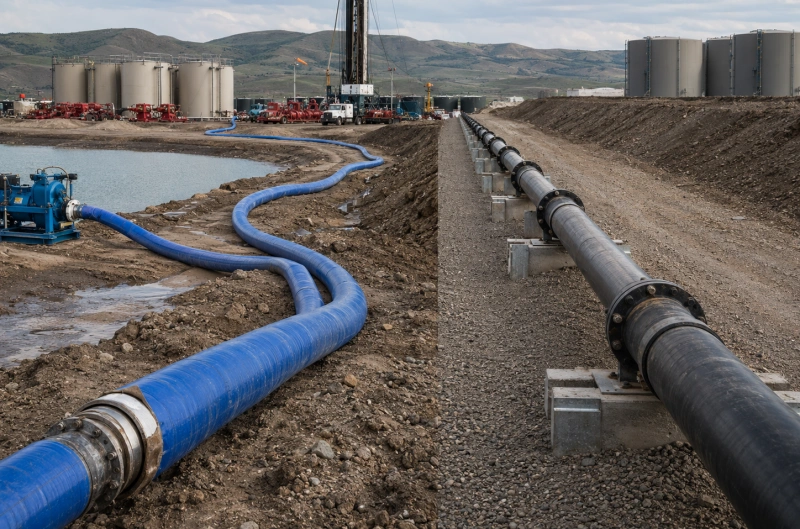
Comparing TPU frac hose vs rigid pipe is not really a contest between a “modern” product and an “old” one. It is a question of duty. A flexible TPU layflat line can be the practical choice for temporary frac-water or compatible produced-water transfer, while rigid HDPE or steel pipe may be the stronger fit for a permanent, protected mainline.
The decision changes with the route, pressure, flow, water chemistry, expected service life, deployment frequency, and connection plan. In many shale operations, the best answer is a hybrid system: rigid pipe where the route is stable and TPU hose where the layout moves with the job.
Quick Answer: Flexible Pipe vs Rigid Pipe
Choose a TPU layflat hose when you need fast deployment, compact transport, long flexible sections, and frequent relocation. Choose rigid pipe when the line is intended to stay in place, needs strong mechanical protection, or forms part of fixed infrastructure.
Use both when a permanent trunk line must feed changing pads, tanks, or temporary transfer routes.
- TPU layflat hose usually fits temporary or mobile surface water-transfer systems.
- Rigid HDPE or steel pipe usually fits long-term, fixed routes.
- Neither option is automatically safer or cheaper. Installation quality, pressure control, route protection, inspection, and fluid compatibility still govern the result.
- A water-transfer layflat hose is not the same product as a reinforced 15K or 20K high-pressure frac hose. Select by the actual service class.
TPU Layflat Hose vs Rigid Pipe at a Glance
| Decision factor | TPU layflat frac water hose | Rigid HDPE or steel pipe |
| Best fit | Temporary, mobile, or frequently re-routed water transfer | Permanent or semi-permanent mainlines |
| Deployment | Reel- or coil-based payout; fewer handling steps on suitable routes | Joint alignment plus fusion, welding, flanging, or mechanical assembly |
| Transport and storage | Long lengths pack into compact coils or reels | Straight pipe sections need more yard and transport space |
| Terrain response | Follows gradual curves and uneven ground within routing limits | Needs planned alignment, supports, trenching, or civil preparation where required |
| Connections | Long sections can reduce the number of joints; couplings must match pressure and handling duty | Joint count depends on pipe length and joining method; quality control at each joint is critical |
| Mechanical protection | Needs protection from dragging, sharp edges, traffic, crushing, and unsupported fittings | More resistant to crushing and impact when correctly specified and installed |
| Relocation | Designed for retrieval and reuse when condition remains acceptable | Relocation is usually slower and may require cutting or disassembly |
| Maintenance approach | Inspect the hose body, couplings, abrasion zones, kinks, and pressure history | Inspect joints, supports, corrosion or damage, settlement, and leak points |
| Cost pattern | Often favors short campaigns and changing routes | Often favors stable routes and long service periods |
This comparison is a selection guide, not a substitute for the exact hose datasheet, pipe design basis, hydraulic calculation, or project risk review.
Start by Defining What “Frac Hose” Means
The phrase frac hose covers several different products. A TPU layflat frac water hose moves fresh water, treated water, recycled water, or compatible produced water at transfer-system pressures. A reinforced high-pressure frac hose connects pumps, manifolds, and pressure equipment. Acid-service assemblies add another material-compatibility problem. These products are not interchangeable.
If your job is surface water transfer, start with the TPU frac water supply hose range. If the duty involves high-pressure fracturing media, compare the broader frac hose product paths and state the maximum working and surge pressure before choosing a construction.
Where TPU Frac Water Hose Has the Advantage?
Fast Mobilization on Temporary Routes
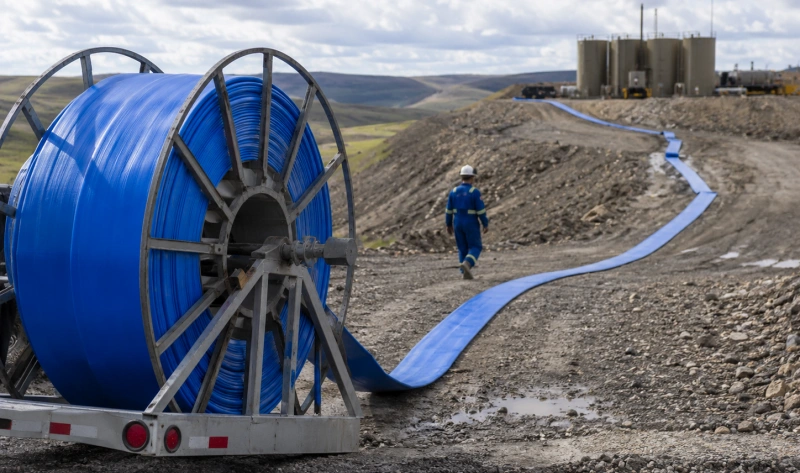
A TPU layflat hose can be paid out from a reel or handled in long coiled sections. That removes much of the alignment and joining work associated with a rigid line. The benefit is most visible when a crew must build a transfer route quickly, retrieve it after a campaign, and move it to the next pad.
Speed still depends on route access, reel capacity, section length, coupling method, road crossings, crew training, and the site’s pressure-test procedure. Treat “fast deployment” as a system outcome, not a guaranteed number of miles per shift.
Compact Logistics and Reuse
Long flexible sections place more transfer length into a smaller storage footprint than straight pipe sticks. This can reduce the number of handling moves and simplify yard planning. After the job, a serviceable hose can be drained, cleaned, inspected, retrieved, and redeployed.
Reuse is conditional. A hose that has been overpressured, kinked, crushed, chemically attacked, badly abraded, or fitted with a damaged coupling should not return to service just because it still holds water. Inspection criteria and retirement rules belong in the operating procedure.
Adaptability to Changing Shale Layouts
Temporary water routes rarely stay perfectly straight. A flexible hose can follow gradual turns, lease roads, and uneven ground without the same amount of civil preparation as a rigid line. That makes it useful for multi-well pads, tank connections, bypasses, and emergency water movement.
Flexibility does not mean unrestricted routing. Keep the hose above its minimum bend radius, protect it at crossings and sharp surfaces, support heavy end fittings, and prevent vehicle traffic from crushing the line.
Long Sections with Fewer Connection Points
Layflat hose is available in long sections, so a route may need fewer field joints than a line assembled from short rigid sections. Fewer joints can simplify installation and inspection. It does not eliminate leak risk: every coupling must be rated for the assembly, installed correctly, restrained where required, and checked during operation.
Where Rigid Pipe Still Makes Better Sense?
Permanent Mainlines and Stable Routes
If the route will operate for years and is unlikely to move, rigid HDPE or steel pipe may justify its slower installation. A fixed line can be engineered around permanent supports, buried sections, road crossings, isolation points, and access for inspection. The upfront work becomes part of a long-life asset rather than a repeated mobilization cost.
Mechanical Protection and Controlled Alignment
Rigid pipe can offer stronger resistance to crushing, localized impact, and external loads when the material, wall thickness, supports, and installation method are correctly designed. Steel may be chosen where higher pressure, temperature, structural strength, or fire exposure drives the design. HDPE may suit water service where fusion quality, temperature, pressure class, and chemical compatibility are acceptable.
Rigid does not mean maintenance-free. Steel can corrode; HDPE can be damaged by gouging, slow crack growth, excessive temperature, or poor fusion; and any line can fail at a joint, support, valve, or transition. The inspection plan must match the chosen material.
A Hybrid System Often Wins
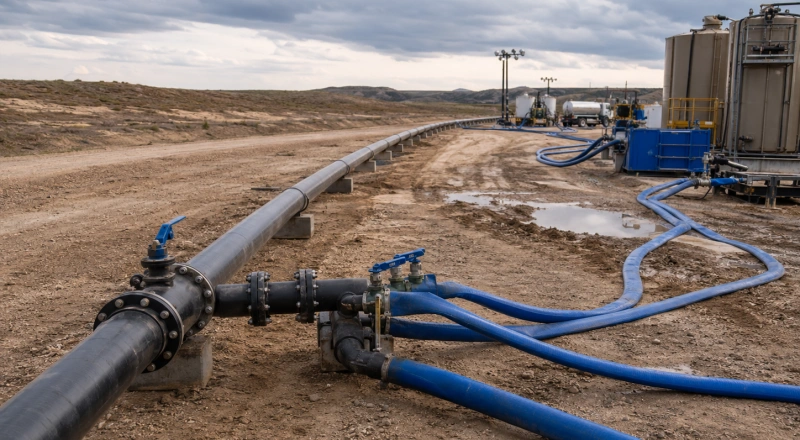
A practical shale-water network often combines both technologies. A rigid trunk line can carry water along a stable corridor, while TPU layflat hose handles the last mile to changing pads, storage tanks, treatment units, or temporary manifolds. The operator keeps a durable backbone without giving up field flexibility.
The transitions deserve careful engineering. Match pressure ratings, bore sizes, connection standards, restraints, valve locations, and surge control across the rigid and flexible sections. Avoid creating a weak point at the pipe-to-hose interface.
Produced-Water Transfer Requires More Than a Material Name
Produced water can contain chlorides, hydrocarbons, suspended solids, scale, bacteria-control chemicals, corrosion inhibitors, acids, and other treatment additives. Its composition can change by well, basin, treatment stage, and time. “TPU compatible” should therefore refer to a reviewed water analysis and operating envelope—not to produced water as a generic category.
Before selecting a produced water transfer hose, provide recent chemistry data, expected solids, temperature, exposure duration, cleaning fluids, and any upset conditions. Ask the supplier to confirm the exact TPU compound and finished construction for that service. Where sour gas or H2S exposure is credible, state it separately; ordinary water-transfer compatibility is not sour-service qualification.
For a closer look at the material trade-offs, see abrasion and chemical resistance in frac hoses and the comparison of TPU frac hose vs rubber hose.
Hydraulics Decide the Diameter
Do not size a frac water transfer hose from nominal diameter alone. The pump curve, target flow, total run, elevation change, fluid density and viscosity, fittings, valves, manifolds, and allowable pressure loss all affect the required bore and pressure class. A longer run or higher flow can create more friction loss, while changes in elevation alter static head.
Ask for a hydraulic review using the actual system data. Then check the selected hose’s rated working pressure at the operating temperature, including credible surges and transients. Burst pressure is design-test information; it is not a normal operating limit.
Compare Total Installed Cost, Not Purchase Price Alone
A fair TPU hose vs rigid pipe cost comparison uses the same flow duty, route, operating period, and risk controls. The lowest unit price can become the more expensive system once installation, transport, downtime, storage, inspection, and demobilization are included.
- Material and assembly: hose or pipe, couplings, fittings, valves, restraints, supports, and transition pieces.
- Installation: reel equipment, fusion or welding, lifting equipment, trenching, supports, road crossings, pressure testing, and commissioning.
- Logistics: freight, truck count, unloading, yard space, storage racks, and return transport.
- Operations: pump energy, pressure loss, monitoring, inspection labor, leak response, and planned maintenance.
- Lifecycle: relocation frequency, expected service period, repair limits, replacement sections, cleaning, retirement, and disposal.
- Downtime and risk: mobilization window, weather exposure, access constraints, spill-control measures, and the cost of an unplanned shutdown.
For a procurement-focused framework, use the oilfield hose cost guide to normalize supplier quotations before comparing price.
Engineering Checklist for TPU Layflat Hose Selection
A useful request for quotation describes the whole transfer system. Send the following information before asking a supplier to name a model:
- Medium: fresh, treated, recycled, or produced water, with current chemistry, additives, solids, and cleaning fluids.
- Hydraulic duty: target flow, total distance, elevation profile, pump curve, inlet pressure, and allowable pressure loss.
- Pressure: normal working pressure, maximum credible surge, pressure cycles, relief settings, and any vacuum or collapse condition.
- Temperature: fluid and ambient minimum/maximum, including startup, shutdown, cleaning, and upset conditions.
- Route: terrain, road crossings, bends, abrasion zones, traffic exposure, support points, and environmental constraints.
- Hose dimensions: required inside diameter, section length, total quantity, reel limits, and handling weight.
- Connections: end type at A and B, nominal size, material, pressure class, mating standard, restraints, and adapter needs.
- Documents and tests: exact datasheet, assembly drawing, production test record, marking, traceability, inspection criteria, and certificates required by the purchase order.
Review available frac hose connection types early. A coupling selected after the hose can introduce an avoidable pressure, flow, or handling mismatch.
Installation, Monitoring, and Maintenance
A well-selected hose can still fail if it is routed or handled badly. Build the field procedure around the manufacturer’s limits and the project risk assessment.
- Inspect the complete hose and both couplings before deployment. Quarantine cuts, exposed reinforcement, severe abrasion, kinks, flattened areas, loose fittings, or unreadable identification.
- Plan the route before payout. Avoid sharp bends, hot surfaces, uncontrolled vehicle crossings, unsupported end fittings, and contact with sharp rock or scrap metal.
- Use approved reels, lifting methods, supports, restraints, and crossing protection. Do not lift a hose by an unapproved coupling or drag it by the end fitting.
- Fill and pressurize gradually under the approved procedure. Monitor pressure, flow, visible movement, couplings, and known abrasion points.
- Depressurize, isolate, drain, and verify zero energy before disconnection. Clean with fluids and methods compatible with the hose construction.
- Record each deployment, inspection, repair decision, pressure event, and retirement action so reuse is based on condition and history.
Use the frac hose maintenance guide as a starting point, then align the inspection interval and acceptance criteria with the exact hose model and site procedure.
Working With a TPU Frac Hose Manufacturer
A specialist manufacturer should help turn operating data into a buildable specification. That means checking the fluid, pressure, temperature, hydraulic duty, length, end connections, handling plan, markings, testing, and document package together. It should also mean saying when a layflat water-transfer hose is the wrong product.
Alienfrac supplies multiple TPU frac water hose constructions and can review project-specific diameter, pressure class, length, and end configuration. Send the operating envelope—not only a requested size—through the contact page for a more useful recommendation.
Conclusion: Choose by Route and Service Life
The TPU frac hose vs rigid pipe decision becomes clearer once you separate temporary transfer from permanent infrastructure. TPU layflat hose is often the better operational tool for mobile water-transfer routes that must deploy, retrieve, and move quickly. Rigid HDPE or steel pipe is often the better asset for a stable mainline designed to stay in service.
Do not force one material across the entire network. Map the route, classify each segment, verify the water chemistry and hydraulic duty, and compare total installed cost. A hybrid system can give you a permanent backbone with flexible connections where the field actually changes.
FAQ
What is the difference between rigid and flexible pipes?
Rigid pipe keeps a fixed shape and normally follows a planned alignment with joints, supports, or burial appropriate to the design. Flexible pipe or layflat hose can bend and conform to a route within its limits, which makes deployment and relocation easier. The right choice depends on pressure, fluid, temperature, mechanical loads, route life, and installation method.
Is TPU hose better than rigid pipe for produced-water transfer?
It can be better for temporary or mobile transfer routes, especially when compact transport and fast relocation matter. Rigid pipe may be better for a permanent mainline or where stronger mechanical protection is required. In either case, confirm produced-water chemistry, solids, temperature, pressure, and cleaning fluids before approval.
Can a TPU layflat hose replace a high-pressure frac hose?
No. A transfer-rated TPU layflat hose and a reinforced high-pressure frac hose are different service classes. Never use a water-transfer hose for 15K or 20K pumping unless the exact finished assembly is specifically designed, rated, tested, and documented for that working pressure.
Which costs should be included in a frac hose vs rigid pipe comparison?
Include the material, couplings, valves, installation equipment, labor, freight, storage, civil work, commissioning, inspection, maintenance, energy loss, relocation, downtime, retirement, and spill-control requirements. Compare both systems over the same route and operating period.
Can TPU layflat hose be reused?
Yes, when the exact hose is designed for retrieval and remains within the manufacturer’s inspection and service limits. Clean, inspect, document, and store it correctly after each job. Do not reuse a section with unacceptable abrasion, chemical damage, deformation, coupling damage, or an unknown pressure history.
When is a hybrid pipe-and-hose system the best option?
A hybrid system fits operations with a stable trunk route and changing last-mile connections. Rigid pipe forms the permanent backbone; TPU hose connects temporary pads, tanks, treatment units, or bypasses. Engineer the transitions so pressure rating, bore, restraints, valves, and surge behavior remain compatible.