
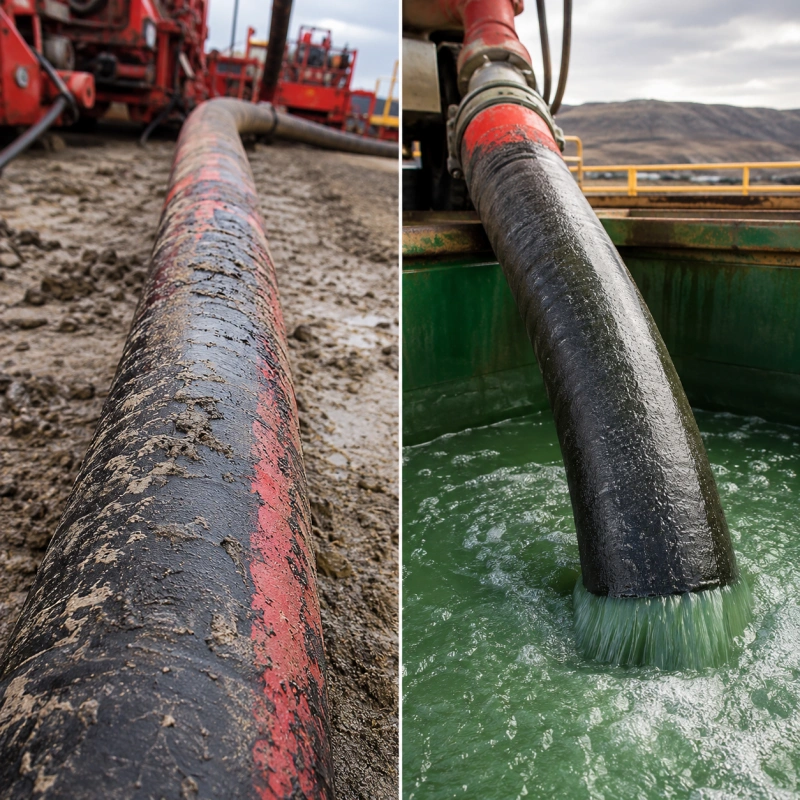
An acid frac hose can be exposed to two damaging mechanisms at the same time. Proppant and suspended solids wear the liner mechanically, while the acid blend, additives, temperature and exposure time act on the liner chemically. A construction that handles one mechanism well is not automatically suitable for the other.
That is why acid frac hose abrasion resistance cannot be judged from a material name or a pressure rating alone. Selection starts with the full fluid recipe and operating duty, then connects those conditions to the liner, reinforcement, cover and end connections as one assembly.
If you need the broader sizing and specification workflow, see AlienFrac’s acid fracturing hose requirements guide. This page stays focused on abrasion, chemical degradation, liner construction and compatibility review.
Use the guidance below for preliminary screening, not as a blanket compatibility approval. Final selection must be reviewed against the exact acid type and concentration, additives, hydrocarbons, solids, temperature, exposure time, pressure, routing and complete hose construction.
Why Acid Frac Hoses Face Combined Abrasion and Chemical Attack?
In a clean liquid, the liner mainly acts as a fluid barrier. In a frac slurry, it also becomes a wear surface. Sand or other proppant particles strike and slide along the bore, especially where flow changes direction or becomes turbulent. At the same time, the carrier fluid can change the liner’s hardness, dimensions, strength or surface condition.
These effects can reinforce each other. A chemically softened surface may wear faster. Abrasion can remove the liner’s smoother surface and expose fresh material to the fluid. Repeated pumping adds pressure cycling and flexing, so a small local change can become more important over time. The practical question is therefore not “Is this hose abrasion resistant?” or “Is it acid resistant?” in isolation. It is “Is this complete construction suitable for this fluid, solids loading and duty?”
Internal Abrasion: Proppant, Velocity and Flow Path
Internal abrasion is driven by more than the presence of sand. Particle size and shape, solids concentration, flow velocity, pumping duration and the number of cycles all influence wear. Two jobs using the same nominal acid can create very different liner duty if one carries a clean fluid and the other carries a high-proppant slurry.
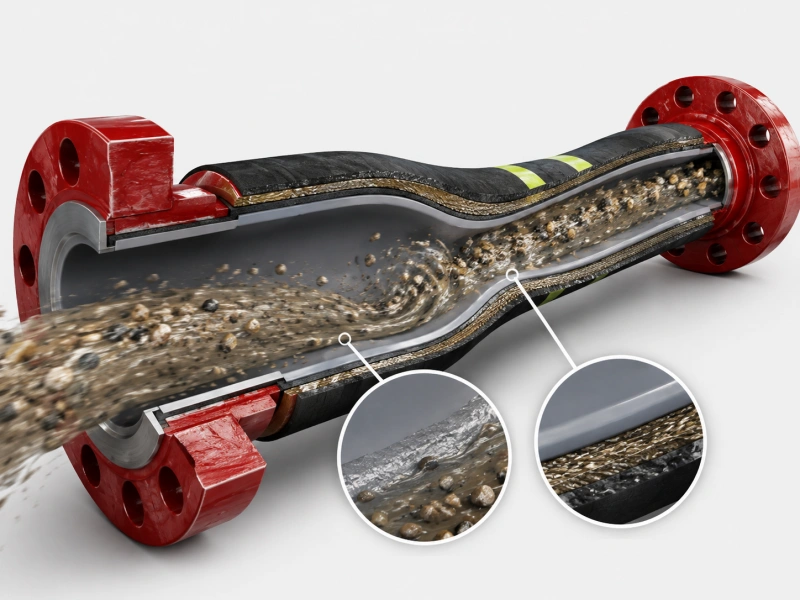
Flow path matters as well. Bends, abrupt changes in bore, partially open valves, connection transitions and disturbed flow can create local turbulence or particle impact. Wear may then concentrate in one area rather than developing evenly along the hose. Routing the hose below its minimum bend radius can add deformation and stress, but it should not be confused with particle erosion; the mechanisms are different even when they appear in the same assembly.
- Record proppant type, particle size and solids concentration.
- Provide expected flow rate or velocity, pumping duration and duty cycle.
- Identify bends, reducers, valves and other points that may disturb the flow.
- Review wear together with pressure history, fluid chemistry and previous inspection findings.
External Abrasion: Routing, Vibration and Ground Contact
External abrasion affects the cover rather than the fluid liner. It commonly comes from dragging, vibration against a support, contact with rough ground, sharp edges, vehicle movement or poorly positioned restraints. The cover is designed to protect the reinforcement from weather and handling damage, but visible cover wear is still a warning that the routing or support arrangement needs attention.
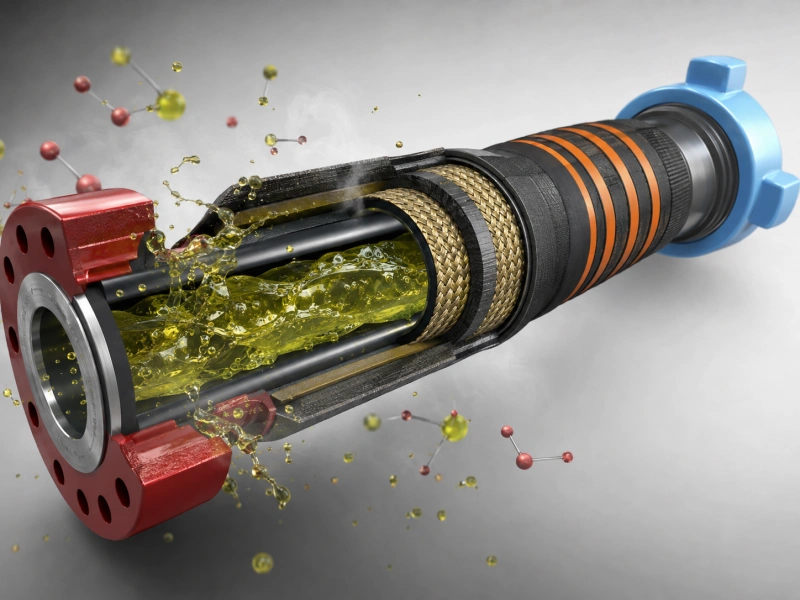
Keep the distinction clear during inspection: a worn cover does not prove that the liner is eroded, and a sound-looking cover does not prove that the bore is undamaged. If the cover is worn through or reinforcement is exposed, remove the assembly from service and follow the manufacturer’s inspection procedure. For the complete cleaning, storage, routing and inspection program, use the frac hose maintenance guide.
Chemical Resistance: Why “Acid Resistant” Is Not Enough
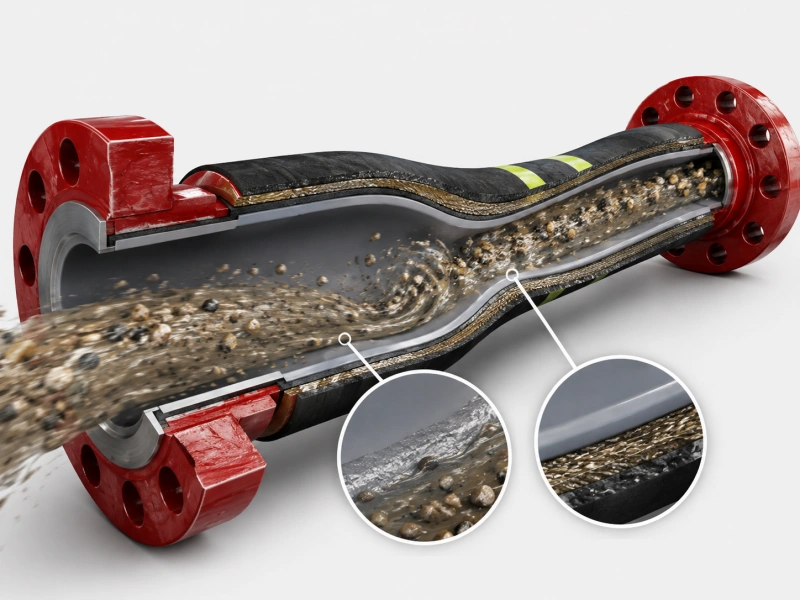
“Acid resistant” is too broad to serve as an approval. For acid frac hose chemical resistance, the complete formulation matters more than a broad material label. A chemical resistant frac hose must be evaluated against the actual recipe. A liner that performs acceptably in one acid system may respond differently when concentration, temperature, solvent content, additives or exposure time changes. General resistance charts are useful for screening, but they do not represent the behaviour of every compound or the performance of a complete hose assembly.
Acid Type and Concentration
State the acid type and both the normal and maximum credible concentration. Avoid using a generic concentration limit unless it has been confirmed for the exact liner compound and service conditions. Also provide the base fluid and the expected fluid condition at the hose, not only the chemical name used at the start of the process.
Temperature and Exposure Time
Chemical compatibility is temperature dependent. A fluid that causes little change at ambient temperature may produce faster swelling, softening, permeation or ageing at a higher temperature. Continuous exposure, intermittent pumping and short flushing contact are different duties. Include normal temperature, maximum temperature, upset duration and the time the fluid may remain in the hose between pumping stages.
Additives, Hydrocarbons and Mixed Fluids
Corrosion inhibitors, surfactants, friction reducers, solvents, oil components, alcohols, foaming agents and cleaning fluids can change the compatibility decision. So can solids. Send the complete recipe, including trade names and safety data where available, instead of listing only the main acid. For a wider comparison of polymer families and selection boundaries, see oilfield hose liner materials.
AlienFrac Acid Frac Hose Liner Constructions
AlienFrac’s catalogue shows several constructions for different positions in a fracturing system. The table below is a product-to-service map, not a universal chemical compatibility statement. It also shows why liner material and assembly pressure rating must be kept separate: the same broad material family can appear in hoses built for very different pressure and flow duties.
| Product / role | Typical application | Tube / liner | Assembly WP | Temperature |
| A801N/FN high-pressure family | High-pressure acid, sand and hydraulic fracturing | UHMW + HNBR | 15,000 or 20,000 psi by configuration | Approx. -29°C to +100°C |
| A804F flange/built-in family | High-pressure acid, sand and hydraulic fracturing | UHMW + HNBR | 15,000 or 20,000 psi by configuration | Approx. -30°C to +100°C |
| A811 suction/discharge | Acid-fracturing suction and discharge | UHMW + synthetic rubber | 500 psi | Approx. -40°C to +82°C |
| A812 abrasive discharge | Abrasive fracturing discharge | Synthetic rubber | 400 psi | Approx. -40°C to +82°C |
| Important: Liner material does not determine the pressure rating. Working pressure belongs to the complete hose assembly and exact configuration. Confirm model numbers, construction, temperature range and rating against the latest catalogue or datasheet before publication and purchase. |
For high-pressure pumping, compare the exact configuration rather than assuming every UHMW acid frac hose carries the same rating. The 15,000 psi vs 20,000 psi frac hose guide explains the pressure-class decision. Suction/discharge and abrasive-discharge hoses serve different system positions and should not be substituted for a high-pressure pumping assembly.
Acid Frac Hose Material and Service Screening Matrix
| Service condition | Main concern | Preliminary direction | Must verify |
| High-proppant slurry | Internal abrasion | Abrasion-oriented liner construction | Particle size, solids concentration, velocity, temperature, duty cycle |
| Acid-based frac fluid | Chemical exposure | Compatible UHMW/rubber construction as applicable | Acid type, concentration, additives, temperature, time |
| Acid + proppant | Chemical and abrasion combined | Construction screened for both mechanisms | Complete recipe, solids and operating conditions |
| Suction/discharge duty | Chemical transfer, vacuum and flexing | Purpose-built suction/discharge construction | Pressure/vacuum, bend, fluid and temperature |
| H2S or CO2 present | Sour-service risk | Separate sour-service review | Gas composition, pressure, temperature, fluids, decompression |
| High-pressure pumping | Assembly integrity | High-pressure frac hose construction | WP, surges, ends, routing and complete assembly rating |
| Screening limitation: This matrix is for preliminary screening only. Final compatibility must be reviewed against the exact fluid composition, concentration, temperature, exposure time, pressure and hose construction. |
If H2S or CO2 is present, do not treat it as ordinary acid chemistry. Gas exposure, pressure and decompression can introduce additional material and assembly concerns. Route that duty through a separate sour-service oilfield hose review.
How Abrasion and Chemical Compatibility Should Be Verified?
A good verification plan separates pressure integrity from wear and chemical compatibility. One result should not be stretched to support a different claim. Ask what was tested, which material or assembly was used, the exact conditions, the acceptance criteria and whether the evidence applies to the proposed hose.
| Evidence / check | What it can show | What it cannot prove by itself |
| Hydrostatic or proof test | Pressure integrity during the stated test | Long-term chemical resistance, abrasion life or field life |
| Burst test | Destructive pressure design evidence | Normal operating life or chemical compatibility |
| Abrasion test | Wear behaviour under a specified method and condition | Every field duty or a different slurry/velocity |
| Chemical immersion or ageing | Material change in a specified fluid, temperature and time | Every acid blend or complete-assembly performance |
| Visual or bore inspection | Currently visible wear, swelling, cracks or blisters | Hidden or future degradation |
At present, do not describe AlienFrac pressure certificates as abrasion or chemical-immersion evidence. If a project needs fluid-specific support, agree on the sample, fluid recipe, concentration, temperature, exposure period, measured properties and acceptance criteria before testing. Record whether the work applies to the liner material only or to the complete assembly.
Signs of Abrasion or Chemical Degradation
Inspection findings should be interpreted with the service history. Remove the hose from service when serious damage is found or when the manufacturer’s procedure requires it; do not invent a universal wear percentage or remaining-life threshold.
| Observation | Possible concern | Recommended action |
| Liner grooves or localized erosion | Internal abrasive wear | Engineering inspection; compare location with flow path and service history |
| Swelling | Possible chemical incompatibility | Remove from service pending engineering review |
| Softening or tackiness | Chemical degradation | Review the complete fluid recipe and compatibility basis |
| Cracking | Ageing, chemical or flex-related damage | Inspect the complete assembly and operating history |
| Cover worn through | External abrasion | Check reinforcement risk and correct routing/support |
| Exposed reinforcement | Serious structural damage | Remove from service and follow the manufacturer’s procedure |
| Blistering | Permeation or decompression-related concern | Remove from service pending engineering review |
What Data Should You Provide for an Acid-Hose Compatibility Review?
The fastest way to get a useful answer is to send a complete duty description with the RFQ. A short request such as “Need a chemical resistant frac hose for acid” leaves the most important decisions unresolved.
- Service position and application: high-pressure pumping, suction, discharge or another duty.
- Acid type, normal and maximum concentration, base fluid and full additive package.
- Hydrocarbons, solvents, inhibitors, surfactants, foam agents and cleaning fluids.
- Proppant type, particle size, solids concentration and expected flow rate or velocity.
- Normal, maximum and upset temperature; exposure time and duty cycle.
- Working pressure, expected surges, vacuum where applicable and required design margin.
- Required hose ID, length, end connections and fitting bore.
- Routing, minimum bend constraints, motion, vibration and external abrasion exposure.
- H2S and CO2 composition, pressure and decompression conditions when present.
- Required documentation, certification, inspection, testing and project specification.
Once these inputs are defined, the engineering review can compare suitable constructions, confirm the assembly rating and identify any missing compatibility evidence. You can then move from the technical screen to the AlienFrac frac hose range or a project-specific quotation.
FAQ
What causes abrasion inside an acid frac hose?
Proppant and other solids strike or slide along the liner. Particle size and shape, concentration, velocity, bends, connection transitions, turbulence and pumping time determine how quickly wear develops and where it concentrates.
Does UHMWPE make a hose resistant to every acid?
No. UHMWPE can suit selected abrasive and chemical duties, but compatibility still depends on the exact grade, fluid recipe, concentration, additives, temperature, exposure time and complete hose construction.
Does liner material determine the hose pressure rating?
No. The pressure rating belongs to the complete assembly, including liner, reinforcement, body construction, end fittings, manufacturing process and exact configuration. Do not infer 15,000 or 20,000 psi capability from “UHMW” or “HNBR” alone.
Is HNBR suitable for an acid fracturing hose?
HNBR can be part of an acid-frac construction, but the family name is not a universal approval. Suitability depends on the compound, fluid recipe, temperature, exposure time, duty and complete assembly.
How can chemical degradation appear in a hose liner?
Possible signs include swelling, softening, tackiness, hardening, cracking, blistering, colour or surface change, and loss of adhesion. The absence of a visible sign does not guarantee that the liner or bond system is unaffected.
What information is needed before selecting an acid frac hose?
Provide the service position, complete fluid recipe, acid concentration, additives, solids, temperature, exposure time, pressure and surges, hose size and length, end connections, routing, gas exposure and documentation requirements. Those inputs allow a construction-specific compatibility review.
Choose the Construction for the Actual Duty
A frac hose chemical compatibility review should address wear and chemistry together. Define the slurry, duty and system position, then compare the liner, assembly rating, ends and inspection needs. This is the basis for abrasion resistant frac hose selection; material names or pressure tests alone are not enough. Review the high-pressure frac hose range or contact AlienFrac.