
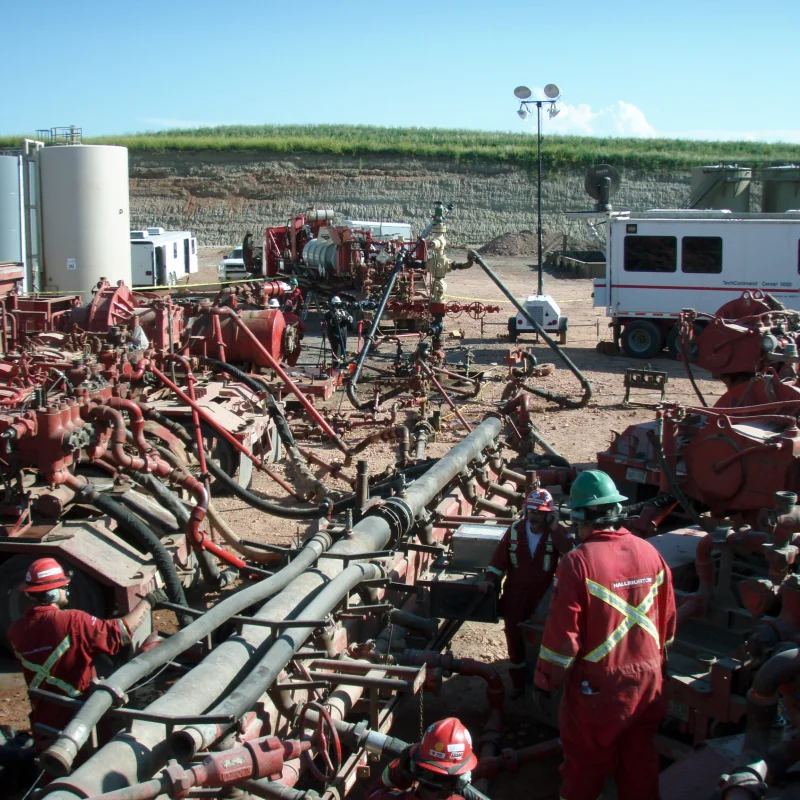
A useful acid frac hose specification starts with the job, not a catalogue model. The hose supplier needs to know what the assembly will carry, how hard the system will run, how the hose will be routed and what evidence the buyer expects at delivery. Without that information, “acid hose” or “15K frac hose” is only a category name—not a complete requirement.
This guide turns acid fracturing hose requirements into a practical selection and RFQ process. It is intended for engineers, contractors, distributors and procurement teams comparing a frac hose range or preparing a project-specific enquiry.
Use it to separate high-pressure treatment duty from suction and discharge service, then document the fluid, pressure, temperature, dimensions, connections, routing and required records.
Quick rule: A liner may be compatible with a fluid, but the working-pressure rating belongs to the complete hose assembly. Tube material, reinforcement, end fittings, temperature, manufacturing method and test basis all matter.
Start With the Service: What Will the Hose Actually Do?
“Acid fracturing hose” is used for several very different duties. Sorting out the hose role first prevents a low-pressure transfer assembly from being compared with a high-pressure treatment line simply because both can encounter acid-based fluid.
| Hose role | Typical duty | Define first | Do not confuse with |
| High-pressure treatment hose | Flexible line between pumps, manifolds and other pressure-system equipment | Maximum working and surge pressure; fluid recipe; solids; ends | Low-pressure transfer hose |
| Acid suction/discharge hose | Compatible fluid transfer where suction, vacuum or moderate discharge pressure may apply | Vacuum; discharge pressure; flow; fluid; temperature | 15K or 20K treatment line |
| Abrasive discharge hose | Discharge of compatible slurry or solids-bearing media | Solids loading; particle size; velocity; pressure; route | High-pressure treatment hose |
| Built-in/integral-end hose | High-pressure assembly with end fittings incorporated into the hose construction | Assembly design; end type; orientation; handling; route | Generic hydraulic hose |
If the line is part of the pressure-pumping system, start with AlienFrac’s high-pressure frac hose family. If the duty is suction or lower-pressure discharge, state that explicitly and include vacuum conditions. The word “transfer” is not enough to distinguish the two.
1. Define the Fracturing Fluid and Chemical Environment
Chemical selection depends on the full recipe as it will reach the hose. A base acid name alone can hide the additives, solvent phases and solids that drive compatibility or wear. Provide a current fluid data sheet where possible, and disclose planned changes between stages.
Acid Type and Concentration
State the acid type and its maximum concentration at the hose—not only the concentrate delivered to site. Include blends, spent acid or mixed returns if the same assembly will handle them. Do not assume that a hose accepted for one hydrochloric-acid concentration is suitable for every concentration, temperature or exposure time.
Compatibility should be reviewed against the exact fluid and operating conditions.
Additives, Hydrocarbons and Inhibitors
List the base fluid and each significant component: corrosion inhibitor, surfactant, gelling agent, friction reducer, scale-control chemical, solvent, diesel or other hydrocarbon phase. Small recipe changes can matter when they alter swelling, permeation or temperature behaviour.
If H₂S or CO₂ may be present, disclose the service conditions separately; acid resistance alone does not establish sour-service suitability. See the sour-service oilfield hose guide for the additional inputs required in an H₂S environment.
Proppant and Solids
For solids-bearing fluid, specify proppant type, particle-size range, solids concentration and expected pumping rate. Internal wear is influenced by the complete flow condition, including velocity, bends, local turbulence and how often the hose is cycled.
External cover wear is a different problem caused by dragging, contact points and site movement. AlienFrac’s guide to abrasion and chemical resistance explains these mechanisms and the material questions to ask.
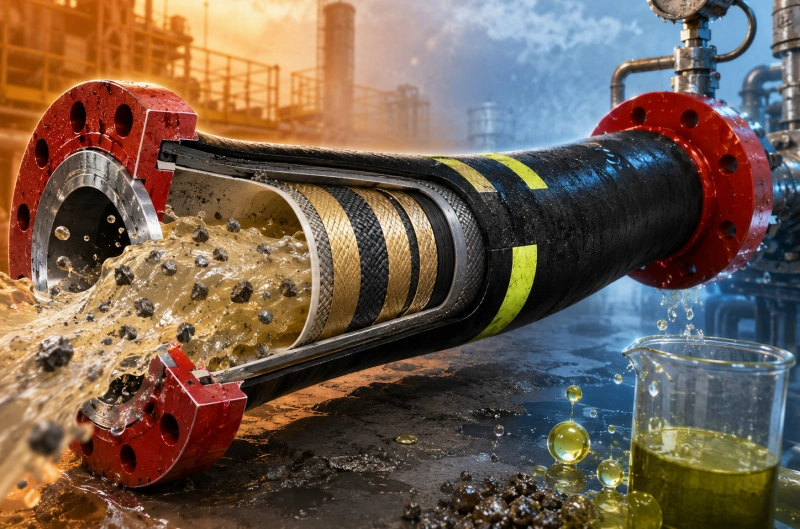
2. Define Working Pressure and Pressure Transients
Pressure information should describe what the assembly will experience in service. Average pump pressure is not enough. Give the normal working pressure, the maximum expected pressure at the hose location, known surges and whether pressure cycling is intermittent or continuous. Also identify any project-defined pressure class.
| Pressure input | Buyer entry |
| Normal working pressure | _____ psi |
| Maximum operating pressure at hose | _____ psi |
| Expected transient or surge | _____ psi / describe event |
| Pressure cycling | Intermittent / continuous; estimated cycles or duty pattern |
| Required pressure class | _____ if project-defined |
| End-connection rating | End A: _____ / End B: _____ |
| Temperature derating or review | Required / not known; provide operating temperatures |
Do not use proof pressure or burst pressure as an operating target. Those values serve different validation or design purposes. The allowable working pressure must be confirmed for the complete assembly, including both end fittings and any adapters.
Where the project is deciding between common high-pressure classes, use the dedicated 15,000 psi vs 20,000 psi frac hose comparison rather than overspecifying pressure by default.
3. Define Temperature Conditions
Provide both fluid temperature and ambient temperature, including expected minimums and maximums. A hose may be exposed to cold weather during rig-up, then carry warmer fluid during pumping. Temperature can affect tube compatibility, cover flexibility, reinforcement behaviour and the rating of seals or connection components.
State whether the maximum temperature is continuous, stage-specific or a short upset. If the fluid is mixed on site, describe the temperature at the hose inlet rather than relying on a storage-tank reading. Applications near or outside a published range need engineering review; a temperature range shown for one model should not be applied to every acid frac hose.
4. Distinguish High-Pressure Treatment From Suction/Discharge Duty
This distinction deserves its own checkpoint because the products are not interchangeable. A high-pressure treatment hose is selected as part of a pressure system. An acid suction and discharge hose may be designed around vacuum capability, flow, flexibility and a much lower discharge pressure. An abrasive discharge hose adds solids-handling concerns but still does not become a 15K treatment line.
- For high-pressure treatment: give maximum working and surge pressure, cycling, full fluid recipe, solids, bore, route and end connections.
- For suction duty: give maximum vacuum, suction source, collapse risk, bend conditions and fluid temperature.
- For discharge duty: give discharge pressure, flow, solids, velocity constraints and external routing conditions.
5. Select the Liner and Hose Construction
The tube or liner is the fluid-contact layer, so it should be screened against the full chemical recipe and temperature. AlienFrac’s current product pages describe UHMW combined with synthetic rubber for selected high-pressure acid-fracturing constructions, while the A812 abrasive discharge hose lists a synthetic-rubber tube. These are product-specific descriptions, not universal claims for every hose on the site.
Reinforcement and coupling construction then determine how the assembly carries pressure and mechanical load. Cover material protects against weather and external abrasion, but a tough cover does not prove compatibility at the bore. For broader background, review oilfield hose liner materials and then confirm the proposed model’s current data sheet.
Compatibility boundary: A factory hydrostatic or pressure test verifies pressure integrity under the defined test conditions. It does not, by itself, prove chemical compatibility, abrasion life or suitability for repeated exposure to a particular acid recipe.
6. Define Hose ID, Length and Minimum Bend Radius
State the required inside diameter and finished overall length using one agreed measurement convention. Identify whether length is measured overall, between sealing faces or between another pair of datum points. A sketch prevents avoidable disputes when large end fittings are involved.
The route matters as much as the nominal length. Provide the available bend space, distance between connection points, elevation change, obstacles and the smallest bend the installed hose would need to make. The required route must respect the selected model’s minimum bend radius in both the pressurized and unpressurized condition. Extra length is not automatically safer: too much slack can create contact points, whipping space, loops or handling problems.
7. Specify End Connections
Describe each end independently. “Hammer union both ends” can still leave the figure, size, pressure rating, material, male/female arrangement and orientation unresolved. Use the following format in the RFQ:
- End A: connection type, nominal size, pressure rating, union figure or flange standard/face, material and orientation.
- End B: the same information, even when it matches End A.
- State whether built-in/integral ends are required, whether adapters are permitted and who supplies them.
- Give clocking or orientation requirements and request drawing approval when alignment is critical.
The lowest-rated component can limit the assembly. Confirm that connection ratings and seal materials suit the pressure, temperature and fluid. For end-selection details, see frac hose connection types.
8. Define Routing and Mechanical Duty
Tell the supplier whether the hose will remain static, move during operation or be handled between stages. Describe vibration, pulsation, torsion risk, dragging, vehicle exposure, supports, clamps, lift points and contact with steelwork or the ground. Include photographs or a simple routing sketch for unusual installations.
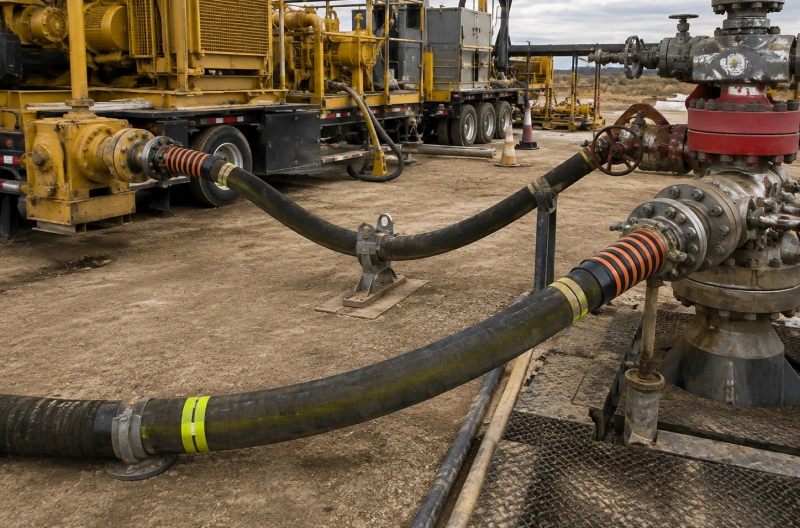
A flexible hose should not be used to correct severe misalignment or forced into a twist during connection make-up. Plan supports so the hose weight and end loads are controlled without creating a hard contact point. If guards, armor, lift eyes, safety clamps or restraints are required, list them as assembly requirements rather than assuming they are included.
After selection, build inspection, cleaning and storage around the actual service; AlienFrac’s frac hose maintenance guide covers that separate operating task.
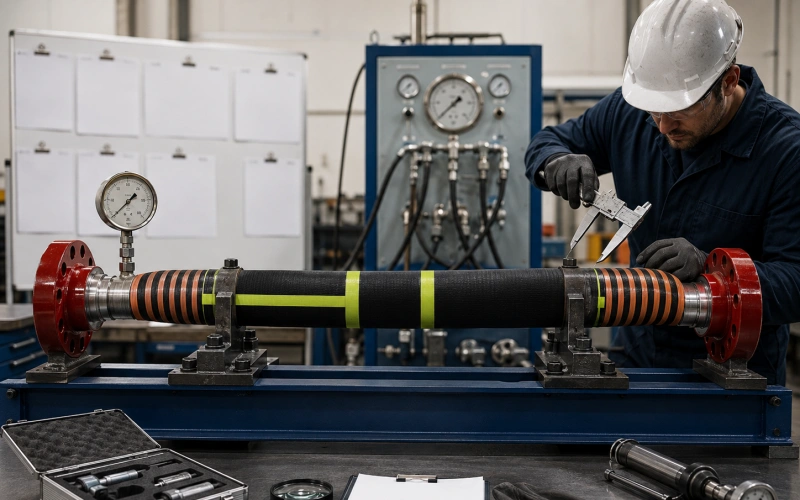
9. Specify Inspection, Testing and Documentation
The purchase specification should define the evidence you need with the hose. Requirements vary by project, so state them before quotation and again on the purchase order. Possible deliverables include:
- Factory pressure-test requirement, test pressure or procedure if project-defined, and test certificate.
- Dimensional inspection against the approved drawing, including overall length and end orientation.
- Material traceability for specified components, when required.
- Third-party witness or hold points, when required.
- Approved drawing, product data sheet, identification/marking details, packing list and document index.
- Project-specific acceptance criteria and applicable standard or customer specification.
Do not write “API compliant” without defining which standard, edition, scope, product and documentation apply. Acid frac hoses should not be blanket-labelled API 7K or API 16C. Confirm the applicable standard and test basis for the exact assembly offered.
AlienFrac Acid Frac Hose Product Mapping
Use the service definition to choose a product path, then verify the selected part number. The table below summarizes current AlienFrac website data as a starting point; it is not a substitute for an approved quotation or data sheet.
| Website product | Service role | Published starting data | Construction / ends |
| High Pressure Frac Hose | High-pressure fracturing fluid transfer | -29°C to +121°C; pressure is configuration-specific | UHMW-PE film + synthetic rubber tube; spiral steel-wire reinforcement; unions/flanges/hubs |
| Super Abrasion Resistant Acid Fracturing Hose (Built-in) | High-pressure acid, sand and hydraulic fracturing duty | 15,000 psi and 20,000 psi entries shown; -29°C to +100°C | UHMW + synthetic rubber tube; steel-cable reinforcement; built-in ends |
| Acid Fracturing Suction and Discharge Hose (Crimped) | Acid suction and lower-pressure discharge duty | 500 psi; -40°C to +82°C | UHMW + synthetic rubber tube; crimped connection options |
| Abrasion Fracturing Discharge Hose (Crimped) | Compatible dilute-acid, chemical and abrasive-slurry discharge | 400 psi; -40°C to +82°C | Synthetic-rubber tube; textile reinforcement; crimped unions/flanges/hubs |
Additional construction options are listed on the current product pages for the flange built-in acid fracturing hose, A801F crimped hose and A801T double-resin crimped hose. Compare them only after the service inputs are complete.
Selection note: Website tables can contain multiple sizes and pressure classes. Check the row for the exact part number; do not carry a rating from one row, construction or product family into another.
Copy-Ready Acid Frac Hose RFQ Checklist
Copy the fields below into an enquiry email or purchasing specification. If an item is unknown, mark it “to be confirmed” instead of leaving it out.
- Application / hose role: ______________________________________________
- Acid type: ____________________ Maximum concentration: ____________________
- Base fluid: ____________________ Additives / inhibitors: ____________________
- Hydrocarbon or solvent content: __________________________________________
- Proppant type: __________ Particle size: __________ Solids concentration: __________
- H₂S / CO₂ conditions, if present: ________________________________________
- Normal working pressure: __________ psi Maximum operating pressure: __________ psi
- Expected transient / surge and cycling: ___________________________________
- Fluid temperature min/max: __________ Ambient temperature min/max: __________
- Hose ID: __________ Finished overall length and datum: ______________________
- Available bend / routing space: __________________________________________
- Duty: static / dynamic Vibration, dragging or external contact: _______________
- End A—type, size, rating, face/figure, material, orientation: __________________
- End B—type, size, rating, face/figure, material, orientation: __________________
- Integral ends required? __________ Adapters permitted? ______________________
- Drawing approval / clocking requirement: __________________________________
- Applicable standard / project specification: _________________________________
- Required testing and acceptance criteria: ___________________________________
- Test certificate: __________ Material traceability: __________________________
- Third-party witness / hold point: __________________________________________
- Required delivery documents and marking: __________________________________
- Accessories / restraints / armor / lift eyes: _________________________________
- Quantity: __________ Required delivery date and destination: _________________
Send the completed checklist, fluid data sheet and routing drawing through AlienFrac Contact Us for product-level review and quotation.
Common Specification Mistakes
- Ordering by hose name alone. “Acid hose” does not define pressure, vacuum, temperature, solids or connections.
- Treating acid concentration as the entire compatibility question. Additives, solvents, temperature and exposure pattern are also part of the fluid environment.
- Using proof or burst pressure as working pressure. Select from the assembly’s rated working pressure and the real maximum service condition.
- Assuming the liner determines the pressure rating. Pressure capacity belongs to the complete assembly.
- Using one connection description for both ends. End A and End B need independent size, rating, interface and orientation data.
- Ignoring the installed route. Too-tight bends, twist, unsupported weight and hard contact points can defeat an otherwise suitable specification.
- Requesting certificates after production. Test, witness, traceability and document requirements should be agreed before the order is released.
FAQ
What information is required to specify an acid fracturing hose?
Define the service role, full fluid recipe, acid concentration, solids, working and surge pressure, fluid and ambient temperature, hose ID and length, routing, mechanical duty, both end connections, applicable project requirements, testing and delivery documents.
Is a high-pressure acid frac hose the same as an acid suction and discharge hose?
No. A high-pressure treatment hose is selected as part of a pressure-pumping system. A suction/discharge hose is selected around vacuum or lower discharge pressure, flow and flexibility. Product ratings and constructions must be checked separately.
Does liner material determine the hose pressure rating?
No. The liner is central to fluid compatibility, but the assembly rating also depends on reinforcement, hose construction, end fittings, manufacturing method, temperature and the verified design/test basis.
How should acid concentration be specified?
Give the acid type and maximum concentration at the hose, together with the base fluid, additives, solvents, solids, temperature and expected exposure. Do not rely on a generic “typical” concentration.
What pressure information should be included in an RFQ?
State normal working pressure, maximum operating pressure at the hose, expected surges or transients, cycling pattern, project-defined pressure class and the rating required at each connection.
Which end connections are used on acid frac hoses?
AlienFrac product pages list options including hammer unions, flanges and hubs, with built-in or crimped constructions depending on the product. Specify the exact interface, size, rating, material and orientation at both ends.
How do proppant and solids affect hose selection?
Solids type, particle size, concentration, velocity, routing and flow disturbance can change internal wear conditions. Provide those inputs so the tube, bore and construction can be reviewed for the actual duty.
What documents should be requested with an acid fracturing hose?
Typical project requests may include an approved drawing, data sheet, pressure-test certificate, dimensional report, marking details, material traceability and third-party witness records. Availability and scope should be agreed for the specific order.
Conclusion
Good acid fracturing hose requirements are specific enough to be checked. Start by naming the hose role. Then document the full fluid recipe, pressure and transients, temperature, dimensions, route, end connections and required evidence. That sequence makes product comparisons clearer and reduces late changes after an order is placed.
When the RFQ is ready, match the duty to the relevant AlienFrac product page and ask Engineering/QA to confirm the exact part number, working limits, compatibility basis, connection drawing, tests and documents. A complete acid frac hose specification gives both buyer and supplier the same service envelope to review.