
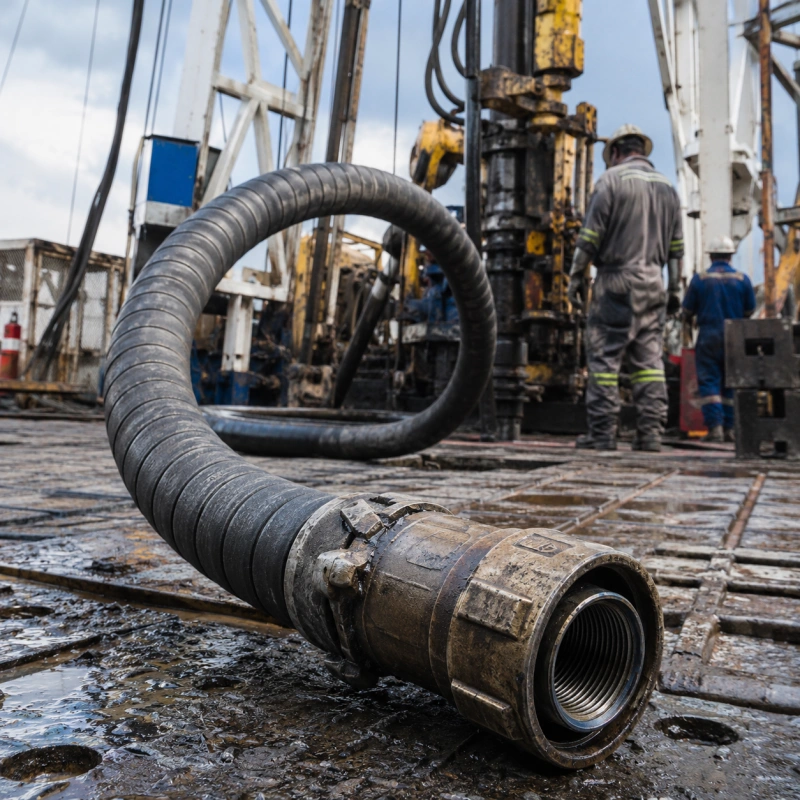
A rotary drilling hose is a flexible, high-pressure assembly in the drilling-fluid circulation system. It normally connects the standpipe to the swivel or top-drive area so drilling mud can flow while the moving equipment travels. A vibrator hose serves a different position, typically between the mud pump and the standpipe, where it helps isolate vibration and pressure pulsation.
That short definition matters because “drilling hose” is often used as a broad field term. The name alone does not tell you where the hose will be installed, what it will carry, or which standard applies. The correct assembly depends on the installed line, media, working pressure, temperature, movement, length, minimum bend radius, end connections, and required verification package.
This guide explains where rotary and vibrator hoses sit in the system, how common terms relate, how construction varies between Alienfrac designs, and what buyers should verify when API Spec 7K is part of the purchase requirement.
Key Takeaways
- A rotary drilling hose usually connects the standpipe to a moving swivel or top-drive connection; a vibrator hose is commonly installed between the mud pump discharge and the standpipe.
- Kelly hose, rotary hose, and mud hose may overlap in everyday use, but the installed position must be stated before you select or quote an assembly.
- Construction is design-specific. Alienfrac A803D uses a synthetic-rubber tube, while A802D uses a UHMW and synthetic-rubber lining; do not assume one liner applies to every model.
- API Spec 7K can define the design, manufacture, testing, and marking boundary for applicable high-pressure mud and cement hose assemblies. Confirm the contract edition, product scope, FSL, and documentation rather than relying on an “API hose” label.
- Working pressure, proof pressure, and burst pressure describe different things. Only the rated working pressure is an operating limit, and credible surges and pulsation still have to remain within the approved system envelope.
- Minimum bend radius is not a handling suggestion. Check the published storage and operating values for the exact size and pressure level, then verify the route through the full equipment travel.
- There is no universal inspection interval or service life for every drilling hose. Follow the governing standard, manufacturer instructions, and the operator’s risk-based inspection and retirement program.
Where a Drilling Hose Sits in the Mud-Circulation System?

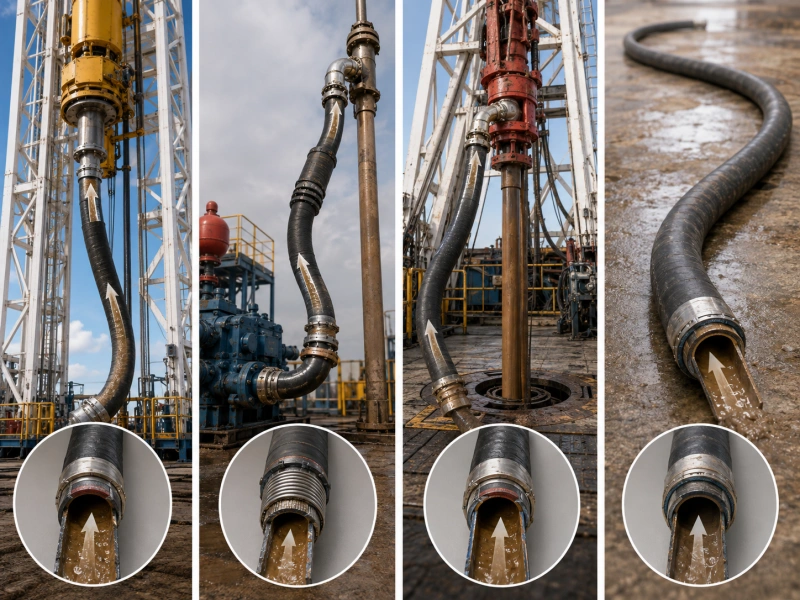
The hose makes a flexible connection inside a system that is otherwise largely rigid. On the high-pressure supply side, the mud pumps move drilling fluid toward the standpipe. From there, the rotary hose carries the fluid to the moving swivel or top-drive connection and into the drill string.
The hose must accommodate movement without kinking, twisting, rubbing against the structure, or loading the end connections incorrectly.
A vibrator hose works closer to the pump discharge. Its job is to carry the specified fluid while helping keep pump vibration and pressure pulsation from being transferred directly into the rigid standpipe piping.
Although Alienfrac’s A803D and A802D product descriptions cover both installed positions, the routing and dynamic duty are not the same. State the start point, end point, and required movement on your data sheet or drawing.
Recommended diagram: Show two separate paths: standpipe → rotary hose → swivel/top drive, and mud pump → vibrator hose → standpipe. A simple position diagram answers the search question faster than another paragraph and gives the page original manufacturer-led value.
Rotary Hose vs Vibrator Hose vs Kelly Hose vs Mud Hose
| Term | Typical position | Main function | Buyer note |
| Rotary drilling hose | Upper standpipe to swivel or top-drive area | Carries high-pressure drilling fluid while the connected equipment moves vertically | Common technical/product-family term |
| Vibrator hose | Mud-pump discharge to lower standpipe or related rigid piping | Carries fluid and helps isolate vibration and pulsation | Position and duty differ from the rotary line |
| Kelly hose | Standpipe to swivel on a Kelly-drive rig | A field name commonly used for the rotary drilling hose | Often overlaps with rotary hose; confirm rig configuration |
| Mud hose | Not specific without more detail | General term for a hose carrying drilling mud | Too ambiguous for a purchase specification |
If your line is part of well control rather than normal mud circulation, review API 7K vs API 16C before choosing a hose family. You can also use Alienfrac’s Kelly hose vs rotary hose vs mud hose comparison when project documents use several names for what may—or may not—be the same installed line.
How a Rotary Drilling Hose Is Built?
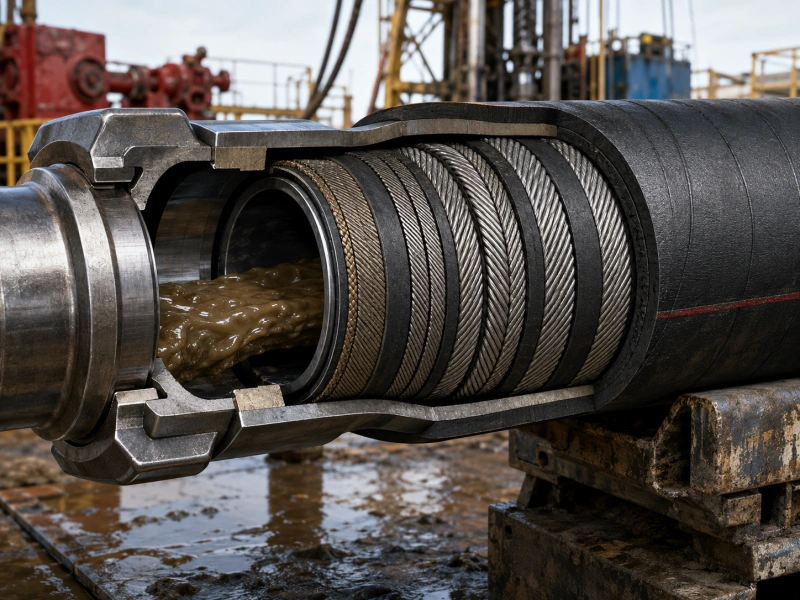
A drilling hose is an engineered assembly, not just a length of reinforced rubber. Its layers and end connections have to work together under pressure, movement, temperature, and exposure to the specified drilling fluid. A typical design includes the following functional elements:
- Inner tube or lining: contains the fluid and must be compatible with the full media composition, temperature range, solids, additives, cleaning fluids, and any credible gas exposure.
- Reinforcement: high-strength steel wire or cable carries pressure load while allowing the flexibility required by the design.
- Intermediate rubber layers: support bonding and load transfer between the liner, reinforcement, and cover.
- Outer cover: protects against weather, oil, abrasion, and normal external exposure within the design limits.
- Couplings and end connections: transfer pressure and mechanical loads into adjacent equipment. Their material, connection standard, orientation, weld/NDE requirements, seals, and pressure rating belong to the assembly specification.
Why the Lining Must Be Model-Specific?
The original article treated NBR as a universal inner-tube material. Alienfrac’s published product pages show why that is too broad. The A803D built-in rotary drilling and vibrator hose lists a full-flow synthetic-rubber tube and high-strength steel-cable reinforcement. The A802D crimped rotary drilling and vibrator hose lists a UHMW and synthetic-rubber full-flow tube with multi-layer, high-tensile spiral-steel-wire reinforcement.
Those descriptions are evidence for the named designs, not a rule for every drilling hose. The right lining depends on the actual media and operating envelope. Give the supplier the water- or oil-based mud composition, solids, additives, temperature, cleaning chemicals, and any unusual exposure. “Drilling mud” by itself is not enough for a compatibility review.
API Spec 7K: What Buyers Should Verify
API Spec 7K covers drilling and well-servicing equipment and includes applicable high-pressure mud and cement hoses within its scope. For a hose purchase, the standard is a technical and quality boundary—not a substitute for an application data sheet. Your purchase documents should identify the required edition, hose service, pressure level, FSL where applicable, marking, tests, records, and any project-specific additions.
Avoid the vague phrase “API-certified drilling hose.” It does not tell you whether the supplier’s license covers the quoted product, whether the assembly is within the claimed design range, which FSL applies, or which certificate and test records will ship with the order. Confirm the current scope directly for the manufacturer and the exact assembly.
Read Pressure Values Correctly
| Value | What it tells you | What it does not mean |
| Working pressure (WP) | The maximum rated operating pressure for the named assembly within its approved conditions | It is not permission to ignore surges, pulsation, temperature, routing, or media limits |
| Proof pressure (PP) | A specified test pressure used to verify integrity under defined test conditions | It is not an allowable continuous operating pressure |
| Burst pressure (BP) | A design-verification or destructive performance value for the named design | It is never an operating target or an emergency working rating |
System design and operating procedures must keep the assembly within its rated working pressure, including credible pressure surges and pulsation. The hose should also be compatible with the lowest-rated connected component in the pressure path.
Typical Alienfrac Product Data: Published Examples
The following values are examples from Alienfrac’s published A803D product page. They show how pressure, diameter, bend radius, and construction are linked. They are not universal drilling-hose values and should not be copied into a purchase order without engineering confirmation.
| Published model | ID | WP | PP | BP | MBR storage / operation | Max length |
| A803D-32-5K | 2 in / 51 mm | 5,000 psi | 10,000 psi | 12,500 psi | 800 / 900 mm | 61 m |
| A803D-64-5K | 4 in / 102 mm | 5,000 psi | 10,000 psi | 12,500 psi | 1,200 / 1,400 mm | 61 m |
| A803D-32-7.5K | 2 in / 51 mm | 7,500 psi | 15,000 psi | 18,750 psi | 1,100 / 1,200 mm | 61 m |
| A803D-64-7.5K | 4 in / 102 mm | 7,500 psi | 15,000 psi | 18,750 psi | 1,400 / 1,500 mm | 61 m |
For the A803D family, Alienfrac publishes a temperature range of -20°C to +121°C (-4°F to +250°F), FSL 1/2, and API Spec 7K / ABS references. Treat those statements as product-page data to be checked against the current quotation, drawing, license/approval scope, and order documentation.
What the table teaches: A 4-inch, 7,500 psi hose is not simply a larger version of a 2-inch, 5,000 psi hose. Outside diameter, weight, operating bend radius, handling, coupling size, and support requirements change with the design.
Basic Selection Factors
A definition page should help you understand the variables without duplicating a full RFQ procedure. Start with these seven questions, then use Alienfrac’s detailed guide on how to choose the right drilling hose for the complete selection workflow.
- Where is the hose installed? State the start equipment, end equipment, rig area, and whether the duty is rotary, vibrator, jumper, cement, or another defined service.
- What moves? Describe vertical travel, lateral movement, vibration, pulsation, alignment, available clearance, and the full route—not only the straight-line distance.
- What is the real pressure duty? Give normal operating pressure, maximum expected operating pressure, credible surges and pulsation, and the pressure rating of adjacent equipment.
- What will flow through it? Provide complete fluid composition, solids, additives, temperature range, cleaning media, and any possible gas or wellbore-fluid exposure.
- What size and length are required? Confirm ID from flow and pressure-loss needs, then verify OD, overall-length datum, tolerance, rigid end lengths, and installation space.
- What ends are required? Define End A and End B separately, including connection type, size, pressure class, material, seal, face/orientation, and any welding or NDE requirement.
- What verification package must ship? List the drawing, certificate of conformance, assembly test report, traceability, certificate/license evidence, marking, inspection plan, and any third-party witness requirement.
Minimum Bend Radius, Length, and Routing
A hose can be long enough to reach and still be incorrectly routed. Check the minimum bend radius through the complete equipment travel, allow space for the rigid coupling sections, avoid torsion, and keep the body away from sharp edges and abrasive contact. Do not force the hose into position by pulling on the ends or using a route that pushes the bend into the coupling area.
Alienfrac publishes separate storage and operating MBR values for A803D sizes. Use the value for the exact model under review, and see the guide to minimum bend radius for high-pressure oilfield hose for routing and handling context.
What Alienfrac Can Verify—and What Your Rig Team Must Confirm
| Responsibility | What must be established |
| Alienfrac / supplier evidence | Exact model and construction; published and quoted WP/PP/BP; size and length range; MBR; end-connection design; applicable license/approval scope; assembly drawing; traceability; test and release documents included in the order |
| Rig owner / buyer inputs | Installed line and function; operating and surge pressure; full media composition; temperature; movement and routing; adjacent equipment ratings; end interfaces; governing standard edition; operator inspection program; local and project requirements |
| Joint engineering review | Compatibility of the proposed assembly with the duty; final route and length; connector details; deviations; required FSL and marking; inspection/test plan; document register; acceptance criteria |
This division is important. A manufacturer can document what was designed, built, inspected, and tested. Only the rig owner and project team can define the real operating envelope and confirm the installed system. A good technical review connects those two records before the hose is released.
For document planning, use the API hose certificate checklist. If the order requires a specific inspection or hydrotest schedule, define it in the purchase documents and compare it with the API hose inspection and hydrotest schedule guide.
Installation, Inspection, and Service Life
Installation errors can damage a correct hose before it enters service. Support the assembly with approved handling and restraint arrangements, protect the cover, keep the hose within its bend-radius limit, align the end connections, and prevent intentional twisting. Follow the supplied installation instructions and the operator’s procedures for the exact hose and rig position.
Inspection frequency should not be reduced to a universal number. It depends on the governing standard, manufacturer instructions, operator program, service severity, pressure cycles, movement, abrasion, previous events, and inspection findings.
A pre-use visual check can be part of the program, but it does not replace scheduled external inspection, coupling checks, internal examination where required, or controlled pressure testing when the approved procedure calls for it.
There is also no universal service life of “several months to several years.” Retire or quarantine a hose when defined rejection criteria are met—for example, leakage, exposed or damaged reinforcement, coupling movement, severe cover damage, kinking, crushing, abnormal deformation, a suspected overpressure or chemical-exposure event, or a failed inspection/test.
Review common drilling hose failure causes to connect visible damage with routing, pressure, compatibility, and handling risks.
Important boundary: Do not assume a drilling-mud hose is suitable for pressurized gas, underbalanced drilling, wellbore effluent, H₂S exposure, or another special service. Disclose every credible exposure and obtain an application-specific review.
FAQ
What is a drilling hose used for?
In the normal high-pressure mud-circulation system, a rotary drilling hose carries drilling fluid from the standpipe to the moving swivel or top-drive connection. A vibrator hose carries fluid between the mud pump discharge and standpipe while helping isolate vibration and pulsation.
Is a rotary drilling hose the same as a Kelly hose?
The terms often refer to the same standpipe-to-swivel flexible connection, especially on a Kelly-drive rig. On a top-drive rig, “rotary drilling hose” is usually the clearer term. Always confirm the installed position instead of relying on the name alone. Alienfrac’s Kelly hose product page provides a product-specific example.
Is a vibrator hose the same as a rotary hose?
They may belong to the same product family, but they serve different installed positions and dynamic duties. The rotary hose follows the moving swivel or top drive; the vibrator hose is normally located near the mud pump and standpipe to manage vibration and pulsation.
Does API 7K tell you which hose to buy?
No. API Spec 7K can define requirements for applicable equipment and hose assemblies, but the buyer still has to specify the installed line, media, temperature, pressure, movement, dimensions, ends, FSL, documentation, and project requirements.
Can burst pressure be used as the operating pressure?
No. Burst pressure is not an operating rating. Select and operate the assembly by its rated working pressure and keep normal pressure, surges, and pulsation within the approved system envelope.
How often should a drilling hose be inspected?
Use the interval and methods required by the governing standard, manufacturer instructions, operator risk program, service severity, and inspection history. There is no single interval that is correct for every hose and every duty.
How long does a rotary drilling hose last?
There is no universal service-life number. Pressure cycles, movement, routing, abrasion, temperature, fluid compatibility, storage, handling, and abnormal events all affect condition. Inspection findings and defined retirement criteria should drive the decision.
What information should I send for a drilling hose review?
Send the installed line, start and end equipment, fluid composition, temperature, normal and maximum pressure, surge/pulsation information, ID, length and length datum, movement, route, MBR limits, End A/End B details, required standard/FSL, quantity, tests, documents, destination, and delivery need.
Conclusion
A drilling hose is the flexible high-pressure connection that keeps drilling fluid moving where rigid piping cannot accommodate equipment travel or vibration. The definition is simple; the engineering is not.
You still have to identify the installed line, distinguish rotary from vibrator duty, match the lining and assembly to the media, read pressure values correctly, protect the minimum bend radius, and define the required API 7K verification package.
Start with Alienfrac’s drilling hose product hub to compare the available product families. For an application review, send your operating data, route, end connections, standard/FSL, and documentation requirements. Alienfrac can then identify a proposed assembly and state exactly what can be verified for your order.