
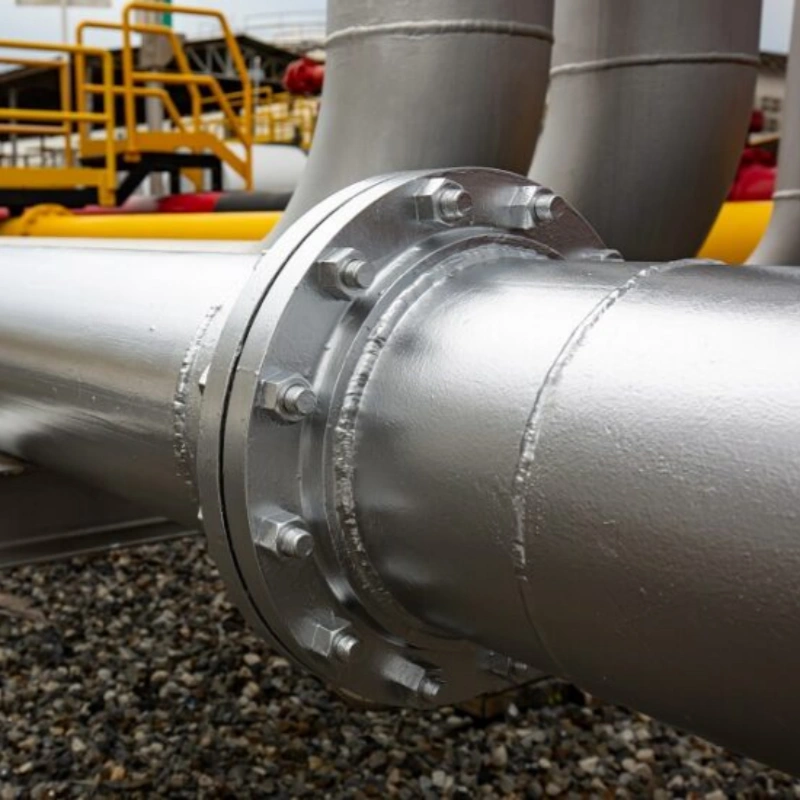
You rely on flanges in engineering and manufacturing to create secure, leak-proof connections. Flanges work by forming robust seals that withstand high pressure and harsh conditions. When you assemble and align a flange correctly, you prevent leaks and maintain system integrity.
Flanges enable easy maintenance. You can separate and reseal pipeline sections quickly, reducing downtime and ensuring continuous operation. Routine inspections let you detect early signs of wear or misalignment, which helps you maintain safety and reliability.
Key Takeaways
- Flanges create secure, leak-proof connections in piping systems, ensuring safety and reliability.
- Regular inspections and maintenance of flanges prevent leaks and extend the lifespan of your systems.
- Choosing the right flange type and material is crucial for handling specific pressure and temperature conditions.
- Following proper bolt tightening sequences ensures even pressure distribution, preventing flange warping and leaks.
- Utilizing high-quality flanges, like Alienfrac API Flanges, enhances operational efficiency and compliance with industry standards.
Flanges in Engineering and Manufacturing
Function of Flanges
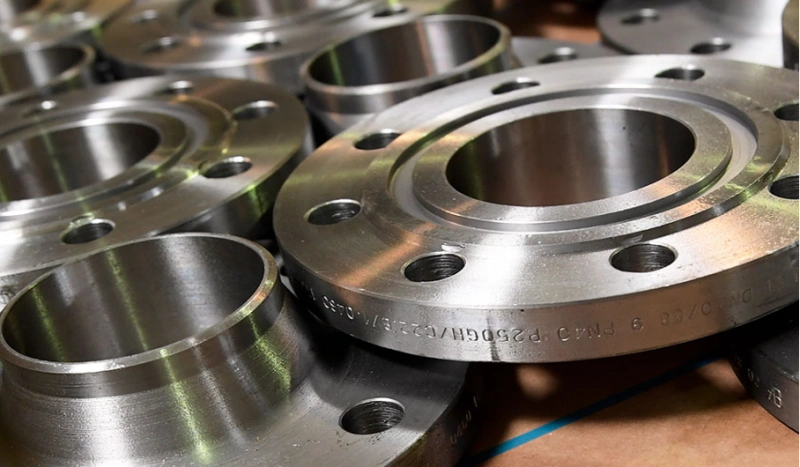
You depend on flanges in engineering and manufacturing to connect pipes, valves, and equipment securely. The function of flanges centers on forming a strong, leak-proof joint that can handle high pressure and temperature.
When you use a flange, you create a protruding rim that allows for easy assembly and disassembly. This design enhances the strength of the joint and provides flexibility for system expansion or modification.
- Flanges serve as the main connection point for critical components.
- They enhance the strength and stability of your piping systems.
- You can easily disassemble them for inspection or maintenance.
- Flanges allow you to adapt your system for upgrades or changes.
- They provide a tight seal that prevents leaks and maintains system integrity.
Alienfrac, a leading manufacturer in the industry, produces API Flanges designed for high-pressure oilfield and industrial applications. These flanges meet strict standards and offer reliable performance in demanding environments.
You can trust Alienfrac’s advanced technology and quality control to deliver flanges that keep your operations safe and efficient.
| Flange Function | Benefit to You |
|---|---|
| Secure Connection | Keeps pipes and equipment joined safely |
| Leak-Proof Seal | Prevents fluid or gas loss |
| Easy Maintenance | Simplifies inspection and repair |
| System Flexibility | Supports expansion and upgrades |
Key Roles in Piping Systems
You rely on flanges in engineering and manufacturing to maintain safety and reliability in your piping systems. Flanges provide a reliable connection point, making assembly and disassembly straightforward.
This feature is essential for routine maintenance and emergency repairs. Flanges also create a tight seal, which prevents leaks and protects the environment.
Flanges distribute load and stress across the joint, reducing the risk of mechanical failure. You can use them to align equipment accurately, ensuring efficient material flow. In high-pressure and high-temperature conditions, flanges maintain system integrity by forming mechanically strong, leak-proof joints.
Weld neck flanges, for example, offer excellent strength and stress distribution, making them ideal for challenging environments.
Alienfrac’s API Flanges excel in these roles. They withstand extreme pressures and temperatures, providing the durability and reliability you need in oil, gas, and industrial systems.
Advantages Over Other Connections
When you compare flanges to welded or threaded connections, you see clear advantages. Flanges facilitate quick disassembly, which enables you to perform regular inspections, cleaning, and maintenance with minimal downtime. This efficiency improves operational performance and reduces costs.
Flanges provide strong connections that remain stable under high pressure and temperature. They prevent loosening, which enhances safety. The excellent sealing performance of flanges stops fluid leakage, helping you avoid resource waste and environmental pollution.
| Advantage | Importance |
|---|---|
| Facilitates Maintenance and Inspection | Enables quick disassembly for regular inspection, cleaning, and maintenance, reducing downtime and improving operational efficiency. |
| Provides Strong Connections | Ensures stability under high pressure and temperature, preventing loosening and enhancing safety. |
| Excellent Sealing Performance | Effectively prevents fluid leakage, avoiding resource waste and environmental pollution. |
Alienfrac’s API Flanges stand out because they combine high-pressure tolerance, durability, and compliance with industry standards. You can count on these flanges in engineering and manufacturing to deliver secure, leak-proof connections that keep your systems running safely and efficiently.
Flange Connection Components
Flange Body and Sealing Surfaces
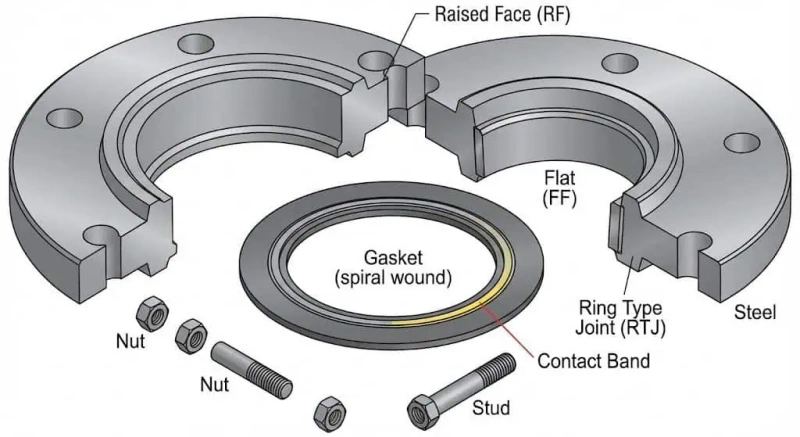
You rely on the flange body as the foundation of every connection. The flange provides the structural strength needed to withstand high pressure and mechanical stress. The sealing surfaces on the flange play a critical role in preventing leaks.
You must ensure these surfaces remain smooth and free from defects. Different sealing surface types, such as raised face or ring-type joint, affect how the gasket interacts with the flange and influence the overall sealing effectiveness.
| Component | Contribution to Sealing Performance |
|---|---|
| Gasket | Seals the gap between flanges, preventing fluid leakage; material choice affects resilience and deformation under force. |
| Bolt Pre-tightening Force | Ensures even distribution of force on the gasket, improving sealing effectiveness. |
| Flange Stiffness | Reduces deformation under load, allowing for better transmission of bolt force to the gasket. |
| Sealing Surface Types | Affects contact quality between gasket and flange, influencing overall sealing effectiveness. |
Gaskets and Sealing Materials
You select the gasket based on the operating conditions. The gasket fills the gap between flanges and prevents fluid leakage. Non-metallic gaskets, such as rubber or PTFE, work well for medium and low pressure.
Spiral wound gaskets combine metal and non-metal materials, offering strength and heat resistance for higher pressure and temperature. The resilience and elasticity of the gasket are crucial for maintaining sealing performance. You must choose the right gasket material to ensure reliable sealing under all conditions.
- Non-metallic gaskets suit medium and low pressure.
- Spiral wound gaskets handle high pressure and temperature.
- Gasket elasticity maintains sealing effectiveness.
Bolts, Nuts, and Fasteners
You use bolts and nuts to secure the flange assembly. Flange bolts feature a built-in flange that centers the load and saves assembly time. Serrated flange bolts add a locking action, making them ideal for high-vibration environments.
Flange nuts distribute load over a larger surface area, reducing deformation during high-torque assembly. You must tighten bolts symmetrically and uniformly to maintain optimal sealing and prevent leaks.
- Flange bolts provide a consistent bearing area.
- Serrated bolts resist vibration.
- Flange nuts enhance joint integrity.
Alignment and Coatings
You ensure proper alignment by keeping flange faces parallel. This practice maintains uniform sealing pressure and prevents leaks. Bolt hole deviation should not exceed 5% of the hole diameter. You observe alignment regularly to detect early signs of misalignment.
Protective coatings, such as epoxy, shield the flange from corrosion, abrasion, and chemical exposure. These coatings extend the service life of flanges and reduce friction inside the pipeline.
Tip: Always check alignment and apply protective coatings to maximize flange performance and longevity.
Flange Connection Assembly and Safety
Preparation and Inspection
You start every flange connection by preparing and inspecting all components. This step is critical for safety and reliability. Begin by visually checking each flange for corrosion, wear, or misalignment. Clean all parts to remove dirt, grease, or debris. Make sure the flange face is smooth and free from scratches.
Inspect the gasket and replace it if you see any damage or deformation. Confirm that the bolts and nuts match the required specifications and show no signs of wear.
Before you assemble, align the pipes or equipment with the flange face. This alignment prevents stress and reduces the risk of leaks. Always check that the flange and its components meet the drawing and standard requirements.
Alienfrac API Flanges undergo strict quality control, so you can trust their consistency and reliability in high-pressure environments.
Inspection Checklist:
- Check for corrosion, wear, or misalignment.
- Clean all flange surfaces and components.
- Inspect the gasket condition and replace it if needed.
- Confirm bolt and nut specifications.
- Align pipes or equipment with the flange face.
Gasket Placement and Centering
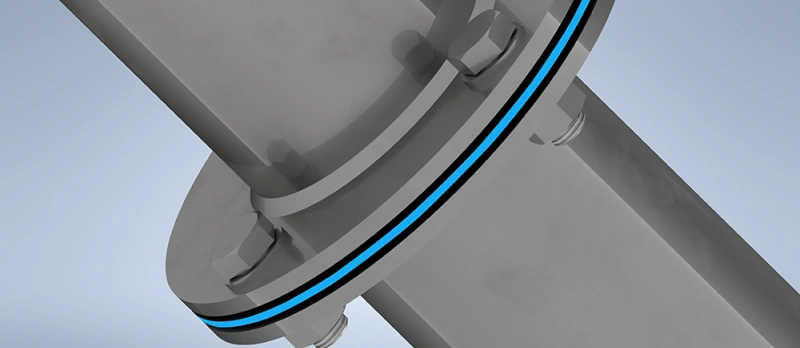
Proper gasket placement is essential for a leak-proof seal. You must thoroughly clean the sealing surfaces to remove any contaminants. Place the gasket carefully between the flange faces, making sure it is centered and does not overhang.
Misalignment or an off-center gasket increases the risk of leaks by creating gaps or weak points.
A tight seal depends on even compression of the gasket. When you align the flange faces correctly, you avoid uneven stress and ensure the gasket seats properly. This step is vital for preventing leaks and maintaining system integrity.
Alienfrac API Flanges feature precision-machined faces, which help you achieve perfect gasket placement every time.
Tip: Always double-check gasket centering before tightening bolts to avoid future leaks.
Bolt Tightening and Torque Control
You secure the flange connection by tightening the bolts in a controlled sequence. Use calibrated torque wrenches to ensure accuracy. Lubricate threads and washers unless the specification says otherwise. Avoid using impact wrenches, as they can damage the flange or bolts.
Follow a star or cross-pattern tightening sequence. Start by hand-tightening all bolts. Next, apply 30% of the final torque in the star pattern. Increase to 60% torque in the same pattern, then finish with 100% torque, checking for uniformity.
This method distributes the load evenly and prevents flange warping or gasket crushing.
| Step | Action |
|---|---|
| 1. Hand-tighten | All bolts |
| 2. 30% Torque | Star pattern |
| 3. 60% Torque | Repeat the star pattern |
| 4. 100% Torque | Final pass, check uniformity |
Check flange alignment before the final tightening. In high-temperature applications, re-torque bolts after system heat-up. Alienfrac API Flanges are designed to handle high torque values, ensuring a secure, leak-proof seal even under extreme conditions.
Leak Prevention and Best Practices
You prevent leaks by following best practices throughout the flange connection process. Always maintain proper alignment to avoid uneven gasket compression. Ensure the gasket is seated correctly and centered between the flange faces. Use standardized procedures for installation and tightening.
Utilize calibrated torque wrenches and follow the cross-pattern sequence to minimize stress on the flange. Inspect pipe support and alignment before tightening to guarantee even gasket seating.
After assembly, conduct a leak test by pressurizing the system or introducing fluid to verify the integrity of the flange connection.
Alienfrac API Flanges meet strict industry standards for leak prevention. Their robust design, precise machining, and quality materials help you achieve a tight seal and reliable performance.
Regular maintenance, including periodic inspections and bolt re-tightening, further reduces the risk of leaks and extends the service life of your flange connection.
Note: Consistent application of these best practices ensures safety and system reliability, especially in high-pressure environments.
Types of Flanges and Applications
Weld Neck, Threaded, Blind, and API Flanges
You will find many flange types in piping systems. Each type has unique features that suit different connection needs. The table below helps you compare the main flange types you use in engineering and manufacturing:
| Flange Type | Distinguishing Features | Common Applications |
|---|---|---|
| Weld Neck | Long tapered hub, welded to pipe for high strength. | High-pressure, high-temperature piping. |
| Threaded | Internal threads connect to externally threaded pipes. | Low-pressure, non-critical piping. |
| Blind | Solid disk, no opening, closes the end of a pipe. | Isolating sections, pressure testing. |
| API | Built to API standards, handles extreme pressure and temperature. | Oil, gas, and power piping systems. |
You select the right flange type based on the pressure, temperature, and function of your piping system. Weld neck flange joints give you strength and durability. Threaded flange types let you make quick connections without welding. Blind flange types help you seal off piping ends.
API flange types from Alienfrac ensure safety in demanding environments.
Flange Face Types and Gasket Compatibility
You must match the flange face type with the correct gasket to create a reliable seal. Different flange types have different face designs. These designs affect how the gasket fits and how well the flange joint seals.
- Raised face, flat face, and ring-type joint flange types need specific gasket styles and hardness.
- The surface finish of the flange face changes how the gasket seals.
- Flange material can cause stress points that affect gasket sealing.
- Bolt load distribution may distort the flange face, changing gasket compression and sealing.
You improve the performance of your flange joint by choosing the right combination of flange face and gasket.
Material Selection and Corrosion Resistance
You must choose the right material for your flange types to prevent corrosion and ensure a long service life. Common flange materials include carbon steel, stainless steel, and alloy steel. Each material works best in certain piping environments. Stainless steel flange types resist rust and chemical attack.
Alloy flange types handle high temperatures and harsh chemicals. You should always match the flange material to the fluid, temperature, and pressure in your piping system.
Tip: Use protective coatings on flange types in corrosive environments to extend their lifespan.
Standards and Compliance
You must follow industry standards when you select and install flange types. Standards like API, ASME, and ANSI set the rules for flange dimensions, pressure ratings, and materials. API flange types from Alienfrac meet strict requirements for oil, gas, and power piping systems.
You ensure safety and reliability by using flange types that comply with these standards. Always check that your flange joint matches the required specifications before starting any connection.
Note: Using certified flange types reduces the risk of failure and keeps your piping system safe.
Flanges for System Reliability and Maintenance
Inspection and Traceability
You maintain the reliability of your system by inspecting each flange regularly. Visual inspections help you spot early signs of wear, corrosion, or deformation. You clean flanges to remove contaminants and apply corrosion inhibitors to reduce rust. You monitor fasteners and gaskets for leaks or breakdown.
Traceability ensures you track every flange in your system. You record installation dates, material grades, and torque values. This practice helps you identify weak points and schedule maintenance before failures occur.
- Conduct routine visual inspections for wear and corrosion.
- Clean flanges to prevent surface corrosion.
- Monitor operating conditions to stay within rated limits.
- Keep records for each flange to support traceability.
Tip: You improve system reliability by keeping detailed records and following a strict inspection schedule.
Performance Limits and Failure Causes
You must understand the performance limits of each flange in your system. Flanges have rated pressure and temperature limits. You monitor operating conditions to prevent exceeding these limits. Incorrect flange selection can lead to leaks, failures, and costly repairs.
You avoid stress points by ensuring proper installation and tightening techniques. Over-tightening bolts or using damaged gaskets increases the risk of leaks. You replace worn-out components to maintain system integrity.
| Failure Cause | Prevention Method |
|---|---|
| Incorrect flange choice | Select flanges per standards |
| Over-tightening bolts | Use proper torque settings |
| Damaged gaskets | Replace during maintenance |
| Corrosion | Apply inhibitors and clean |
Note: You protect your system by choosing the right flange, following standards like ASME B16.5, and monitoring conditions.
Summary of Benefits
You gain several benefits by using flanges and following best practices for maintenance. Proper flange selection ensures effective pipe joining and impacts safety and leak prevention. You reduce downtime by making maintenance easier. You improve system reliability and avoid costly repairs.
Compliance with industry standards keeps your system safe and efficient.
- Proper flange selection impacts safety and leak prevention.
- Maintenance routines extend system life and reduce leaks.
- Traceability helps you schedule maintenance and avoid failures.
- Compliance with standards ensures reliable performance.
🚀 You maximize system reliability and safety by combining careful flange selection, regular maintenance, and strict traceability.
Conclusion
You depend on flanges to ensure safe, reliable, and efficient operations across engineering and manufacturing. Industry experts recognize flanges as critical for secure connections, quality assurance, and regulatory compliance.
Proper selection, precision assembly, and adherence to standards—especially with Alienfrac’s API Flanges—help you minimize downtime and maximize system longevity.
- Flanges support fluid and gas flow, enhance operational safety, and optimize maintenance routines.
- Routine inspections and best practices prevent severe disruptions, safety hazards, and costly repairs.
| Impact Type | Description |
|---|---|
| Unplanned Downtime | Flange failures halt production and increase financial losses. |
| Safety Hazards | Damaged flanges risk leaks, fire, or explosion. |
| Environmental Impact | Failures can cause harmful leaks and ecological damage. |
🛠️ Apply regular maintenance and choose high-quality flanges to protect your system and ensure long-term success.
FAQ
What is the main purpose of a flange in a piping system?
You use a flange to connect pipes, valves, or equipment. Flanges create a secure, leak-proof joint. They allow for easy assembly, disassembly, and maintenance.
How do you choose the right flange material?
You select flange material based on fluid type, pressure, and temperature. For corrosive environments, stainless steel works best. For high pressure, alloy steel provides strength. Always match material to your system needs.
Why should you follow a bolt tightening sequence?
You follow a bolt tightening sequence to distribute pressure evenly. This prevents flange warping and gasket damage. Proper tightening ensures a reliable, leak-free seal.
What makes Alienfrac API Flanges suitable for high-pressure applications?
Alienfrac API Flanges use high-quality materials and precise machining. They meet strict API standards. You can trust them for durability and leak prevention in demanding oilfield and industrial systems.