
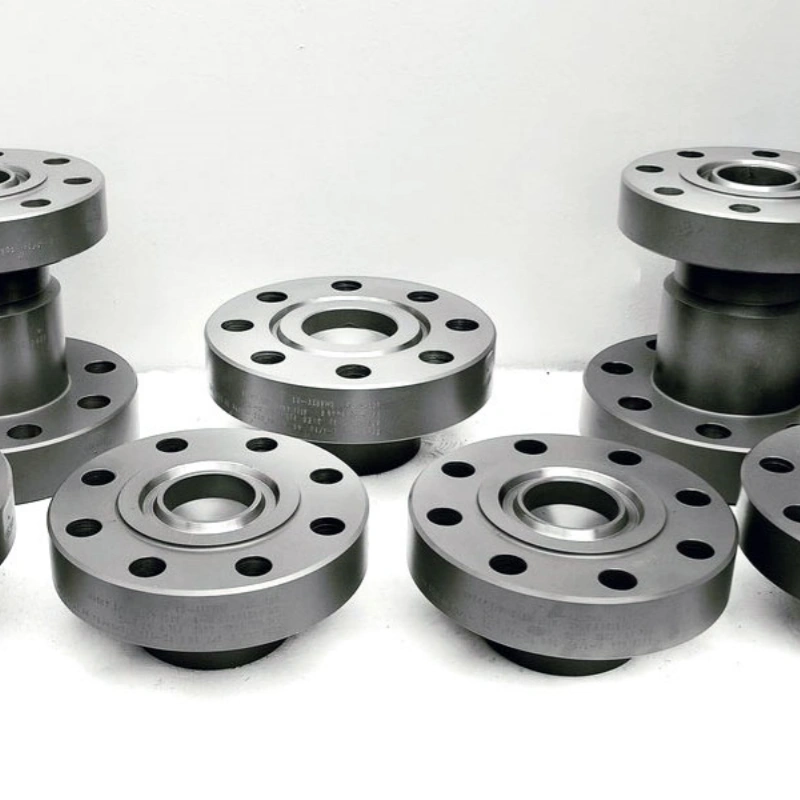
Selecting an API flange material is not the same as choosing a metal from a catalogue. You need to match the flange family, pressure rating, material designation, temperature class, service environment, Product Specification Level (PSL), and documentation requirements as one package.
A grade that looks suitable by chemistry alone may still be wrong for the required strength, heat treatment, toughness, hardness, or sour-service limits.
This guide focuses specifically on API 6A flange material selection for wellhead and tree equipment. If your project uses general process-piping flanges, first compare API and ASME flanges before applying any material table.
Key Takeaways
- Confirm the governing standard and flange type before discussing alloy grades.
- Treat 45K, 60K, and 75K as API material strength designations, not as commercial steel grades.
- Select sour-service material from the actual H2S, CO2, chloride, temperature, pressure, and project requirements; do not request a generic “NACE certificate.”
- Specify PSL, temperature class, inspection, traceability, and records in the RFQ rather than asking only for “API-compliant material.”
- Require engineering confirmation against the project-specified edition of API 6A before purchase or substitution.
Start With the Correct Flange Standard
The term API flange can refer to different equipment families in search results and supplier catalogues. For this page, the relevant system is API Specification 6A for wellhead and tree equipment. API 650 tank nozzles, legacy API 605 large-diameter flanges, and ASME B16.5 or B16.47 piping flanges follow different design and material rules.
Their grade lists and pressure classes should not be merged into an API 6A purchasing decision.
Before you select material, confirm the required standard, flange family, bore, pressure rating, and connection form. Use the separate API flange standard guide for the standards overview and the API flange size guide for dimensional planning. For non-API applications, use the broader industrial flange materials guide instead of extending this API 6A selection logic.
Selection boundary: This article is a procurement and engineering-input guide. It does not replace the licensed API specification, the purchaser’s design basis, or approval by the responsible engineer.
How API 6A Flange Material Selection Works
A complete API 6A material specification uses several classifications together. Keeping them separate prevents one of the most common RFQ errors: naming a commercial alloy while omitting the performance and service conditions the finished flange must satisfy.
| Selection input | What it controls | What to put in the RFQ |
| Flange type and rating | The connection design and the pressure-rating basis. | 6B or 6BX; weld neck, blind, threaded, test, adapter, or drawing-defined; rated working pressure. |
| Material designation | Minimum mechanical-property category used by API 6A, commonly expressed as 45K, 60K, or 75K for flange applications. | Required designation, or the design inputs needed for the manufacturer to propose it. |
| Material class | Minimum material requirements linked to the service environment and pressure-containing or wetted parts. | Required class plus fluid composition and project corrosion basis. |
| Temperature class | The operating-temperature range and related toughness basis. | Minimum and maximum design temperatures; required class; impact-test requirement. |
| PSL | The applicable technical, manufacturing, inspection, testing, traceability, and record requirements. | Required PSL and any purchaser supplements. |
| Commercial alloy | The chemistry, heat-treatment response, weldability, corrosion behavior, and availability of the starting material. | Grade/specification, product form, heat treatment, and permitted alternatives. |
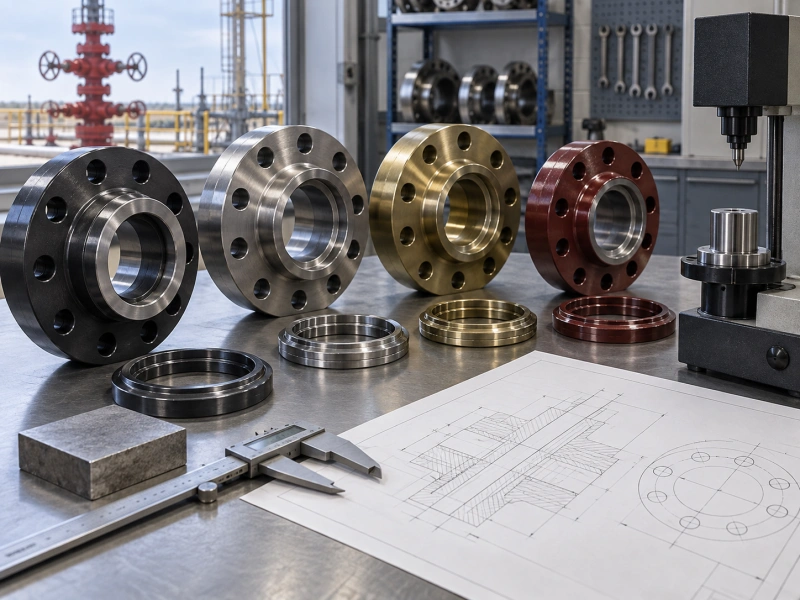
How API 6A Flange Material Grades and Designations Differ?
AISI 4130, AISI 4140, ASTM A105, and ASTM A182 grades identify material specifications or alloy families. In contrast, 45K, 60K, and 75K identify minimum yield-strength categories used within API 6A requirements.
A manufacturer may use a commercial grade only when the finished, heat-treated part satisfies the applicable chemistry, mechanical properties, hardness, toughness, qualification, and product-specific rules.
The screening table below reflects commonly published API 6A weld-neck flange mappings. Use it to frame an RFQ, not to release a purchase order. The acceptable designation depends on the flange design and the project-specified edition of API 6A.
| Flange family | Rated working pressure | Common screening designation | Required next check |
| Type 6B weld neck | 2,000 / 3,000 / 5,000 psi | 45K | Confirm the exact product table, bore, weld-end requirements, and temperature class. |
| Type 6BX weld neck | 2,000 / 3,000 / 5,000 / 10,000 psi | 60K or 75K | Confirm which designation is permitted by the applicable product requirements and design basis. |
| Type 6BX weld neck | 15,000 / 20,000 psi | 75K | Confirm the current API 6A requirements, toughness, hardness, material class, PSL, and project supplements. |
Do not extrapolate: Integral flange connections, blind flanges, threaded connections, adapters, and customer-designed parts can follow different product-specific requirements. Confirm the exact component category before applying a strength designation.
Common API 6A Flange Material Families
The best API flange material is the material that satisfies the complete service and documentation package. Cost and availability matter, but they come after pressure containment, environmental cracking resistance, toughness, weldability, and compatibility with adjoining equipment.
Carbon and Low-Alloy Steels
Carbon steel and low-alloy steels are common starting points for general and high-strength API 6A applications. Commercial grades such as ASTM A105 or AISI 4130/4140 may appear in supplier literature, but the grade name alone does not establish an API 6A designation. Ask for the final heat-treatment condition and test results from the represented heat or qualification coupon.
Low-Temperature Materials
For cold environments, do not select material by hardness or room-temperature tensile strength alone. Define the minimum design temperature, required temperature class, impact-test temperature, acceptance criteria, specimen orientation, and any project-specific toughness requirement. A familiar alloy can perform differently after changes in section size and heat treatment.
Stainless, Duplex, and Super Duplex Options
Stainless and duplex families may be considered where corrosion resistance is required, particularly in chloride-bearing or offshore service. Selection still requires a review of strength, pitting and crevice-corrosion risk, galvanic compatibility, welding procedure, heat treatment, ferrite control where applicable, and the effect of the environment on cracking. “Stainless” is not a complete material specification.
Nickel Alloys and CRA Overlay
Nickel alloys or corrosion-resistant alloy (CRA) overlay may be considered for severe corrosion conditions or to protect sealing and wetted surfaces. Define the base material, overlay alloy, qualified welding procedure, minimum finished thickness, dilution limit, coverage area, NDE method, and repair criteria. An alloy name without these details is not enough to control the finished flange.
Select API Flange Material by Service Condition
| Service condition | Primary material question | Evidence to request |
| Sweet, non-corrosive service | Can the proposed grade and heat treatment meet the required API designation, temperature class, and design basis? | MTR, heat-treatment record, mechanical test results, hardness results, and dimensional report. |
| Sour service with H2S | Is the material qualified for the actual environmental limits and hardness restrictions in the specified sour-service standard? | Material class, ISO 15156/NACE MR0175 basis where specified, hardness map, chemistry, heat treatment, and purchaser acceptance. |
| Low ambient or fluid temperature | Does the material retain the required toughness at the specified minimum temperature? | Impact-test report, test temperature, specimen orientation, acceptance criteria, and temperature-class confirmation. |
| Offshore or chloride exposure | Is the selected metallurgy resistant to localized corrosion and environmentally assisted cracking in the stated exposure? | Corrosion basis, grade/UNS, heat treatment, welding controls, PMI, and any project-required corrosion testing. |
| High temperature or cycling | Do strength, tempering condition, oxidation resistance, and joint compatibility remain acceptable across the full temperature range? | Maximum design temperature, temperature class, heat-treatment record, material data, and engineering approval. |
| CRA overlay or inlay | Are alloy, coverage, dilution, thickness, surface finish, and defect limits fully defined? | WPS/PQR, overlay map, chemistry/PMI, thickness report, NDE report, and repair record. |

Sour Service Requires Defined Conditions
Sour service flange material selection cannot be reduced to a universal certificate attached to any flange. ISO 15156/NACE MR0175 addresses material resistance to damage mechanisms in H2S-containing oil and gas production environments, but material acceptability depends on defined environmental and metallurgical limits.
Your RFQ should state H2S partial pressure or basis, CO2, chlorides, pH if available, operating temperature, pressure, fluid phase, material class, and any purchaser-specific hardness or testing rules.
Do not assume that a single maximum hardness value proves suitability for every sour application. Confirm the applicable material route, heat treatment, weld condition, and acceptance limits with the responsible engineer and the current project specification.
Pressure, Temperature, PSL, and Material Must Agree
Pressure rating does not select the alloy by itself. The correct choice is produced by the combination of flange family, rated working pressure, temperature class, material designation, material class, PSL, and project-specific loads or corrosion requirements. A higher-strength designation is not automatically better: additional strength can affect weldability, toughness, hardness control, and sour-service qualification.
Use the API flange pressure-rating guide to define the pressure and temperature inputs. If you are deciding between connection families, review the difference between API 6B and 6BX flanges before selecting the material designation.
PSL is not a steel grade: PSL affects the applicable manufacturing, inspection, testing, traceability, and record requirements. Always state it separately from material class and commercial alloy grade.
A Practical API 6A Flange Material Selection Process
- Define the equipment boundary. Confirm that API 6A applies and identify whether the part is a standalone flange, integral connection, adapter, spool, or drawing-defined component.
- Fix the connection data. State 6B or 6BX, flange form, nominal bore, rated working pressure, ring groove or gasket interface, mating equipment, and drawing revision.
- Describe the service. Provide minimum and maximum temperatures, process fluid, H2S and CO2 basis, chlorides, water phase, external environment, corrosion allowance, and design life where applicable.
- Set the API classifications. State material designation, material class, temperature class, PSL, and any performance or purchaser requirements. If unknown, ask the supplier to identify assumptions and obtain engineering approval before order placement.
- Define the material route. Name the commercial grade or permitted family, forging/product-form requirement, heat treatment, welding or overlay requirements, and prohibited substitutions.
- Define verification and records. Specify MTR content, heat and part traceability, mechanical tests, impact tests, hardness, PMI, NDE, dimensional inspection, pressure testing where applicable, third-party witness points, and final data-book format.
Documents to Request From an API Flange Supplier
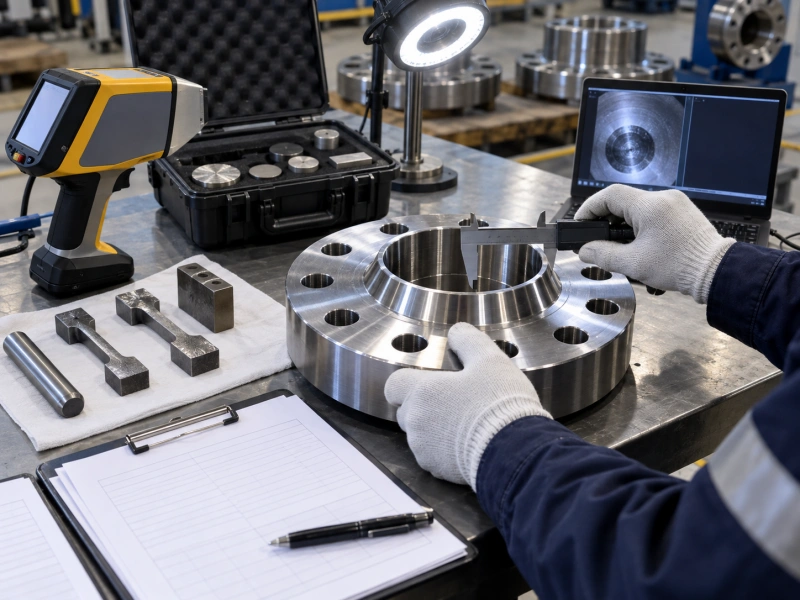
Flange MTR requirements should be defined together with the full document package. The records should prove what was manufactured, from which heat, by which process, and against which acceptance criteria. The exact list depends on PSL, product type, project specification, and purchase order.
| Document or record | What to verify |
| Material Test Report (MTR/MTC) | Heat number, specification and grade, chemistry, mechanical properties, heat-treatment condition, test results, and authorized certification. |
| Traceability record | Link among raw material, heat/lot, qualification coupon where applicable, work order, finished part marking, and inspection reports. |
| Heat-treatment record | Cycle, temperatures, hold time, quench/temper route, furnace identification, chart or log, and represented parts. |
| Mechanical and impact tests | Test location/orientation, specimen size, test temperature, values, acceptance criteria, and link to the represented heat/part. |
| Hardness report | Method, locations, number of readings, acceptance range, any mapping requirement, and traceability to the finished flange. |
| PMI/chemistry verification | Method, test locations, results, and acceptance against the specified grade or overlay alloy. |
| NDE reports | Applicable UT, MT/MPI, PT/LPI, or overlay examination method; procedure; personnel qualification; coverage; acceptance criteria; results. |
| Dimensional report | Bore, bolt pattern, flange thickness, hub, ring groove, sealing surface, mating dimensions, tolerances, and drawing revision. |
| Certificate of conformity | Purchase order, standard and edition, product description, quantity, serial or heat traceability, deviations, and authorized sign-off. |
For a deeper explanation of inspection stages and report content, see the flange inspection guide. For how forging, heat treatment, and machining affect the final part, see flange manufacturing processes.
API 6A Flange RFQ Checklist
Send the following information with your inquiry. If a field is unknown, mark it for engineering confirmation instead of allowing an uncontrolled supplier assumption.
- Governing standard and edition, plus customer or project specification
- Flange family and form: 6B or 6BX; weld neck, blind, threaded, test, adapter, integral, or drawing-defined
- Nominal bore, rated working pressure, mating connection, ring groove/gasket, and quantity
- Material designation, material class, temperature class, PSL, and other required API classifications
- Commercial material grade or approved alternatives; forging/product form; heat treatment
- Minimum and maximum design temperature; impact-test requirements
- Process medium, H2S/CO2 basis, chlorides, water phase, and external environment
- Sour-service standard and purchaser-specific hardness or corrosion-testing requirements
- CRA overlay/inlay alloy, coverage, finished thickness, dilution, surface finish, and NDE
- MTR, traceability, mechanical testing, hardness, PMI, NDE, dimensional report, pressure test, third-party inspection, and data-book requirements
- Drawing, marking, coating, preservation, packing, destination, and required delivery date
Common Material Selection Mistakes
- Using an ASME, API 650, or API 605 material table for an API 6A flange without confirming the standard boundary.
- Treating 4130, 4140, 45K, 60K, material class, and PSL as interchangeable labels.
- Selecting stainless steel only because the environment is “corrosive,” without defining chlorides, H2S, temperature, welding, or galvanic contact.
- Requesting “NACE certification” instead of stating the applicable sour-service standard, environmental limits, and acceptance criteria.
- Assuming higher yield strength automatically improves safety or interchangeability.
- Approving a substitution based only on chemistry while ignoring heat treatment, toughness, hardness, section size, qualification, and traceability.
- Accepting a generic certificate package that cannot link each finished flange to its heat, processing records, and inspection results.
Request API 6A Flanges From AlienFrac
AlienFrac supplies API 6A flange options for high-pressure oilfield connections. For a technical quotation, send the connection type, bore, pressure rating, material and API classifications, service conditions, quantity, drawing, and required inspection documents. If you are still defining the product family, begin with the API flanges overview.
A complete RFQ allows the supplier to identify missing inputs before production and reduces the risk of material substitutions, incomplete traceability, or document gaps at final inspection.
FAQ About API Flange Material
What material is commonly used for API 6A flanges?
Carbon steel and low-alloy steels such as 4130 or 4140 are commonly discussed for API 6A applications, while stainless, duplex, super duplex, nickel alloy, or CRA overlay may be considered for specific corrosion conditions. The commercial grade must still meet the required API material designation, class, temperature, PSL, heat-treatment, and project requirements.
What is the difference between 45K, 60K, and 75K?
They are API material strength designations based on minimum mechanical-property requirements; they are not alloy grade names. The required designation depends on the component type, flange family, pressure rating, and applicable edition of API 6A.
Does 4130 automatically qualify as 60K or 75K material?
No. The grade name alone cannot prove the API designation. The finished material condition and represented test coupon must demonstrate the applicable chemistry, heat treatment, mechanical properties, toughness, hardness, and product-specific requirements.
Is stainless steel always better for sour service?
No. Sour-service suitability depends on the specific alloy, strength or cold-work condition, heat treatment, hardness, welding, H2S exposure, chlorides, pH, temperature, and the limits of the applicable sour-service standard. Select the material from defined service data, not from the word “stainless.”
What should an API flange MTR include?
At minimum, verify material specification and grade, heat number, chemistry, mechanical properties, heat-treatment condition, required impact and hardness results, test methods, and certification. The MTR should link to the finished flange marking and the other inspection records required by the purchase order.
Can a supplier substitute a higher-strength material?
Only after technical review and purchaser approval. A higher yield-strength category can change welding, toughness, hardness, sour-service, machining, and mating-component considerations. The substitution must comply with the governing standard and project requirements and be documented before manufacture.