
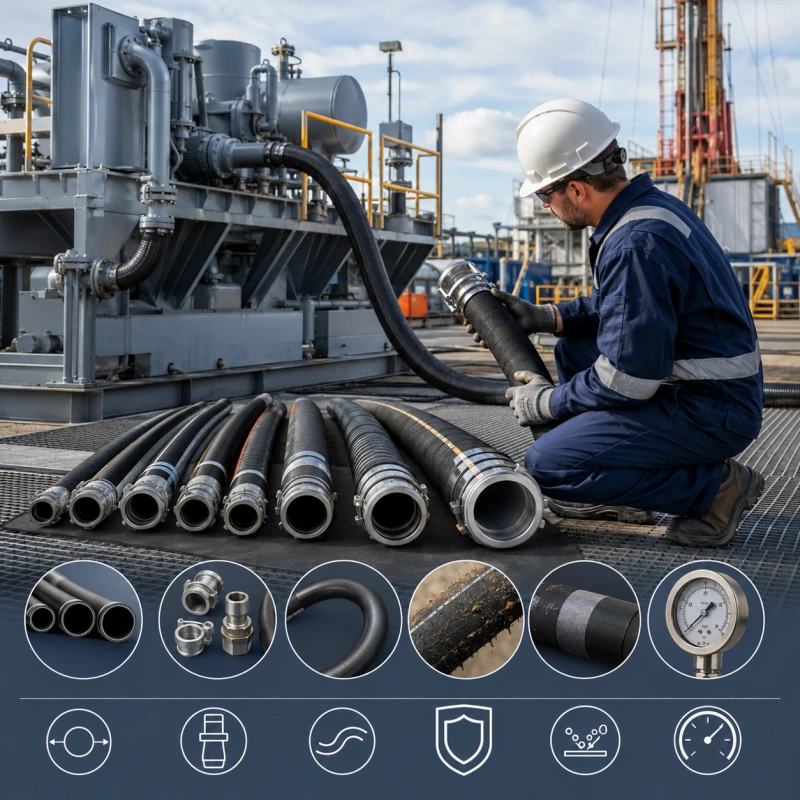
Selecting a mud degasser hose is less about choosing a generic “heavy-duty” hose and more about matching the assembly to the actual drilling-fluid system. Before an RFQ is released, confirm the fluid, maximum pressure, operating temperature, required line size, routing and minimum bend radius, end connection, and finished hose length.
Those seven items determine whether a hose can be evaluated against the real installation instead of a catalogue description.
For AlienFrac’s A861 degasser hose, the published range includes 3 in and 4 in IDs, a 2,000 psi working pressure, an 8,000 psi burst pressure, and model-specific minimum bend radii. The figures below come from the current A861 product page and should be treated as the baseline for selection.
If your service falls outside these published limits, send the operating data and connection drawing for engineering review rather than assuming a different configuration will be suitable.
A861 Degasser Hose Specifications at a Glance
| Model | I.D. | O.D. | Working Pressure | Burst Pressure | Minimum Bend Radius | Weight |
| A861-48-2K | 3 in / 76 mm | 96.3 mm | 2,000 psi | 8,000 psi | 950 mm | 6 kg/m |
| A861-64-2K | 4 in / 102 mm | 128 mm | 2,000 psi | 8,000 psi | 1,000 mm | 10.4 kg/m |
The A861 product page lists a temperature range of -28°C to +93°C (-18.4°F to +199.4°F). Its tube is described as an NR/SBR + UHMWPE rubber compound, reinforced with two layers of high-tensile flexible spiral steel wire. The published connection is a 4 in male NPT hose tail and ferrule.
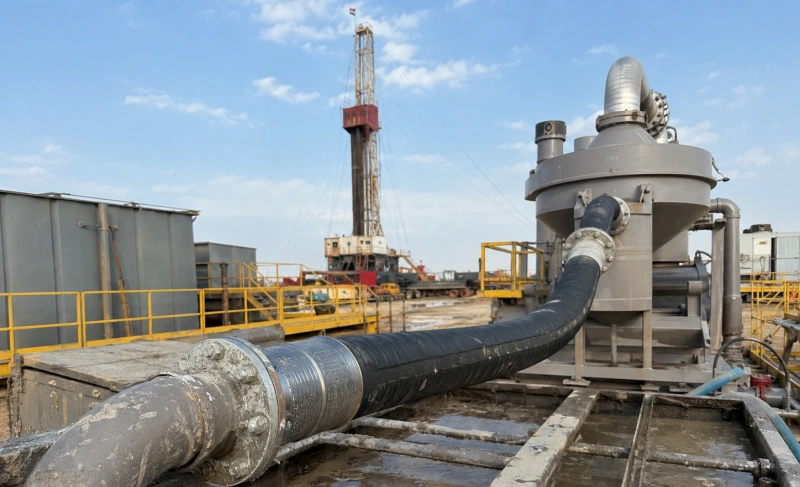
AlienFrac A861 2,000 PSI Degasser Hose
These specifications are useful starting points, but they do not replace application review. A 4 in hose is not automatically the better choice, and a 2,000 psi rating is not automatically sufficient simply because normal operating pressure is lower. Selection should follow the system data in the steps below.
Step 1 — Define the Mud or Drilling Fluid
Start with the fluid rather than the hose. A degasser line may see water-based mud, oil-based or synthetic-base systems, suspended solids, treatment chemicals, and changing temperatures during operation. Those details matter because the hose tube is in continuous contact with the conveyed medium.
For an RFQ, provide the fluid name or mud system, base fluid, major additives if known, solids or abrasive content, and expected operating temperature. If the fluid formulation changes during a drilling program, include the most demanding condition you expect the hose to see.
AlienFrac publishes the A861 tube as an NR/SBR + UHMWPE rubber compound. That description should not be used as a blanket statement of compatibility with every drilling fluid. Chemical compatibility needs to be checked against the actual medium and temperature. If the application includes unusual additives, high concentrations, or a service condition not shown on the product page, flag it for engineering review.
For background on where degassing fits into the circulation system, see AlienFrac’s guide to drilling mud systems and its explanation of gas-cut mud.
Step 2 — Confirm the Degasser Hose Pressure Rating
The published working pressure for both A861 models is 2,000 psi. The published burst pressure is 8,000 psi. For selection, the working-pressure figure is the key operating limit; burst pressure is not a normal operating target.
Do not size the hose from an average gauge reading alone. The RFQ should state the maximum pressure expected at the hose location and identify any start-up, shut-down, valve, pump, or transient conditions that may raise pressure above the normal value. If the system can exceed the published 2,000 psi working pressure, the A861 should not be assumed suitable without a separate engineering review.
A useful way to document the pressure requirement is:
- Normal operating pressure
- Maximum expected pressure at the hose location
- Any known transient or upset pressure
- Pump or equipment connection point
- Pressure unit and data source
This avoids a common purchasing error: selecting a hose because its nominal pressure “looks higher” than the usual system pressure without checking the actual maximum condition.
Step 3 — Choose the Right Degasser Hose Size: 3 in vs 4 in
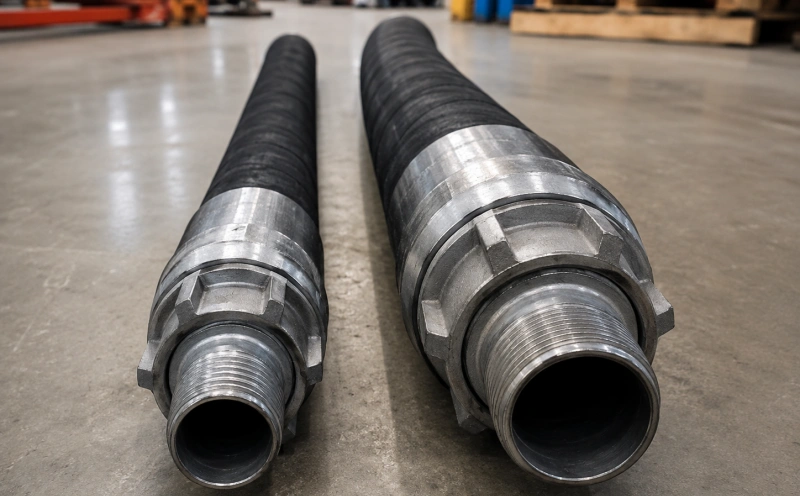
AlienFrac lists two A861 IDs: 3 in (76 mm) and 4 in (102 mm). The correct degasser hose size should be based on the equipment interface and hydraulic requirement, not on a rule that “larger is safer.”
Check three things before choosing between A861-48-2K and A861-64-2K:
- Equipment connection size. Confirm the actual connection on the degasser, tank, manifold, or adjoining line. A photograph is useful, but a dimensioned drawing is better.
- Required flow. Provide the design or expected flow through the line. Changing internal diameter changes velocity and pressure loss, so the hose ID should match the system rather than being selected in isolation.
- Available routing space. The 4 in model is physically larger and has a 1,000 mm minimum bend radius, compared with 950 mm for the 3 in model. The installation must have enough room to respect that geometry.
If you are replacing an existing hose, record the current hose ID, OD if accessible, overall length, end connections, and the equipment ports at both ends. Avoid converting a model number directly into a nominal pipe size. For example, the “64” in A861-64-2K is part of the model designation; the published hose ID is 4 in / 102 mm.
For a broader comparison of hose roles in the mud system, see degassing hose vs mud hose.
Step 4 — Check the A861 Temperature Limits
The current A861 product page lists an operating temperature range of -28°C to +93°C (-18.4°F to +199.4°F). Use the fluid temperature at the hose location as the starting point, then consider the ambient environment if the assembly is exposed outdoors.
When preparing the RFQ, provide both:
- Minimum and maximum conveyed-fluid temperature
- Minimum and maximum ambient temperature, if relevant to the installation
If the expected fluid temperature falls outside the published A861 range, do not assume that a “special hose” is automatically available. Send the temperature requirement to AlienFrac for confirmation against the actual product configuration that can be supplied.
Step 5 — Verify Degasser Hose Bend Radius and Routing
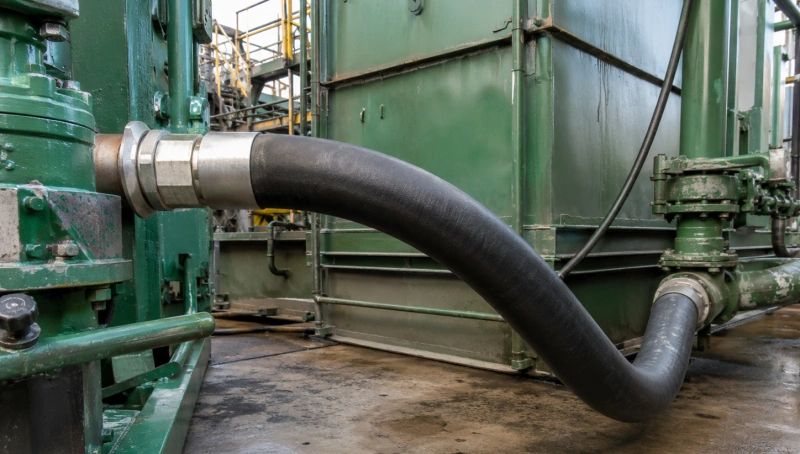
Minimum bend radius is an installation limit, not a suggestion for making the hose fit. AlienFrac publishes an MBR of 950 mm for A861-48-2K and 1,000 mm for A861-64-2K.
Before ordering, sketch or photograph the intended route and identify where the hose will leave each connection. Check that the hose can transition into its bend without being forced sharply against a fitting, frame, tank wall, or support. Also allow enough space so the assembly is not twisted to make the end connections line up.
A practical routing review should answer:
- Is there enough straight space immediately after each end connection?
- Can every bend stay at or above the published MBR?
- Will the hose rub against structural steel, equipment edges, or nearby piping?
- Is the hose expected to move, vibrate, or be repositioned in service?
- Does the installed route place the hose in torsion?
If any of these points are unclear, include an installation drawing with the RFQ. A simple dimensioned sketch often prevents more mistakes than adding extra length “just in case.”
Step 6 — Confirm the Hose End Connections
The published A861 connection is a 4 in male NPT hose tail and ferrule. That is the configuration shown on the current product page and is the only connection that should be treated as verified from the public specification.
Before ordering, confirm the mating connection at both ends. Do not rely only on a verbal description such as “threaded,” “union,” or “4 inch.” Record the thread or flange standard, nominal size, gender where applicable, and any dimensions or equipment drawing references available.
If your system uses a different connection arrangement, send the connection drawing or clear photographs with dimensions and ask AlienFrac to confirm whether a suitable assembly can be supplied. This is more reliable than assuming that hammer unions, flanges, quick-connects, or other ends are standard options for A861.
Step 7 — Specify Hose Length and Installation Geometry
Finished hose length should come from the installed route, not from a straight-line distance between two points. A hose that is too short can be pulled into an unacceptable bend or loaded at the end fittings; a hose that is excessively long can sag, rub, or be routed into unnecessary loops.
For a replacement, provide the existing assembly length and explain how that length was measured. For a new installation, send a sketch showing the two connection points, their orientation, centerline distance, elevation difference, and any obstacles between them.
Useful details include:
- Required finished length and measurement method
- Connection orientation at each end
- Centerline-to-centerline distance
- Height difference between connection points
- Required movement or service access
- Nearby structures that constrain the bend
- Preferred hose support points, if already defined by the system designer
The aim is not to “add enough hose to make it fit.” It is to provide enough geometry for the assembly to be reviewed against size, bend radius, and connection orientation together.
RFQ Checklist for Mud Degasser Hose Engineering Review
A complete RFQ speeds up technical review and reduces back-and-forth. For a mud degasser hose, send the following information in one package whenever possible:
- Application: equipment and service description
- Fluid: mud type/base fluid, additives or unusual chemicals, solids/abrasive content
- Pressure: normal and maximum pressure at the hose location
- Temperature: minimum and maximum fluid temperature; ambient range if relevant
- Size / flow: required hose ID, equipment port size, and expected flow if available
- Connections: type, size, standard, gender, and drawings or photographs
- Length: finished length and measurement method
- Routing: installation sketch, bend locations, available space, movement, and support points
- Location: onshore/offshore and any environment details that affect the assembly
- Documentation: any project-specific inspection, test, traceability, or document requirements that need to be reviewed before quotation
For the published A861 specifications, refer to the AlienFrac A861 2,000 PSI Degasser Hose. You can also review the wider degasser hose product range.
Common Mud Degasser Hose Selection Errors
Choosing by pressure alone
Pressure is only one part of the specification. A hose can have an adequate working-pressure rating and still be a poor fit because the temperature, fluid, ID, connection, or routing is wrong.
Treating 3 in and 4 in as interchangeable
The two A861 sizes have different IDs, ODs, weights, and minimum bend radii. Select the size from system requirements and interface data rather than substituting one for the other without review.
Ignoring the minimum bend radius
The published MBR is 950 mm for the 3 in A861 and 1,000 mm for the 4 in model. If the route cannot accommodate the required radius, changing only the hose length will not necessarily solve the installation problem.
Assuming the connection from the hose size
Hose ID and end connection are separate specification items. Confirm the mating equipment connection and provide the standard or drawing instead of writing only “3 inch” or “4 inch hose.”
Sending an incomplete RFQ
Missing temperature, pressure, connection, or routing data forces the supplier to make assumptions. For an oilfield hose assembly, those assumptions can change the actual product required. A short, complete data sheet is more useful than a long description without dimensions or operating limits.
Mud Degasser Hose FAQ
What is the working pressure of the AlienFrac A861 degasser hose?
AlienFrac currently publishes a 2,000 psi working pressure for both A861-48-2K and A861-64-2K. The published burst pressure is 8,000 psi. Selection should be based on the maximum pressure at the actual hose location, not the average operating pressure.
What is the difference between the 3 in and 4 in A861 models?
A861-48-2K has a 3 in / 76 mm ID, 96.3 mm OD, 950 mm minimum bend radius, and published weight of 6 kg/m. A861-64-2K has a 4 in / 102 mm ID, 128 mm OD, 1,000 mm minimum bend radius, and published weight of 10.4 kg/m. Both are listed at 2,000 psi working pressure and 8,000 psi burst pressure.
What temperature range is published for A861?
The current A861 product page lists -28°C to +93°C (-18.4°F to +199.4°F). Applications outside that range should be submitted for engineering review rather than assumed suitable.
How do I check the degasser hose bend radius before ordering?
Compare the proposed hose route with the published model-specific MBR: 950 mm for A861-48-2K and 1,000 mm for A861-64-2K. A dimensioned installation sketch is the clearest way to show available routing space and connection orientation.
Can I specify a different connection for the A861 hose?
The public A861 page lists a 4 in male NPT hose tail and ferrule. If your equipment uses another end connection, send the connection standard, drawing, and dimensions and ask AlienFrac to confirm the available assembly configuration before quotation.
What information should I send for a degasser hose quotation?
At minimum, send the application, fluid, maximum pressure, temperature range, required ID or flow, end connections, finished length, and an installation drawing or photographs. Add project-specific documentation or testing requirements at the RFQ stage so they can be reviewed before quotation.
Send Your Degasser Hose Data for Review
A reliable mud degasser hose selection starts with verified system data. If you are evaluating A861-48-2K or A861-64-2K, send AlienFrac the fluid, pressure, temperature, line size, connection drawing, finished length, and routing information. The published specifications can then be checked against the actual installation instead of relying on generic hose assumptions.
Review the AlienFrac A861 2,000 PSI Degasser Hose or browse the degasser hose product range before submitting your RFQ.