
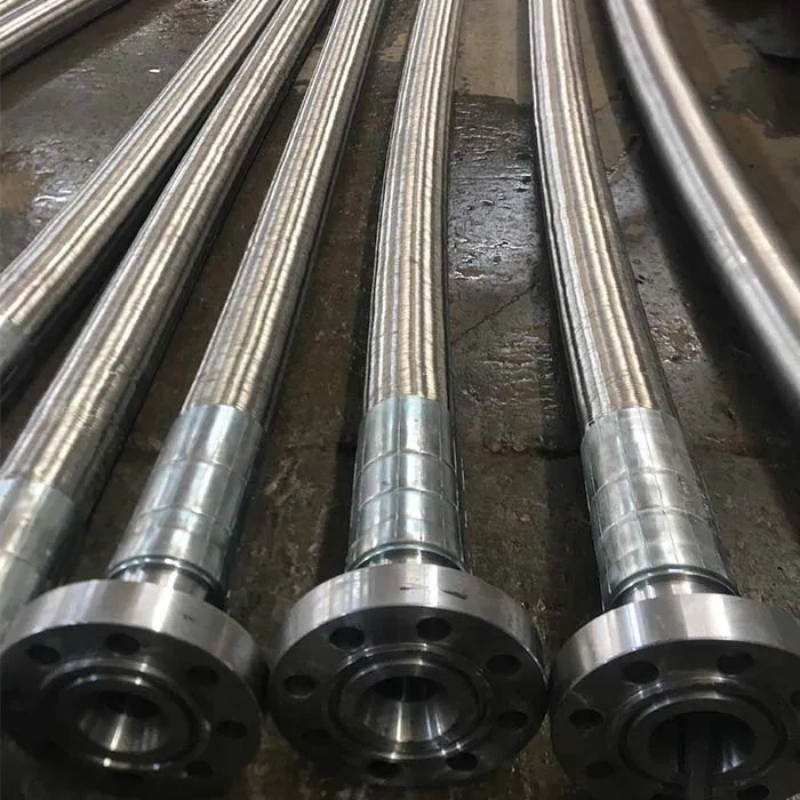
There is no single API hose inspection and hydrotest schedule that fits every oilfield hose. Start by identifying the hose type, its governing standard, the manufacturer’s operating and maintenance instructions, and your operator or project integrity requirements.
A rotary drilling hose under API Spec 7K is not managed by copying the test pressure or interval used for a flexible choke and kill line under API Spec 16C.
For API 7K rotary hose, published API RP 7L field-test guidance provides a useful, traceable procedure: inspect the hose first, arrange it without twist, remove all air, use water when possible, control the pressure rise, keep field test pressure at or below 1.25 times the hose maximum working pressure, and hold the maximum pressure for no more than 10 minutes.
Those numbers are not a universal rule for every API hose. They apply only when the guidance is appropriate to the hose, system, contract, and approved test procedure.
This guide separates API 7K from API 16C, shows you how to set a defensible inspection interval, explains when a hose should be quarantined, and gives you a record structure that can support maintenance decisions and audits.
Key Takeaways
- Identify the hose and governing standard before choosing an inspection interval or hydrotest pressure.
- Do not transfer API 7K rotary-hose field-test limits to API 16C choke and kill lines, or the reverse.
- Treat factory qualification, production proof testing, and field fitness-for-service testing as different activities with different purposes.
- Use condition, duty, environment, operating history, manufacturer instructions, and project HSE requirements to set the schedule.
- Inspect and quarantine first. A pressure test is not a safe way to investigate a visibly damaged or untraceable hose.
- Keep a serialized record that ties hose identity, MWP, procedure, calibrated instruments, pressure chart, defects, disposition, and approvals together.
- Do not impose a universal five-year service life. Replace or retire a hose when the applicable criteria, manufacturer limits, integrity program, or condition require it.
Which Standard Applies to Your Hose?
“API hose” is a market phrase, not one complete maintenance category. Your first decision is therefore classification. The API 7K hose product hub covers drilling and well-servicing hose families, while the API 16C choke and kill hose page addresses flexible lines used in well-control equipment. If you are still comparing the two families, use the API 7K vs API 16C guide before writing the inspection procedure.
| Hose or equipment | Standards position | Field-planning implication |
| Rotary, vibrator, jumper mud, and cement hose | API Spec 7K defines product requirements. API RP 7L Addendum 2 contains public operating, inspection, care, and rotary-hose field pressure-test guidance. | Use the hose certificate, nameplate/layline, current project requirements, manufacturer instructions, and an approved procedure. Apply RP 7L field-test details only within their stated scope. |
| Flexible choke and kill line | API Spec 16C covers choke and kill equipment, including flexible choke and kill lines. API lists the 3rd edition with Addendum 1 and Errata through Errata 3 (December 2025). | Separate product design/qualification and factory testing from field inspection or recertification. Use the applicable edition, manufacturer O&M, operator integrity program, well-control requirements, and local rules. |
| General petroleum or industrial hose | May fall under manufacturer procedures, purchaser specifications, industry handbooks, or jurisdiction-specific rules rather than API 7K or API 16C. | Do not label a general 150% industrial-hose procedure as an API 7K/16C requirement. Confirm the exact hose standard and service. |
| Water-based fire protection system | NFPA 25 is the ITM baseline for water-based fire protection systems. | NFPA 25 is not the general inspection standard for oilfield API hoses. Keep fire-protection requirements outside this oilfield hose procedure. |
| Important distinction: A hydrotest result confirms pressure integrity under the test conditions at that time. It does not by itself prove remaining fatigue life, chemical compatibility, sour-service capability, fire resistance, or unrestricted return to service. | ||
API 7K Rotary Hose: Field Inspection and Pressure-Test Guidance
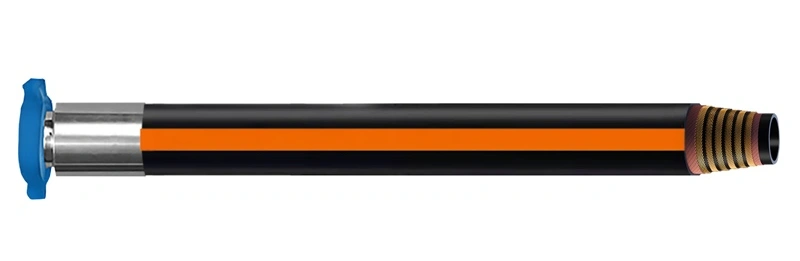
API Spec 7K is the product specification for drilling and well-servicing equipment. The current API update register lists Spec 7K, 6th edition, with published errata. API RP 7L is an older recommended practice, but its public Addendum 2 remains valuable because Appendix A states exactly what the rotary-hose field test is intended to do: establish periodic safety levels for continued operation when a field test is required.
Use that guidance as a controlled reference, not as permission to test every hose automatically. The responsible owner should confirm that the hose is eligible for the test, the full assembly and isolation system can accept the test conditions, and the manufacturer or approved procedure does not impose a lower limit.
Pre-Test Inspection and Eligibility
A hose should pass identification and condition checks before pressure is applied. Use the oilfield hose inspection checklist as a practical field aid, then confirm the product-specific criteria in the manufacturer’s manual.
- Verify the unique hose ID, manufacturer, hose type, applicable standard, maximum working pressure (MWP), size, end connections, service, and last inspection or test.
- Confirm the layline or nameplate is readable and matches the certificate and equipment register. Quarantine the hose if identity, pressure rating, or traceability cannot be established.
- Clean enough of the cover and fittings to see the complete surface. Examine cuts, abrasion, blisters, bulges, soft areas, kinks, crush damage, twist, exposed reinforcement, corrosion, and unusual deformation.
- Inspect couplings and end structures for cracks, distortion, leakage evidence, corrosion, looseness, or movement between hose body and coupling.
- Check safety clamps, attachment points, restraints, slings, and fasteners for correct location, damage, deterioration, and security.
- Check routing and support. The hose should not be twisted, pulled axially, forced below its minimum bend radius, or contacting a structure that can abrade it. See Alienfrac’s minimum bend radius guide.
For rotary hoses exposed to pressurized gas, API RP 7L calls for inspection of the liner to determine whether it has been breached or collapsed. Its public guidance describes full-length borescope examination and identifies bulges, blisters, punctures, or another liner breach as cause for rejection from further service.
Controlled Field Hydrotest for Rotary Hose
Safety boundary: Only trained and authorized personnel should perform high-pressure testing under an approved job procedure, energy-isolation plan, barricade/exclusion zone, rated restraints, and site-specific PPE requirements. Never use this article as the test procedure by itself.
- Confirm the written test basis. Record the hose MWP, required test pressure, pressure limit of every valve, fitting, adapter, blind, and test component, and the governing manufacturer/project procedure. The lowest permitted component limit controls.
- Verify the test equipment. Use rated connections, a suitable pump, pressure-relief and controlled depressurization provisions, and calibrated pressure instruments with current certificates and an appropriate range.
- Position the hose correctly. API RP 7L states that the hose should be arranged as straight as possible without twist and, before testing, suspended in its normal unstressed position from standpipe to swivel.
- Fill with the approved liquid and remove trapped air. The published guidance says all air must be bled before pressure is applied and water should be used as the test medium when possible.
- Raise pressure at the approved controlled rate. API RP 7L A.15.4 gives a pressure-rise range of 6.9 to 68.9 MPa per minute (1,000 to 10,000 psi per minute). A project procedure may require a slower or staged ramp within an allowable basis.
- Respect the field-test ceiling. For rotary hose within this guidance, field test pressure must not exceed 1.25 times the hose MWP, regardless of a higher manufacturer delivery-test pressure. Valves or other isolation equipment may impose a lower limit.
- Limit the maximum-pressure hold. API RP 7L A.15.6 says the maximum test pressure hold should not exceed 10 minutes. Use the approved procedure to define the actual hold and stabilization steps.
- Observe from protected positions. Monitor for leakage, abnormal pressure decay, fitting movement, cover changes, distortion, or other unusual behavior. Stop and depressurize in a controlled manner if the procedure’s abort criterion is met.
- Depressurize and inspect. Release pressure under control, confirm zero energy, drain or flush as required for the next service, then repeat the external and connection inspection.
- Record and disposition. Attach the pressure-time chart, note any anomalies, and obtain the required technical approval before returning the hose to service. A leaking hose must be removed from service under the RP 7L guidance.
API 16C Choke and Kill Lines: Keep Product Testing Separate From Field Maintenance
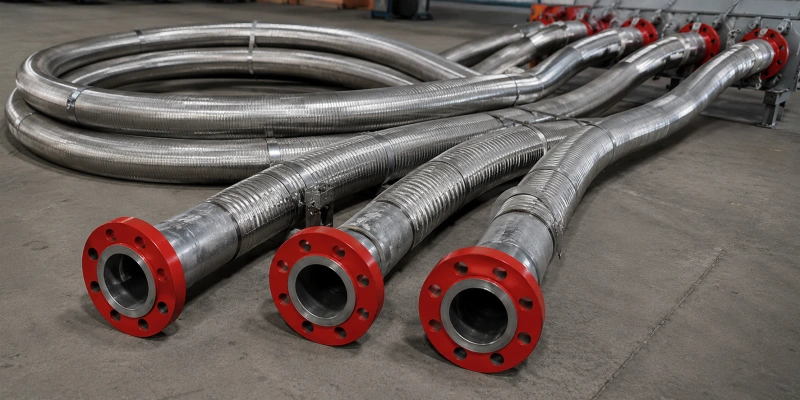
API Spec 16C establishes minimum requirements for the design and manufacture of choke and kill equipment, including flexible choke and kill lines. Its technical scope includes performance, design, materials, welding, testing, inspection, storing, and shipping. API’s latest-update register identifies the 3rd edition and lists Addendum 1 (July 2024) plus Errata 3 (December 2025).
That scope does not create one public field hydrotest interval for every installed line. Do not take a design-validation, factory proof, burst, fire, or sour-service qualification value and use it as a recurring field test. Before field inspection or recertification, obtain the exact assembly documentation and the manufacturer’s approved O&M or IMR process. Alienfrac’s API 16C maintenance guide provides additional lifecycle context, while the API hose certificate checklist helps you verify the document package.
What to Verify Before an API 16C Field Decision
- Assembly serial number, manufacturer, model/design, rated working pressure, flexible specification level where applicable, temperature range, service media, minimum bend radius, end connections, and armor or fire-protection configuration.
- Current certificate, manufacturing data, original test records, drawings, approved O&M manual, previous inspections and pressure charts, service history, repairs, abnormal events, and storage periods.
- Operator well-control and hose integrity requirements, jurisdictional rules, customer specifications, third-party witness points, and any limits imposed by connected well-control equipment.
- Evidence that the proposed field method is approved for the specific assembly. Confirm pressure, medium, temperature, ramp, hold, acceptance criteria, post-test drying, and disposition directly from the controlling procedure.
- Sour-service or chemical limits where applicable. A hydrotest with water does not requalify a hose for H2S, rapid gas decompression, fire, or a new chemical service.
How to Set an Inspection and Hydrotest Schedule?
A useful schedule combines routine observation, planned detailed inspection, event-driven inspection, and pressure testing only when justified. The calendar is an output of the integrity decision, not the starting assumption.
| Planning layer | When it applies | Typical decision |
| Pre-use or operating check | At the operator-defined frequency for the duty, such as before use, per shift, or before a critical operation. | Confirm identity, routing, MBR, restraints, connections, leakage, cover condition, and abnormal movement. Remove from service if an immediate hazard or rejection condition is found. |
| Planned detailed inspection | At an interval set by the manufacturer, operator integrity program, regulation, contract, and risk assessment. | Clean and examine the full assembly; review records; measure or inspect internally when required; decide continue, shorten interval, test, repair only if manufacturer-approved, or retire. |
| Event-driven inspection | After overpressure, severe pressure pulsation, fire/heat exposure, impact, kink, twist, excessive bend, dropped load, chemical upset, gas exposure, leakage, or abnormal handling. | Quarantine first. Obtain engineering/manufacturer disposition before any test or return to service. |
| Field hydrotest or recertification | Only when required by the applicable approved procedure, manufacturer, operator program, contract, regulation, or competent technical authority. | Use the hose-specific test basis. Do not select a multiplier or hold time from another hose family. |
| Retirement review | When rejection criteria are met, traceability is lost, limits are exceeded, repeated deterioration is observed, or the integrity program reaches a defined retirement point. | Retire or obtain the manufacturer-approved disposition. Age alone is not a universal API retirement rule. |
Risk Factors That Can Shorten the Interval
Use a shorter review interval, more detailed inspection, or stronger controls when the consequence or likelihood of failure increases. Document why the interval changed.
- Well-control or another high-consequence service.
- Frequent pressure cycling, severe pulsation, surge, vibration, or dynamic movement.
- Operation near pressure or temperature limits.
- Sour gas, CO2, aggressive chemicals, abrasive solids, high-velocity flow, or incompatible cleaning media.
- Tight routing, repeated flexing, torsion, axial loading, external abrasion, deck contact, offshore motion, UV, ozone, saltwater, or weather exposure.
- Unknown or incomplete service history, long storage, prior repairs, missing pressure charts, or uncertain traceability.
- A trend of cover damage, fitting corrosion, pressure instability, or recurring minor findings.
- Any excursion beyond MWP, minimum bend radius, temperature, chemical, decompression, or handling limits.
Reject or Quarantine Criteria
Your controlling standard and manufacturer procedure determine the final disposition. The following conditions normally justify immediate removal from service or quarantine pending qualified review. For broader failure-mechanism context, see oilfield hose failure modes and prevention.
| Finding | Immediate action | Reason |
| Leak, sweating, or uncontrolled pressure loss during test or service | Stop, isolate, depressurize safely, and remove from service. | The pressure boundary has not demonstrated integrity. |
| Bulge, blister, puncture, liner collapse, or another internal breach | Reject or quarantine; obtain manufacturer disposition. | May indicate liner damage, permeation/decompression damage, or reinforcement loading. |
| Exposed, corroded, broken, or displaced reinforcement | Remove from service and protect personnel from the assembly. | Structural capacity may be reduced and hidden corrosion may continue. |
| Coupling movement, separation, cracked fitting, distorted end, damaged weld, or severe corrosion | Quarantine immediately. | End retention and pressure sealing may be compromised. |
| Kink, crush, permanent flattening, twist, or operation below MBR | Remove from service pending qualified disposition. | Internal layers can be damaged even when the cover looks recoverable. |
| Fire or excessive heat exposure, overpressure, impact, or other major event | Quarantine and preserve event data. | A normal visual check may not reveal heat, fatigue, or internal damage. |
| Unreadable ID/MWP or records that cannot be tied to the assembly | Quarantine until traceability and rating are restored through approved records. | A safe procedure cannot be selected without verified identity and limits. |
Inspection and Hydrotest Record Template
A good record should let another competent reviewer reconstruct the decision without relying on memory. Include the following fields in the equipment register, inspection report, and pressure-test package.
| Record group | Required fields |
| Hose identity | Unique ID/serial number; manufacturer; hose type/model; applicable standard and edition; size; overall length; end connections; date of manufacture; layline/nameplate status. |
| Ratings and service | MWP; temperature range; MBR; media; actual service; operating pressure/temperature; sour or chemical limits; connected equipment limits. |
| Inspection basis | Procedure and revision; manufacturer manual; operator/project requirement; inspection level; reason for inspection; previous inspection/test date. |
| Visual/internal findings | Cover, reinforcement, end fittings, coupling movement, routing, twist, MBR, restraints, liner/borescope findings, measurements, photographs, defect location and severity. |
| Test setup | Test medium; fluid temperature; target pressure; ramp stages/rate; stabilization and hold; pump; relief device; gauge/transducer IDs, ranges, accuracy and calibration due dates; adapters and blinds. |
| Results | Actual peak pressure; actual hold time; pressure-time chart; leaks; pressure decay; dimensional or fitting movement; post-test inspection; pass/fail against named criteria. |
| Disposition | Return to service, shortened interval, further examination, manufacturer review, approved repair, retirement/destruction; restrictions; next review trigger/date. |
| Approvals | Inspector/tester; competent technical reviewer; operator representative; third-party witness when required; dates and signatures. |
Common Planning Mistakes
Using one annual interval for every hose. An annual hydrotest may appear in general industrial or local regulatory guidance, but that does not make it the API 7K/16C interval for every oilfield assembly.
Testing at 1.5 or 2 times working pressure by habit. The number must come from the specific hose standard, manufacturer, contract, and approved field procedure. API RP 7L limits the cited rotary-hose field test to no more than 1.25 × MWP.
Pressure-testing a visibly damaged hose. Quarantine and assess it first. Hydrotesting can expose personnel and equipment to energy release and does not repair or explain damage.
Calling a factory test a field recertification rule. Production proof, design validation, burst, fire, and field fitness-for-service testing have different objectives and acceptance bases.
Using NFPA 25 for oilfield API hose. NFPA 25 addresses water-based fire protection systems. It should not be cited as the governing inspection standard for API 7K or API 16C oilfield hose.
Replacing every hose at five years. No universal API five-year life applies to every hose in this article’s scope. Use rejection criteria, manufacturer limits, integrity history, service severity, and project rules.
Keeping only a pass/fail certificate. A certificate without hose identity, procedure, instruments, chart, actual conditions, findings, and disposition is weak lifecycle evidence.
Build a Defensible Hose Integrity Program
You do not need a longer calendar; you need a clearer decision trail. Classify the hose, identify the controlling documents, inspect for known damage modes, set the interval from risk and history, and test only under a hose-specific approved procedure. When the service changes, repeat the decision instead of assuming the old schedule still applies.
Alienfrac can review your application data, hose type, end connections, documentation list, and inspection objectives before you request a new assembly or plan a manufacturer-supported inspection. Start with the API 7K hose range or API 16C choke and kill hose range, then send the service envelope and required standards for an application-specific review.
Before publishing or using this guide: Confirm current standard editions, manufacturer instructions, Alienfrac product capabilities, test limits, and jurisdictional requirements with a qualified technical reviewer. This article is planning guidance, not a project-specific pressure-test procedure or fitness-for-service approval.
FAQ
Is there one API hose inspection and hydrotest schedule?
No. API 7K hose, API 16C flexible choke and kill line, and general petroleum hose do not share one universal inspection interval, test multiplier, or retirement age. Start with hose identity, governing documents, manufacturer instructions, service severity, and operator requirements.
What is the API 7K rotary-hose field test pressure?
API RP 7L Addendum 2, A.15.7 states that field test pressure must not exceed 1.25 times the hose maximum working pressure, regardless of a higher delivery-test pressure. Connected valves or other components may require a lower limit. Use this only within an approved procedure for the applicable rotary hose.
How long should the rotary-hose maximum test pressure be held?
API RP 7L A.15.6 says the maximum-pressure hold should not exceed 10 minutes. The approved procedure should define the actual hold, stabilization, monitoring, and acceptance criteria.
Can the API 7K field-test rule be used for API 16C hose?
Not automatically. API 16C covers different equipment and product requirements. Use the specific assembly’s manufacturer O&M/IMR documentation, operator integrity program, contract, applicable edition, and local regulation.
Does a passed hydrotest prove the hose is safe for continued service?
It provides evidence of pressure integrity at the test conditions and time. It does not by itself prove remaining fatigue life, chemical compatibility, H2S capability, rapid gas decompression resistance, fire resistance, or correct installation.
When should a hose be inspected outside the planned interval?
Inspect or quarantine it after an overpressure, fire or heat exposure, impact, severe kink or twist, operation below MBR, chemical upset, pressurized-gas exposure, unexpected leakage, abnormal movement, or any event outside documented limits.
Should every oilfield hose be replaced after five years?
No universal five-year replacement rule applies to every API 7K or API 16C hose. Retirement should follow the manufacturer’s limits, governing integrity program, condition, rejection criteria, operating history, criticality, and applicable regulation.
What should a hydrotest certificate include?
At minimum: hose identity, standard/procedure, MWP, test medium, target and actual pressure, ramp and hold, fluid temperature, gauge/transducer IDs and calibration status, pressure-time chart, inspection findings, result, disposition, and required signatures or witness details.