
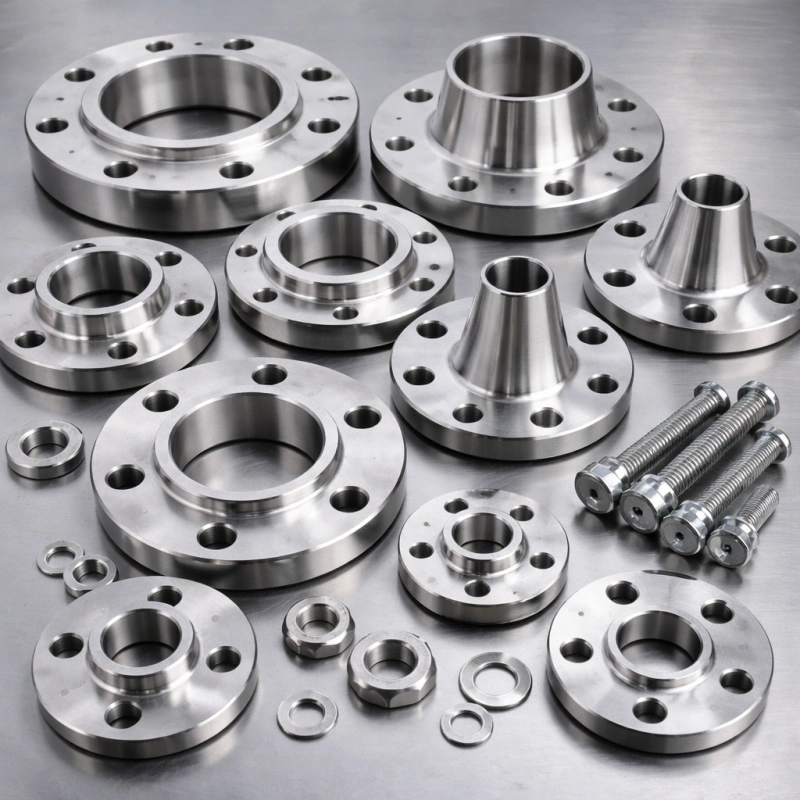
You rely on pipe flanges to create secure, leak-proof connections in industrial piping systems. Each flange supports your pipeline by aligning joints, containing pressure, and resisting corrosion. Flange design ensures easy assembly, vibration dampening, and safe access for inspection or maintenance.
You must understand every flange part and its specification to guarantee operational safety and reliability. For demanding applications, Alienfrac delivers API flanges that withstand extreme conditions and maintain system integrity.
Key Takeaways
- Understand the inside and outside diameter of flanges to ensure a proper fit and smooth flow in your pipeline.
- Choose the right flange thickness based on pressure and temperature conditions to enhance mechanical strength and durability.
- Select the appropriate flange type, such as weld neck or slip-on, based on your pipeline’s specific pressure and temperature requirements.
- Regularly inspect and maintain flanges to prevent leaks and ensure long-term reliability in your piping systems.
- Always match flange materials to the corrosive properties of the fluids they will handle for optimal performance and safety.
Main Parts of Pipe Flanges
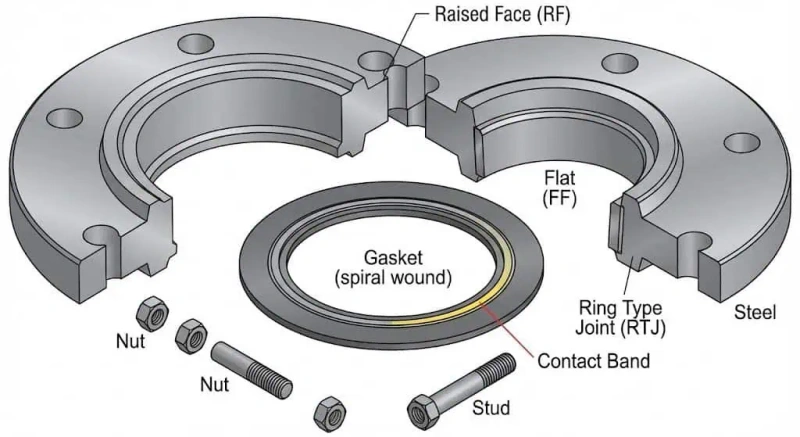
Understanding each part of a flange helps you select the right component for your pipeline. Every detail, from diameter to counterbore, plays a role in the performance and safety of your system.
Inside and Outside Diameter
You must pay close attention to the inside and outside diameter when choosing a flange. The inside diameter matches the pipe’s outer diameter, ensuring smooth flow and a proper fit. The outside diameter determines the overall size and affects the strength and compatibility with other components.
| Parameter / Part | Definition | Role / Purpose |
|---|---|---|
| Inside Diameter (ID) | Bore that matches the pipe’s outer diameter | Supports flow continuity and a correct fit |
| Outside Diameter (OD) | Overall flange size | Affects bolt hole circle and flange strength |
The inside diameter defines the flow capacity. You must match it to the connected pipes to prevent turbulence and pressure drops. The outside diameter determines the flange size and gasket requirements. It must align with adjacent components for a secure connection.
| Diameter Type | Description |
|---|---|
| Inner Diameter (I.D.) | Measurement of the bore in the center of the flange. Defines flow capacity; must match connected pipes to prevent turbulence and pressure drops. |
| Outer Diameter (O.D.) | Measurement of the outside edge of the flange. Determines flange size and gasket requirements; must be compatible with adjacent components for a secure connection. |
Flange Thickness and Hub
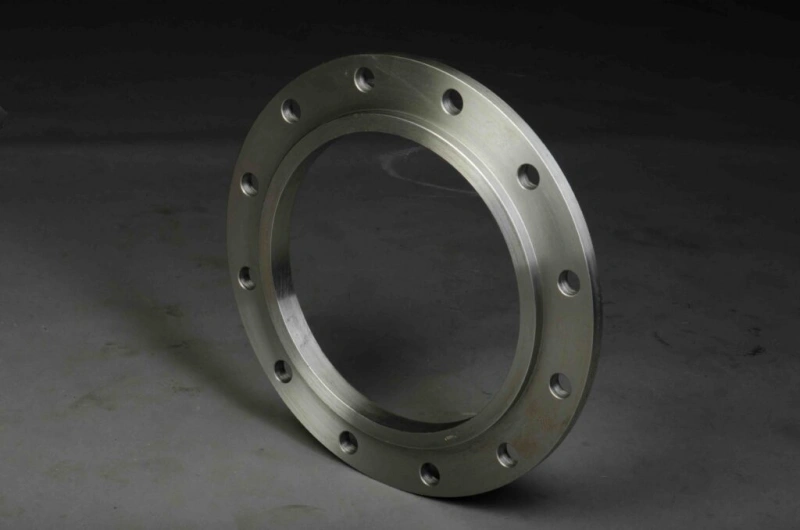
You need to consider flange thickness and hub dimensions for mechanical strength and pressure tolerance. Industry standards, such as API and ASME, specify these dimensions to ensure safety and reliability.
For example, API International hub flanges use forged carbon steel or stainless steel and comply with ANSI/ASME B16.5 and AWWA C207 standards.
| Flange Type | NPS Range | Thickness Tolerance | Hub Diameter Tolerance |
|---|---|---|---|
| Weld-Neck Flanges | 18 and smaller | +0.12″, -0.00″ | ±0.06″ |
| Weld-Neck Flanges | 20 and larger | +0.19″, -0.00″ | ±0.12″ |
| Hub Flanges | 4″ – 6″ | 0.94″ – 1.00″ | 4.5″ – 6.7″ |
| Hub Flanges | 8″ – 12″ | 1.00″ – 1.25″ | 8.6″ – 12.9″ |
| Hub Flanges | 14″ – 20″ | 0.75″ – 1.00″ | 14.2″ – 20.2″ |
| Hub Flanges | 24″ – 30″ | 1.00″ – 1.75″ | 24.2″ – 30.2″ |
| Hub Flanges | 36″ – 48″ | 1.25″ – 2.00″ | 36.2″ – 48.3″ |
| Hub Flanges | 54″ – 72″ | 1.50″ – 2.25″ | 54.3″ – 72.2″ |
| Hub Flanges | 78″ – 144″ | 1.75″ – 3.00″ | 78.3″ – 144.3″ |
Thicker flanges provide greater mechanical integrity and durability. You should select the thickness based on the pressure and temperature conditions of your pipeline.
Higher-strength materials support higher pressures, which is crucial for flange thickness. The design must account for thickness to withstand the forces under varying pressure conditions.
- Material selection impacts the allowable pressure ratings of flanges.
- Higher-strength materials can support higher pressures, which is crucial when considering flange thickness.
- The relationship between temperature and pressure further emphasizes the need for appropriate flange thickness in design.
- The pressure rating indicates the maximum pressure a flange can handle before showing signs of deformation or failure.
- Thicker flanges enhance mechanical integrity and durability, making them essential for high-pressure applications.
- The design of a flange must account for its thickness to ensure it can withstand the forces exerted under varying pressure conditions.
Raised Face and Bolt Circle
The raised face is a critical feature for sealing. You will find an elevated surface above the bolting circle where the gasket sits. This design concentrates pressure on a smaller gasket area, improving the joint’s ability to contain higher pressures.
- Raised face flanges have an elevated surface above the bolting circle where the gasket is placed.
- This raised area helps create a seal when compressed against a gasket, enhancing sealing performance.
- The design concentrates pressure on a smaller gasket area, which increases the joint’s strength to contain higher pressures.
The bolt circle diameter (BCD) is another essential measurement. It is the diameter of the circle that passes through the center of all the bolt holes on a flange. This measurement ensures compatibility with bolt patterns and adjacent flanges.
- Number of Bolt Holes: The total count of fasteners used to secure the flange.
- Bolt Hole Diameter: The size of each hole, which determines the bolt size.
- Bolt Circle Diameter (BCD): The imaginary circle that connects the centers of all bolt holes.
Bolt Holes and Chamfer
You must check the number, size, and placement of bolt holes for proper assembly. The bolt holes allow you to secure the flange to the pipe or another flange. The diameter and spacing must match the bolts and the bolt circle diameter.
The chamfer is a beveled edge at the entrance of the bolt hole or bore. This feature helps guide bolts into place and reduces the risk of damage during installation. You will find that a well-machined chamfer makes assembly faster and safer.
Tip: Always verify bolt hole size and chamfer quality before installation to prevent misalignment and ensure a tight seal.
Radius and Counterbore
The radius refers to the curved transition between the flange face and the bore or hub. This curve reduces stress concentration and increases the mechanical strength of the flange. You should look for a smooth radius to prevent cracks and extend the service life of your pipeline.
The counterbore is a cylindrical recess at the flange’s bore. It allows the pipe end to fit flush with the flange face, improving alignment and sealing. You will achieve a better fit and reduce the risk of leaks when the counterbore matches the pipe dimensions.
By understanding these main parts, you can select the right flange for your application and maintain the safety and efficiency of your pipeline.
Key Flange Specifications
Understanding key flange specifications helps you select the right component for your pipeline. You must evaluate flange types and connections, sizes and ratings, face types, materials, and shapes to ensure safety and performance.
Alienfrac’s API flanges set a benchmark for quality and reliability, meeting the strictest industry standards.
Flange Types and Connections
You encounter several flange types and flange connections in industrial settings. Each type serves a specific purpose and offers unique advantages. The most common flange types include slip-on, weld neck, and blind flanges.
You must choose the right flange based on your pipeline’s pressure, temperature, and maintenance requirements.
| Flange Type | Application Suitability | Key Advantages |
|---|---|---|
| Slip-On Flanges | Suitable for moderate conditions, not ideal for high-pressure or high-temperature. | Easy installation, cost-effective, versatile, lighter weight, easier alignment. |
| Weld Neck Flanges | Ideal for high-pressure environments, used in industrial settings like chemical plants. | Robust, leak-proof design, long service life, stress reduction in high-pressure scenarios. |
| Blind Flanges | Used to seal pipeline ends, effective in high-pressure environments. | Prevents fluid or gas escape, facilitates pipeline extensions, invaluable for pressure testing. |
Weld neck flanges dominate the oil and gas industry, holding a 62% market share by 2035. You rely on these flanges for critical applications because their robust design withstands high pressures and temperatures.
Threaded flanges are emerging as an alternative, especially in smaller diameter piping systems. Alienfrac’s API flanges include weld neck, threaded, and blind types, giving you flexibility for any pipeline scenario.
Tip: Always match the flange connection to your pipeline’s operating conditions to maximize safety and efficiency.
Flange Sizes and Ratings
You must pay close attention to flange sizes and pressure rating when designing or upgrading a pipeline. Flange sizes range from NPS 2 to NPS 60, covering a wide variety of industrial applications.
The pressure rating indicates the maximum pressure a flange can handle at a specific temperature. ASME and API standards, such as ANSI/ASME B16.5 and B16.47, classify flanges by pressure class.
| ASME Pressure Class | Typical Pressure Range* | Common Applications and Service Characteristics |
|---|---|---|
| Class 150 | Up to ~285 psi | Water systems, HVAC, low-pressure steam, fire protection, and general industrial piping. |
| Class 300 | Up to ~740 psi | Process piping, compressed air, hydrocarbons, light chemical service. |
| Class 600 | Up to ~1480 psi | Oil and gas processing, steam systems, chemical plants, and power generation. |
You see that higher class numbers correspond to flanges that can withstand greater pressures. The size of the flange also influences its pressure rating, with larger sizes typically able to handle higher pressures.
| Class | Maximum Pressure (psi) | Temperature (°F) |
|---|---|---|
| 150 | 150 | 100 |
| 300 | 300 | 100 |
| 600 | 600 | 100 |
| 900 | 900 | 100 |
| 1500 | 1500 | 100 |
| 2500 | 2500 | 100 |
Alienfrac’s API flanges comply with API 6A, API 605, and other international standards. You can select from a wide range of sizes and pressure ratings, ensuring compatibility with your pipeline’s requirements.
Face Types
Flange face types play a critical role in sealing and gasket selection. The most common flange face types are raised face (RF) and flat face (FF). You must select the appropriate face type to ensure a leak-tight seal and long-term reliability.
| Flange Face Type | Description | Gasket Implications |
|---|---|---|
| Raised Face (RF) | Slightly raised surface creates a stronger seal. | Suitable for various gaskets, including spiral wound types. |
| Flat Face (FF) | Completely flat surface, full contact with the gasket. | Best for low-pressure applications, typically with flat gaskets. |
The sealing surface also includes concave/female, convex/male, tenon, groove, and ring-type joint (RTJ) faces. Each type suits different working conditions, pressures, and media. You must consider the type of fluid, temperature, pipeline vibration, and corrosion risk when choosing a flange face.
Note: Proper flange facing enhances system reliability and safety. A well-machined face ensures effective gasket compression, maintaining a leak-tight seal under varying conditions.
On-site reconditioning of worn flange faces can reduce maintenance time and costs. This process avoids the need for extensive pipeline section removals, minimizing downtime.
Flange Materials
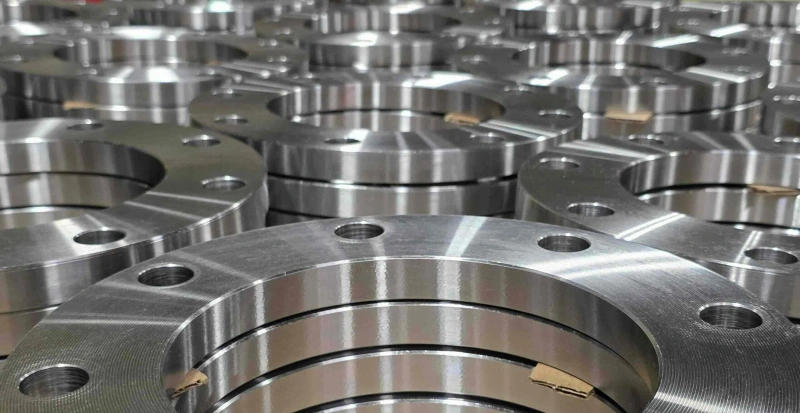
Selecting the right flange material is essential for corrosion resistance and mechanical strength. You will find stainless steel, carbon steel, cast iron, alloy steels, aluminum, titanium, and plastics as common options.
- Stainless steel: Excellent resistance to corrosion and oxidation, suitable for various environments, good mechanical properties, and lower upkeep.
- Cast iron: Lower cost, good stiffness, improved toughness in ductile iron.
- Alloy steels: Good mechanical strength, relatively low cost, well understood in design.
- Aluminum: Lightweight, decent corrosion resistance, easy to work with.
- Titanium: High strength-to-weight ratio, excellent corrosion resistance, long service life.
- Plastics: Corrosion resistance, low cost, lightweight.
| Material Type | Corrosion Resistance | Mechanical Properties | Typical Applications |
|---|---|---|---|
| Stainless Steel | Excellent resistance to corrosion | High strength, suitable for high-temperature and high-pressure applications | Chemical processing, marine, desalination, corrosive service conditions |
| Carbon Steel | Poor corrosion resistance, requires coatings | High tensile strength, economical, good machinability | Oil, natural gas, water treatment |
| Cast Iron | Weak corrosion resistance, typically used with coatings | Less expensive, suitable for low-stress applications | General use in low-stress environments |
Alienfrac’s API flanges use high-quality stainless steel, carbon steel, and alloy steel. You can trust these materials to deliver long-lasting performance in harsh environments.
Flange Shapes
You must understand flange shapes to ensure proper installation and leak prevention. International standards recognize several shapes, each with unique benefits.
| Flange Shape | Description | Application Context |
|---|---|---|
| Raised Face (RF) | Most common, raised portion for gaskets. | Used with spiral wound gaskets to prevent leakage. |
| Flat Face (FF) | Flat design, often for lower-pressure applications. | Solid connection with rubber gaskets. |
| Ring-Type Joint (RTJ) | Groove for a metal ring gasket, suitable for high-pressure. | Strong connections in high-pressure and temperature. |
| Tongue and Groove | Resembles puzzle pieces, allows for easy disassembly. | Useful for frequent maintenance. |
| Male-Female (M/F) | Ensures alignment, similar to T&G but simpler. | Ideal for precise alignment in installations. |
Weld neck shapes provide exceptional mechanical strength and leak prevention. You use these flanges in severe service conditions where a secure, leak-proof connection is critical. Anchor flanges secure pipes to fixed structures, absorbing forces from thermal expansion and vibration.
Alienfrac’s API flanges meet ANSI, ASME, AWWA, API, and DIN standards. You can rely on these flanges for proper fit, safety, and performance in any pipeline system.
Remember: Matching flange specifications to your application ensures optimal performance and safety. Alienfrac’s broad product range gives you the flexibility to meet any challenge.
Factors Affecting Flange Selection
You must evaluate several factors when choosing the right flange for your pipeline systems. Each factor impacts the safety, reliability, and performance of pipe flanges in demanding environments.
Pressure and Temperature
Pressure and temperature ratings determine the suitability of a flange for your pipeline. You need flanges that can withstand the maximum working pressure and temperature of your system. Alienfrac API flanges are engineered for high-pressure and high-temperature applications, meeting API and ASME standards.
| Material Group | Pressure Rating | Temperature Rating |
|---|---|---|
| ASTM A105 | Class 150 | Up to 350°F |
| ASTM A182 F304 | Class 300 | Up to 800°F |
Tip: Always match the flange material and rating to your pipeline’s operating conditions to prevent leaks and failures.
Corrosive Environments
Corrosive fluids require flanges made from materials with superior resistance. You should select flanges based on the chemical properties of the fluid and the environment. Alienfrac API flanges offer options like stainless steel, alloy steel, and Hastelloy for harsh conditions.
| Flange Material Name | Characteristics | Applicable Environment | Application Area |
|---|---|---|---|
| ASTM A182 F304 | Good corrosion resistance, formability | Up to 870°C | Oil, gas, chemical, food |
| ASTM A182 F316 | Enhanced chloride resistance | Seawater, high corrosion, up to 870°C | Marine, pharmaceutical |
| Hastelloy C276 | Excellent resistance to acids and seawater | Highly aggressive chemical environments | Pollution control, marine |
Installation and Maintenance
Installation and maintenance procedures affect flange selection. You must inspect and clean all parts, align the flange face, and use proper torque tightening. Alienfrac API flanges are designed for easy installation and maintenance, reducing downtime.
- Inspect and clean all parts.
- Center the gasket between flange faces.
- Insert bolts and tighten nuts.
- Use a torque wrench in a star pattern.
- Check for gaps and conduct a leak test.
Note: Proper installation extends the service life of your pipeline systems.
Mechanical Strength
Mechanical strength ensures the flange can handle operational loads. You should look for flanges that pass the hardness and tensile tests. Alienfrac API flanges undergo rigorous testing to guarantee durability and performance.
- Hardness tests
- Tensile tests
Disassembly Needs
Frequent maintenance requires flanges that allow quick disassembly. Lap joint flanges are ideal for systems needing regular adjustments. Alienfrac offers lap joint flanges that simplify maintenance and reduce costs.
- Lap joint flanges provide flexibility for frequent assembly and disassembly.
- Only the stub end contacts the process fluid, reducing the use of high-cost materials.
- Quick disassembly is crucial in maintenance-heavy environments.
Consider Alienfrac’s certifications and product features when selecting flanges for critical applications. You ensure safety and reliability in your pipeline systems.
Conclusion
You improve system performance and safety by understanding every part and specification of pipe flanges. Proper flange selection prevents leaks, failures, and costly downtime. Certified products like Alienfrac API Flanges deliver proven advantages:
| Benefit | Description |
|---|---|
| Compliance with Industry Standards | Certified products meet specific industry regulations, ensuring safety and reliability. |
| Enhanced Reliability | Engineered designs improve performance in high-pressure and abrasive environments. |
| Reduced Downtime | Customization and system-level integration lead to easier installation and less operational downtime. |
You ensure compatibility and long-term reliability by choosing flanges that meet industry standards. Select the correct flange type and material for leak-free operation and mechanical strength. Follow these expert tips for matching flange specifications:
- Align surfaces properly to maintain seal integrity.
- Center the gasket between flanges without twisting.
- Tighten bolts in a criss-cross pattern, increasing torque gradually.
- Inspect gaskets and bolt tightness regularly.
- Replace worn gaskets immediately.
- Use standards like ASME B16.20 or B16.21 for assurance.
For tailored solutions, consult with industry experts or visit Alienfrac’s website. You secure your operations with the right flange every time.
FAQ
What is the difference between API and ASME flanges?
You will find that API flanges meet oil and gas industry standards for high-pressure, high-temperature service. ASME flanges cover a broader range of industrial applications. Always check your project requirements before choosing a flange type.
How do you select the right flange material?
You should consider the fluid type, pressure, temperature, and corrosion risk. Stainless steel works well for corrosive environments. Carbon steel suits general service. Review your system’s needs before making a selection.
Why do flange face types matter?
You need the correct face type to ensure a leak-proof seal. Raised face flanges handle higher pressures. Flat face flanges work best in low-pressure systems. Always match the face type to your gasket and application.
How often should you inspect flanges?
You should inspect flanges during routine maintenance or after any system upset. Look for leaks, corrosion, or bolt loosening. Regular checks help you prevent failures and extend service life.
Where can you find certified API flanges?
You can visit Alienfrac’s API Flanges page for certified, high-quality options. Alienfrac provides flanges that meet strict industry standards for safety and reliability.