
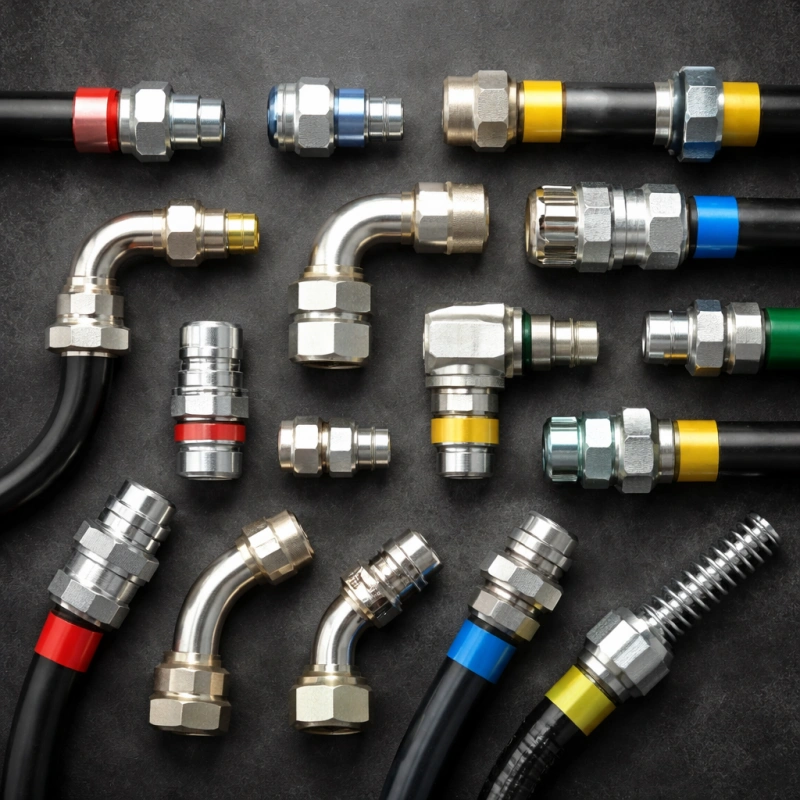
When you explore hydraulic hose connector types, you will find several common options in industrial applications:
- Threaded fittings, such as NPT and BSP, offer secure, leak-proof connections for high-pressure systems.
- Flanged fittings provide stability and easy maintenance.
- Quick couplings allow fast, tool-free connections.
Choosing the right connector impacts safety, performance, and cost. You must consider compatibility, durability, and proper installation to avoid failures and ensure long-lasting, reliable operation.
Key Takeaways
- Choose the right hydraulic hose connector to ensure safety and prevent leaks in your system.
- Understand different connector types like threaded, flanged, and quick couplings for various applications.
- Regularly inspect and maintain connectors to extend their lifespan and avoid costly downtime.
- Always verify the compatibility of connectors with your hydraulic fluid and system requirements.
- Consult experts or suppliers for tailored solutions to meet your specific hydraulic needs.
What Are Hydraulic Hose Connectors?
Definition and Role
Hydraulic hose connectors serve as essential links in fluid power systems. You use these components to join hoses, pipes, and tubes, creating a secure path for hydraulic fluid. Each connector type plays a specific role, ensuring that fluid flows efficiently and safely throughout the system.
When you select the right connector, you prevent leaks and maintain system pressure. Hydraulic hose connector types include threaded, flanged, and quick coupling designs, each suited for different applications and requirements.
Hydraulic fittings allow you to rapidly connect and disconnect hydraulic fluid lines. This capability minimizes downtime and boosts productivity in demanding environments. You can attach and detach hoses frequently without compromising the integrity of the system.
Importance in Hydraulic Systems
Hydraulic hose connectors impact the reliability and performance of your equipment. The proper selection and compatibility of hoses and fittings determine the integrity of the hydraulic circuit.
If you use incompatible components, you risk costly downtime, reduced productivity, and safety hazards. Leaks and spills can cause environmental damage and threaten personnel safety.
You rely on connectors to ensure a seamless flow of hydraulic fluid. They maintain system integrity, preventing leaks and damage. Maintenance becomes simpler, allowing you to reduce downtime and keep operations running smoothly.
- Enhance efficiency and productivity in various applications.
- Facilitate frequent attachment and detachment of hydraulic lines.
- Simplify maintenance, reducing downtime and boosting productivity.
When you understand hydraulic hose connector types, you make informed decisions that protect your equipment and improve operational safety. Choosing the right connector ensures your hydraulic system operates reliably under high pressure and harsh conditions.
Main Hydraulic Hose Connector Types
Hydraulic hose connector types play a crucial role in ensuring safe, efficient, and reliable hydraulic systems. You encounter a variety of connectors, each designed for specific sealing mechanisms, pressure ratings, and industry standards.
Understanding these types helps you select the right connector for your application and maintain system integrity.
O-Ring Face Seal (ORF) and Metal Seal

You rely on O-Ring Face Seal fittings when you need a leak-free connection under high pressure. These connectors compress an O-ring against the fitting’s face, creating a dynamic seal that improves as system pressure increases.
The O-ring material, such as nitrile rubber, fluorocarbon, or EPDM, matches your hydraulic fluid and temperature requirements. Metal seal connectors use precision-machined surfaces to achieve a tight, reliable seal without soft materials.
O-Ring Face Seal connectors are essential in petrochemical, industrial gas, oil and gas, and high-pressure systems. Their design prevents leaks and maintains system integrity, especially in applications where gas containment is critical.
- You find these connectors in agriculture, construction, industrial manufacturing, marine, and automotive industries.
- Their reliability under high pressure makes them indispensable for demanding environments.
Soft Seal and Tapered Thread
Soft seal connectors use flexible materials to create a forgiving seal. You benefit from easier assembly and disassembly, and these connectors tolerate minor misalignments.
Tapered thread connectors rely on thread engagement and torque to form a seal. You find them simple and inexpensive, but they require careful installation to avoid thread damage.
| Type of Connector | Advantages | Disadvantages |
|---|---|---|
| Soft Seal Hydraulic Hose Connectors | Easier to assemble and disassemble. More forgiving of minor misalignments. More vibration-resistant. | Lower pressure and temperature limits compared to metal seal connectors. Susceptible to damage from abrasion, chemicals, or extreme temperatures. |
| Tapered Thread Hydraulic Hose Connectors | Simple and inexpensive to use. Widely available and easy to find. | Requires significant torque to achieve a proper seal, risking thread damage. Sealing effectiveness influenced by thread cleanliness and lubrication. |
You choose soft seal connectors for systems with frequent maintenance or vibration. Tapered thread connectors suit low-pressure applications and environments where cost and availability matter.
NPT, BSP, JIC, SAE, and Metric Fittings

You encounter several hydraulic hose connector types based on regional and industry standards. NPT (National Pipe Thread) and JIC (Joint Industry Council) fittings dominate North American markets, while BSP (British Standard Pipe) fittings are common in the UK and British standard countries.
SAE (Society of Automotive Engineers) and metric fittings ensure compatibility and reliability in global applications.
| Fitting Type | Common Applications | Region |
|---|---|---|
| NPT | Automotive, Industrial | North America |
| BSP | Precise connections, Self-sealing | UK and British standard countries |
| JIC | Automotive, Industrial | United States |
You select these fittings based on system requirements, regional standards, and compatibility with existing equipment. SAE standards provide performance and reliability in the automotive and industrial sectors.
ISO standards ensure international compatibility. DOT standards govern transportation-related hydraulic systems.
Tip: Always verify the thread type and standard before installation to prevent leaks and ensure proper fit.
Quick Couplers and Push Lock Fittings
Quick couplers and push lock fittings offer speed and convenience. You assemble and disassemble these connectors without specialized tools, making them ideal for applications where frequent changes are necessary.
Leak prevention ensures secure connections under high pressure. Flat-face designs resist contamination and simplify maintenance.
- Fast and easy to assemble and disassemble.
- No specialized tools required.
- Leak-free connections enhance safety by reducing slip hazards from oil leaks.
- Facilitates quick attachment changes, reducing downtime.
You use quick couplers in mobile equipment, agricultural machinery, and industrial systems where speed and reliability matter. Push lock fittings suit low-pressure applications and simplify hose replacement.
Specialty and Adapter Fittings
Specialty and adapter fittings address unique hydraulic system requirements. You evaluate performance needs, including operating pressure and temperature extremes.
Material selection, such as corrosion resistance for marine applications, ensures longevity and reliability. Adapter solutions offer customization and easy upgrades as system demands change.
- Choose materials that match technical specifications and operational environments.
- Look for adapters that provide flexibility and support future system modifications.
Alienfrac specializes in high-pressure oilfield connectors, offering a comprehensive range of hydraulic hose connector types. You benefit from tailored solutions, advanced manufacturing, and industry certifications.
Alienfrac’s expertise ensures you receive connectors that withstand harsh environments and deliver reliable performance.
Note: When you select hydraulic hose connector types, consider industry standards, system requirements, and the expertise of your supplier. Alienfrac’s certified products and innovative designs support efficient and safe operations in oilfield and industrial applications.
Identifying Connector Types and Applications
Visual Identification Tips
You can quickly identify hydraulic hose connector types by examining a few key features. Start by looking at the nose seat and measuring the seat angle. For example, JIC fittings use a 37° angle, while SAE fittings use a 45° angle. These angles help you match the connector to the correct hose or port.
Check the fitting termination. Flare, flange, and compression styles each serve different applications. Thread type also matters. NPT threads have a 60-degree taper, while BSPT threads use a 55-degree angle.
Use this table to guide your inspection:
| Characteristic Type | Identification Tips |
|---|---|
| Nose Seats and Seat Angles | Look for 37° (JIC) or 45° (SAE) seat angles. |
| Fitting Terminations | Identify flare, flange, or compression ends. |
| Thread Types | NPT threads are tapered at 60°, BSPT at 55°. |
| Sealing Methods | Spot O-rings or mated angle seals on the connector. |
- Examine the fitting for unique design details, such as the shape and angle of the nose seat.
- Measure the seat angle to confirm compatibility.
- Check for crimp marks on permanent fittings, which show they are not reusable.
Tip: Always match the connector’s seat angle and thread type to your system to prevent leaks and ensure a secure fit.
Common Uses by Connector Type
You must choose the right connector for your application. High-pressure systems require robust connectors. Metal seal connectors, JIC fittings, and crimped connectors handle high pressure and temperature.
These types work well in oilfields, construction, and industrial equipment. Push-lock connectors fit low-pressure systems. They offer quick assembly and suit maintenance tasks or temporary setups.
Here is a quick reference:
| Connector Type | Pressure Suitability | Typical Applications |
|---|---|---|
| Metal Hydraulic Hose Seal Connectors | High | Oilfield, drilling, heavy machinery |
| JIC Fittings | High | Industrial, automotive, hydraulics |
| Crimped Hydraulic Hose Connectors | High | Permanent, high-pressure systems |
| Push-Lock Hydraulic Hose Connectors | Low | Maintenance, low-pressure circuits |
You improve safety and performance when you match the connector type to the system’s pressure and use case. Always verify the connector’s specifications before installation.
Choosing the Right Connector
Key Selection Criteria
When you select a hydraulic hose connector, you must evaluate several important factors. Each application has unique requirements, so you need to match the connector to your system’s demands. Use the table below to guide your decision:
| Criteria | Description |
|---|---|
| Application Type | Consider the type of equipment the hose will be used on. |
| Environmental Factors | Assess the conditions the hose will be exposed to, such as temperature and chemicals. |
| Mechanical Loads | Determine if mechanical loads will be applied to the assembly. |
| Routing | Evaluate if the routing will be confined or require flexibility. |
| Abrasion Resistance | Identify if the assembly will be subjected to abrasion and select appropriate hoses. |
| Compatibility with Media | Ensure the hose is compatible with the medium being conveyed, including all components. |
| Pressure Ratings | Select hoses with pressure ratings that meet or exceed system requirements. |
| Industry Standards | Adhere to relevant industry standards for construction type, size, and performance. |
You should also consider pressure and flow requirements. Pressure rating ensures the connector can handle your system’s maximum pressure. Flow requirements help you choose the right hose diameter and type for efficient fluid movement.
Longer hoses and smaller diameters can cause pressure drops, so always check these factors before installation.
Compatibility and Durability
You need to choose materials that match your system’s fluid and environment. Stainless steel offers excellent corrosion resistance, making it ideal for harsh or wet conditions. Carbon steel provides strength for high-pressure applications.
Brass works well with water and many fluids, while aluminum alloys are lightweight but less durable. Always confirm that the connector’s inner tube and seals are compatible with your hydraulic fluid. Incompatible materials can degrade, causing leaks or system failures.
Common issues in the field include leaks from mismatched threads or damaged O-rings, hose bursts from exceeding pressure ratings, and fitting blow-offs due to improper assembly. You can prevent these problems by selecting connectors that meet your system’s specifications and by following proper installation practices.
Alienfrac Quality and Innovation
Alienfrac stands out in the market for its commitment to quality and innovation. You benefit from c that meet strict international standards, including API 7K, API 16C, DIN, SAE, Japanese, and GB. These certifications ensure reliable performance in demanding oilfield and industrial environments.
Alienfrac’s connectors feature ultra-high pressure resistance, withstanding up to 20,000 PSI. You get products with strong abrasion and corrosion resistance, long service life, and impulse resistance for high-pulse hydraulic systems.
Major oil and gas companies trust Alienfrac as a core supplier, reflecting the brand’s reputation for reliability and advanced engineering. When you choose Alienfrac, you gain access to tailored solutions that support safe and efficient operations across a wide range of hydraulic hose connector types.
Installation and Maintenance Tips
Best Practices for Installation
You achieve leak-free hydraulic hose connections by following proven installation methods. Start with the right tools and equipment. Use manufacturer-specified crimping machines and dies to ensure proper retention strength.
After crimping, inspect the crimp shell for even formation and check for cracks or distortion. Apply the correct torque values for threaded fittings to avoid damage and secure the connection.
- Select the optimal hose length to allow movement and prevent tension or kinking.
- Adhere to the minimum bend radius specified for your hose to maintain pressure capacity and avoid stress.
- Install hoses without twisting. Twisting can cause premature failure.
- Secure hoses with clamps and supports to prevent excessive movement and maintain proper routing.
- Route hoses away from sharp edges and abrasion points. Use protective sleeves or guards if needed.
- Use adapters and elbows to achieve correct alignment and minimize sharp bends.
Always follow manufacturer instructions and ensure cleanliness during installation. Clean hydraulic fluid prevents wear and damage.
Common installation mistakes include improper crimping, incorrect fitting selection, and poor routing practices. Avoid these errors to maximize connector reliability.
Maintenance and Failure Prevention
You extend the service life of hydraulic hose connectors by implementing routine maintenance. Inspect fittings regularly for leaks, wear, or damage. Maintain cleanliness to prevent buildup that can cause corrosion. Replace fittings at recommended intervals to ensure optimal performance.
| Inspection Frequency | Equipment Type | Action Required |
|---|---|---|
| Every 3 months | Stationary equipment | Check for leaks, cracks, and wear |
| 400-600 hours or 3 months | Mobile equipment | Inspect routing and connector status |
Regular inspections help you identify potential issues before they lead to failures or accidents. You ensure compliance with safety standards and extend the lifespan of your equipment.
Preventative maintenance includes checking for proper routing, avoiding external abrasion, and monitoring for excessive heat exposure. Fluid compatibility also matters. Use the correct hydraulic fluid to prevent internal degradation.
Routine inspections and preventative maintenance keep your hydraulic system efficient and safe. Early detection of wear or damage prevents costly downtime and ensures reliable operation.
Conclusion
You gain lasting benefits when you select the right hydraulic hose connector for your operation. Choosing wisely improves efficiency, boosts safety, and reduces maintenance costs. You ensure secure, leak-free connections and quick attachment changes.
Expert guidance helps you pick quality hoses and fittings that resist wear, maintain system responsiveness, and prevent contamination. Regular maintenance and proper assembly keep your equipment running smoothly. For tailored solutions and reliable support, consult specialists or reach out to Alienfrac’s team.
Investing in the correct connector type protects your system and maximizes performance for years to come.
FAQ
What is the most common hydraulic hose connector type?
You often find NPT, JIC, and BSP connectors in hydraulic systems. These types offer reliable sealing and easy installation. Your choice depends on system requirements and regional standards.
How do you identify the correct connector for your hose?
You should check the thread type, seat angle, and fitting style. Use calipers to measure dimensions. Refer to manufacturer charts for accurate identification.
Can you mix different connector types in one system?
You should avoid mixing connector types. Incompatible threads or sealing methods can cause leaks or failures. Always match connectors to system specifications.
What makes Alienfrac connectors suitable for high-pressure applications?
Alienfrac connectors use advanced materials and precision engineering. You benefit from high-pressure resistance, corrosion protection, and international certifications. These features ensure safe, long-lasting performance.
Tip: Always consult your supplier or manufacturer for compatibility and installation guidance.
